



by Jeremy Reynolds
 Musicologists have long been fascinated by works that transform from a dark, minor tonality to a brighter major key. Perhaps the most famous example of this phenomenon is Beethoven’s fifth symphony, which achieves its thematic unity through a ubiquitous rhythmic motif. Would the symphony in question pack the same punch without this cohesion? Probably not. The second concert in ChamberFest, “Becoming Light,” began with Thomas Adès’s primordial Darknesse Visible for solo piano, progressed through Shostakovich’s transformative Piano Quintet, Op. 57, and concluded with Beethoven’s glittering Septet in E-flat Major, Op. 20. Three different composers, three different instrumentations, and three different harmonic eras combined to create an aural journey from despair to jubilance, from darkness to light. And while intra-musical cohesion may be a prerequisite for a convincing metamorphosis within a single piece, “Becoming Light” successfully forged three works into an uplifting experience.
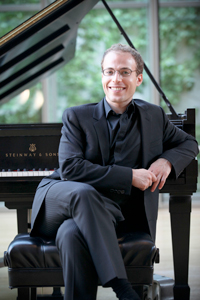
Orion Weiss (pictured above) performed the agonized opening of Darknesse Visible (1992) with poignancy. The work — which Adès adapted from John Dowland’s lute song, In Darkness Let Me Dwell (1610) — alternates between sharp, percussive wails at the extreme ends of the piano’s range and a slow, meandering melody that never really goes anywhere. These two ideas are bridged by means of a flickering tremolo. Although the work lacks harmonic impetus, Weiss interpreted the brooding passages with an immediacy that demanded to be heard in the moment, defying the need for resolution. This was a touching performance.
Shostakovich’s Quintet (1940) begins with a similar anguish. Performers Diana Cohen (violin), Alexi Kenney (violin), Yura Lee (viola), Peter Wiley (cello), and Roman Rabinovich (piano) played with assurance, the strings often set off against a countermelody in the piano. After Rabinovich’s opening statement, Wiley led the quartet with a gripping solo to finish the Lento introduction. Lee joined Rabinovich to introduce the first movement’s quicker tempo, contrasting the work’s initial pathos with a mocking, waltz-like tune. Though intonation was occasionally shaky between the two violins, the quintet’s balance was excellent throughout, their melodic lines easily heard over the thick, lush chords in the accompaniment.
This was particularly true in the second movement. In the fugue, each of Shostakovich’s five voices functions independently, but all of the musicians played with sensitivity, achieving a sound greater than the sum of their individual lines. So effective was the change of timbre from the more aggressive first movement to this somber lament that the quartet sounded as though they were playing with mutes.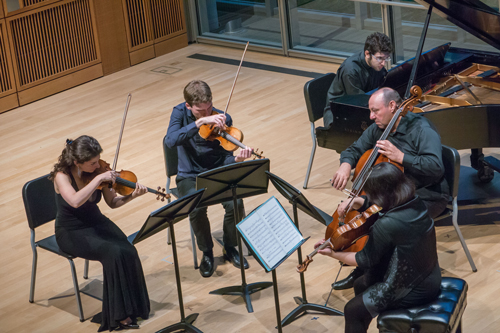
Brash and obnoxious are adjectives that jump to mind in describing the scherzo movement’s forced cheer. The quartet battled Rabinovich for dominance, sometimes pulling slightly ahead of the pianist. While it was exciting, a slightly slower pace might have allowed for tighter ensemble playing.
After some wonderfully expressive playing in the intermezzo — especially from Cohen and Wiley — Rabinovich transitioned quickly from the weighty drama that preceded to a lighter, carefree style in the final movement. Where the scherzo is furiously sarcastic, this movement is genuinely sunny, marking the turning point both within the Quintet and the concert as a whole. Shostakovich composed this work to allow him to perform with the Russia’s Beethoven String Quartet, which had premiered most of his quartets. The finale showcases the camaraderie he must have felt playing with the group, and, despite some references to the pathos of earlier movements, the work finishes with a relaxed amiability.
Like Shostakovich’s Quintet, Beethoven’s Septet often pits instrumental groups against one another. Amy Schwartz Moretti (violin) was joined by Hsin-Yun Huang (viola), Clive Greensmith (cello), and Nathan Farrington (bass) to complete the string section, while Franklin Cohen (clarinet), William Caballero (horn), and Fernando Traba (bassoon) rounded out the complement of winds. Schwartz Moretti led the opening of Beethoven’s Septet with grace — Cohen contrasted her dignity with a more comical aplomb throughout the first movement, trading melodies and interjections with the other winds to punctuate the strings’ music.
In the adagio second movement, all seven musicians maintained a wonderfully casual atmosphere, blending seamlessly into one another’s sounds. There was a brief pause when Cohen took a moment to cough, but the ensemble quickly regained its concentration, moving into the minuet with the same joviality as before. Here, Caballero’s horn solos stood out, his sparkling tones cutting nicely through the strings.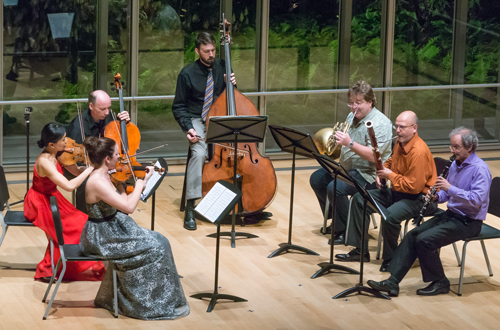
In the variations that followed, each instrument had an opportunity shine, joining in some tight ensemble work in the following scherzo. The final movement begins with an introduction in a minor key, but in context, it sounded more tongue-in-cheek than serious, like a mother shaking a finger at her child while hiding a smile. Although the romping presto could easily have sped forward, the septet maintained a quick but controlled pace until the end, when a triumphant horn call heralded a final accelerando. The septet raced towards a glorious conclusion, illuminating the hall and the listeners with an effusion of jubilance and cheer.
Performance Photos: Gary Adams
Published on ClevelandClassical.com June 23, 2015.
Click here for a printable copy of this article
