


by Mike Telin
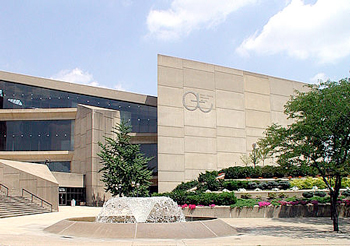 When the Edwin J. Thomas Performing Arts Hall opened at the University of Akron in October 1973, the multi-use space received rave reviews from critics. The 2,955 seat auditorium also became home to the Akron Symphony. On Saturday, October 12 beginning at 8:00 pm, Music Director Christopher Wilkins will lead the ASO in a concert that celebrates the Hall’s 40th anniversary. The program features Brahms’s Academic Festival Overture conducted by Guy Victor Bordo, Nikola Resanovic’s Concerto for Clarinet and Orchestra (Collateral Damage) with Kristina Belisle Jones as soloist, and Strauss’s Ein Heldenleben.
As is the case with many of the world’s concert halls, E.J. Thomas has presented acoustical challenges for the symphony. But as Wilkins points out, “the positives of E.J. Thomas are easy to enumerate. It’s a very comfortable space for the audience and I think it’s an interesting piece of architecture. Also the physical location is ideal because it’s right on the line between the University campus and downtown and as the campus has moved toward downtown that whole area is so active.”
Wilkins says he chose Ein Heldenleben not so much because it was autobiographical for Strauss but rather it was a musical story of an artist’s life. “It shows his virtuosity as a composer but it also shows his extraordinary mastery of the orchestra. And of course he was one of the greatest conductors of the twentieth century. So he knew the orchestra both as a performer and a composer. That’s one of the reasons that it is so appropriate for this concert because it is a celebration of the Akron Symphony.”
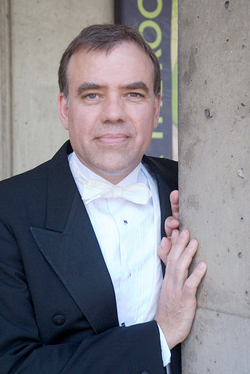 For this concert Wilkins will be augmenting the string section, “We’ll have about one hundred musicians on stage, and I think that in E.J. Thomas the large orchestra works sound the best. It is a very big space and it’s going to be a great celebration.”
Wilkins is pleased to have Guy Victor Bordo, director of the University of Akron’s orchestral program, be part of the evening “I knew of him long before I came to Akron and I am very aware of how effective he has been not only in leading the University orchestra but also in developing the program.”
And what about University of Akron professor Nikola Resonovich’s Collateral Damage? “It’s just a kick, and every moment holds your attention. It has an enormous emotional range from serious moments to contemporary and then just some foot stomping Serbian folk melodies. It’s really fun.”
Wilkins is quick to point out that despite some acoustical issues, having access to the three-level, 2,955 seat auditorium has on many occasions allowed the Akron Symphony to present concerts that would simply not be possible in smaller venues. “There are times when we are very glad it has the seating capacity that it does. For example, during Porgy and Bess, when we almost sold out twice.”
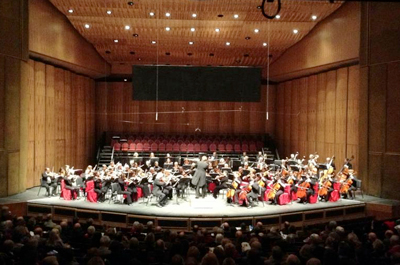 Wilkins added that last season’s performances of Stravinsky’s Rite of Spring utilized the maximum stage space available, as will be the case this season for a performance of Mendelssohn’s Midsummer Night’s Dream. “In a standard concert hall you wouldn’t be able to do what we are going to be able to do with that. It will be a full theatrical presentation complete with costumes, sets and lights. And that is an advantage to working in E.J. Thomas, there’s no question.”
While some music directors could be less interested in the science of acoustics, Wilkins says that he finds it to be an interesting part of the job. “I love it and I’m completely fascinated by acoustics. I have gotten to know Christopher Jaffe, who did the Severance Hall makeover. I spoke to him about the challenges here and he helped to clarify a number of things for me and encouraged me to keep experimenting.” And with that in mind, this week’s audience will notice that the winds and brass are seated quiet a bit higher than usual. “Putting the winds up a few feet is like putting them downstage a few feet”. Wilkins says. “Again it’s a way of adjusting to the large space.”
Published on ClevelandClassical.com October 8, 2013
Click here for a printable version of this article.
