


by Mike Telin
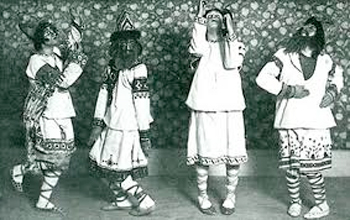 In his book, First Nights, Harvard professor Thomas Forrest Kelly begins his description of the premiere of Stravinsky’s Le Sacre du printemps on May 29, 1913 at the Théâtre des Champs-Elysées in Paris with reflections by its ballet master and a famous composer who happened to be in the audience.
I think the whole thing has been done by four idiots: First, M. Stravinsky who wrote the music. Second, M. Roerich who designed the scenery and costumes. Third, Mr. Nijinsky who composed the dances. Fourth, M. Diaghilev who wasted money on it. —Enrico Cecchetti
The choreography is ridiculous, the music sheer cacophony. There is some originality, however, and a certain amount of talent. But taken together, it might be the work of a madman. —Giacomo Puccini
This Saturday and Sunday, August 17 and 18 at 8:00 pm at the Blossom Music Center, Chicago’s Joffrey Ballet will join The Cleveland Orchestra, Tito Muñoz, conducting, in Robert Joffrey and Millicent Hodson’s 1987 recreation of Nijinski’s original choreography for The Rite of Spring. The score will be played in a reduced orchestration for stage performances by noted conductor Jonathan McPhee published by Boosey & Hawkes (the only reduction to be authorized by the Stravinsky Trust).
The performances celebrate the centenary of the first production of one of the most seminal artistic creations of the twentieth century. Also on the program: Jerome Robbins’s Interplay (to Morton Gould’s American Concertette, with pianist Joela Jones), Stanton Welch’s Son of Chamber Symphony (to music by John Adams), and Yuri Possokhov’s Adagio (to music by Aram Khachaturian from Spartacus).
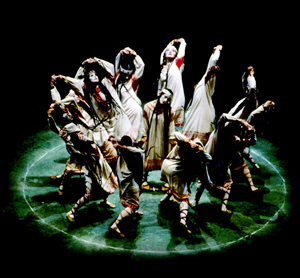 Stravinsky’s score for Sacre was revolutionary in 1913 and still sounds fresh and inventive today. Similarly, Nijinsky’s choreography represented a complete disconnect with classical ballet when it was first unveiled a hundred years ago — and may have been largely responsible for the rowdiness of its first night audience. In an article for Dance Research Journal, Millicent Hodson traced the origins of Nijinsky’s concept from visual images of pre-Christian Russian idols. She quotes from an essay by Jacques Rivière written several months after the premiere. The body, he says,
...moves only as a whole, it forms a totality and its manner of speaking is to leap suddenly with arms and legs outspread, or to move to the side with knees bent and the head on the shoulder…If one can, for once, stop confusing grace with symmetry and the arabesque, he will find it on every page of Le Sacre du printemps, in the sight of profiles of faces posed upon full-front shoulders, in the elbows glued to the body, in the horizontal forearms, the rigid and open hands, in the trembling which descends like a wave from the head of the dancers to their feet, in the obscure, sparse, and preoccupied march of the adolescents in the second act.
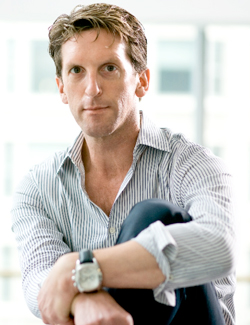 Joffrey’s artistic director Ashley Wheater agrees about that first night reaction. “I don’t think it was the music that caused the stir, I think it was more the ballet,” he said in a phone conversation from Chicago. “And to be honest, I think a lot of people did not think it was a particularly good piece of choreography. I think also the shock of it was that the Ballet Russe had become so famous for producing beautiful works from Russia — so when people went to see the ballet Russe they were expecting to see a classical ballet company.
“What upset or angered people was that they were offered something that just turned them upside down. I think people said, I don’t like this and I don’t want to see this. But it was a breakthrough in many ways. Looking back on it, would dance and music be different today if Stravinsky hadn’t written Sacre? It’s hard to say, because to me the music has always been brilliant.”
Stravinsky’s music lives on, but Nijinsky’s choreography was soon forgotten. “It really didn’t survive,” Wheater said. “I think they did five performances in Paris and another nine in London and then it disappeared. What’s interesting about coming back to it, because I was there when they re-created it in 1987, was that in many ways I think it was a very brave move of Robert Joffrey to take a look and stay as close to the original idea. Bringing it back so many years later, I think people had a much greater appreciation for the complexity of what Nijinsky was trying to choreograph.”
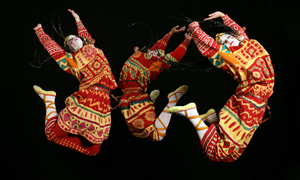 Dance historian Millicent Hodson spent eight or nine years researching Sacre. Wheater remembers the end of that process very well. “We spent a summer in Iowa City back in 1986, because we have an ongoing collaboration with Hancher Auditorium. Millicent worked with us every day reconstructing it. It was tedious but it was also fascinating and I would say that we completely respected what Robert Joffrey was trying to do.”
What challenges did Robert Joffrey and his dancers face in remounting Nijinsky’s choreography? “Dancers spend years refining their technique and the shape of their bodies”, Wheater explained. “In classical ballet there’s a rotation in the legs and the arms and it’s all very organic and it takes a lot of practice. With Sacre, the problems that happened back in 1913 are the same problems that we have today — to dancers it feels very foreign for them to have to rotate their legs in. Whether it’s the women or the men they’re all turned in and they have clenched fists pounding the floor. The idea is that ballet is ethereal and light and this is so earthbound. You have to change your way of thinking when you go into rehearsals for Sacre because it demands something very different.”
Wheater continued: “Also the complexity of the music and getting the rhythm and the counting in your body takes a lot of time. Working on all of those things was an experience that I don’t think any of us will every forget because I think in the outcome it was really fascinating. It was quite a triumphal moment and I think that this generation of dancers at the Joffrey also got so much out of understanding something that was created one hundred years ago that was pushing to break the boundaries of classical ballet.”
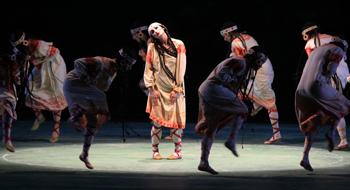 Physical issues are always present in ballet, and the particular demands of Sacre also determine where the 36-minute piece fits into an evening of dance. “Wherever we perform Sacre it is always the last thing on the program,” Wheater said. “Partly because I think that is where it belongs but also because of the nature of the rest of the program it would be very difficult going from Sacre into a more classical ballet. It would be very hard on your body – it’s easier to go the other way.”
Sacre will indeed end each evening at Blossom this weekend, but Wheater is delighted with the rest of the menu as well. “It’s a very diverse program, but I think there are very beautiful things in it. Interplay is a wonderful opening work, and you can hear that Adams was maybe influenced by Stravinsky when he wrote Son of Chamber Symphony. The two pieces complement each other very well.”
Daniel Hathaway contributed to this article.
Joffrey Ballet photos by Herbert Migdoll.
For more information about Stravinsky’s score, visit these NPR pages:
100 Years After The Riot, The ‘Rite’ Remains (Michael Tilson Thomas)
The Primitive Pulse of Stravinsky’s ‘Rite of Spring’ — Getting Hooked on the ‘Rite’ Sound (Marin Alsop)
Published on ClevelandClassical.com August 13, 2013
Click here for a printable version of this article.
