

by Mike Telin
 Lets face it, not all music is best heard from a soft seat inside a recital hall with 500 to 1,000 of your closest friends. In fact, some music cries out to be heard in an intimate space where the audience and the performer are only a few feet if not inches from one another – we want to see the performer’s fingers navigate up and down the finger board of their instrument, their facial expressions that accent the comedy and seriousness in their music.
Thanks to a new series presented by the Cleveland Museum of Art at the Transformer Station, both new music lovers and the new music curious have a place to go to enjoy performances that feature composed and improvised music by some of the most accomplished artists working in contemporary music. I recently attended three CMA performers at the Transformer Station.
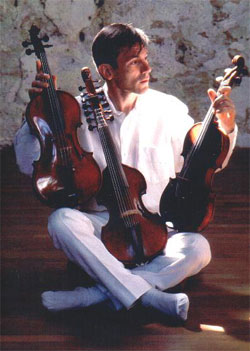
Irish-born violist Garth Knox began his October 27 concert with the very fun 16 Sneakers (2012) by Frederic Rzewski. A short work that includes spoken word – no these sneakers are not the kind one wears but rather someone who, like Rzewski’s piece, sneaks in — does what it came to do and gets out before anyone notices. Knox’s sneaky expressions added tremendously to the work’s humor. Knox’s passion for combining early music with that of the 21st century was evident during his passionate performance of Rory Boyle’s Such Sweet Sorrow, based on an Elizabethan work for clavichord by Farnaby (2009).
Following Ligeti’s Hora and Chaconne (1994) Knox regaled the audience with his own Viola Spaces (2009), written as etudes for violists to practice the many extended techniques that they now encounter in new music. These, however are not your run-of-the-mill practice room etudes, but rather musically sophisticated works that leave you wondering – how did he do that?
During Kurtag’s Signs, Games and Messages for viola and double bass, Knox found a sympathetic collaborator in the exceptionally gifted Scott Dixon. Together the duo brought nuanced stylishness to Kurtag’s often thorny work. Prior to Signs, each player showed off his own musical and technical prowess with solo performances of the composer’s brief etudes.
After the riveting ai limiti della notte (1975) by Salvatore Sciarrino, the program concluded with one of Knox’s recent compositions, Three Weddings and a fight (2013). The piece depicts not three weddings, but rather three family views of a single wedding. And yes, a single viola can depict the sound of mayhem perfectly. As an encore, Knox and Dixon performed what Knox said was “the shortest encore in the world,” the 6 second Homage to Tristan.
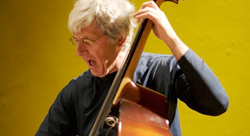 During his November 10th performance, American double bassist Mark Dresser proved time and again that the instrument deserves to be heard in a solo recital setting. Or, maybe it was Mark Dresser himself. Not only is he in complete technical command of the instrument, he is also a gifted composer and improviser.
Although his program consisted almost entirely of his own compositions, the diversity of their musical content easily holds your interest. A highlight was Threaded. Dedicated to experimental cellist Frances-Marie Utti, the work copies her special technique of playing with two bows simultaneously, one on top of and the other underneath the strings. Sounds a bit odd, but the end result was musical hues of other-worldly sounds. Dedicated to the memory of sitar legend Ravi Shankar, Raviji was given a heartfelt performance. This is was a thoroughly engaging evening of music making and the large audience responded with a deserved ovation.
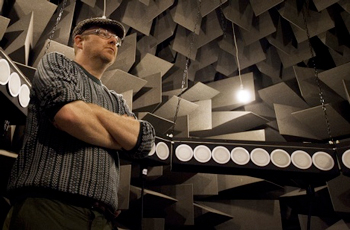 The November 13 performance by British electronic musician and multidisciplinary artist Mark Fell was a stunning event. In a recent interview with ClevelandClassical.com, Fell described his untitled piece as an “ambisonic work that uses thirty-two channels of analogue synthesis…if you can, imagine a hypothetical sphere with your head in the middle. Throughout the performance I’ll introduce these oscillations at different points around the sphere. The piece begins very quietly and builds to quite a loud sound but nothing painful or damaging.”
Rather then sitting in a chair, I chose to lay on a yoga mat – an option provided for the audience. The piece did exactly what Fell said it would: start imperceptibly soft and gradually grow louder. But as it did, I soon found myself being physically enveloped by a sonic kaleidoscope of sound. Then suddenly, just as I took the precautionary measure of covering my ears, it was over. Then a remarkable thing occurred – people began talking to one another. People I had seen at previous concerts but never spoken to began to introduce themselves and share their thoughts on Mark Fell’s untitled work.
It’s difficult to find anything not to like about this series. In addition to the outstanding performances, the venue — especially for the type of music presented at these concerts — is acoustically superb. If the person seated in front of you blocks your view of the performer, no problem! Scoot your chair an inch to one side or the other. And following each concert, hang around, look at art and enjoy a glass of wine with your fellow concert goers, meet new people and discuss the music with them and the artist. What could be better?
Published on ClevelandClassical.com November 26, 2013
Click here for a printable version of this article.
