

by Stephanie Manning
 This article was originally published on Cleveland.com
CUYAHOGA FALLS, Ohio — For an outdoor concert on July 3, you could hardly have asked for a nicer summer evening — or a more expert conductor.
“How about this weather!” Michelle Rakers cheerfully boomed from the podium, greeting the audience who had packed the lawn and pavilion at Blossom Music Center.
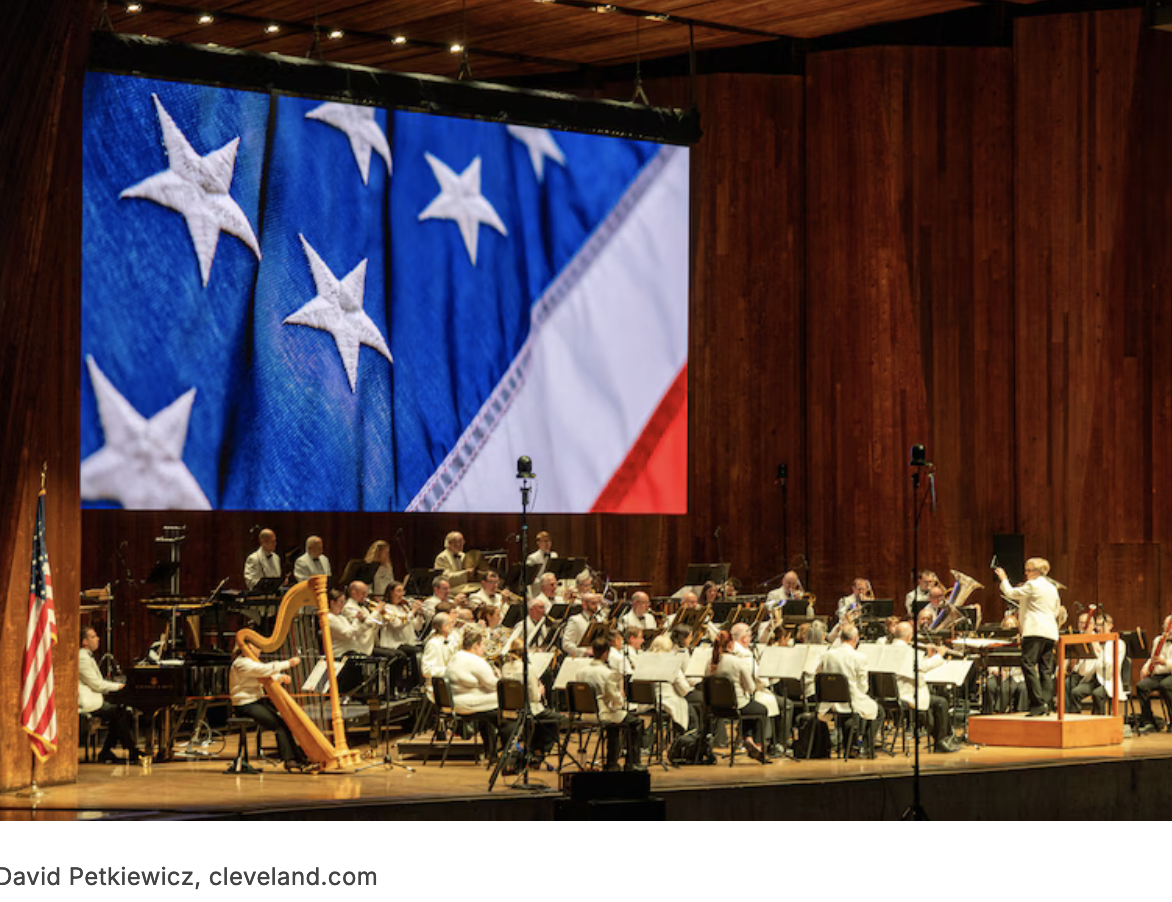
Under Rakers’ direction, the Blossom Festival Band presented “Salute to America,” a memorable take on the annual Fourth of July program that favored some lesser-known selections without ignoring the classics.
Thursday marked Rakers’ debut at Blossom, and this performance found the conductor in her element. A patriotic wind band concert like this one was a daily event during the fourteen years she spent as senior assistant director for “The President’s Own” United States Marine Band. Unsurprisingly, she kept everything together with relaxed precision.
A top-notch ensemble, The Blossom Band easily responded to her guidance, dashing off complex, fast-paced works like Leonard Bernstein’s Overture to Candide without breaking a sweat. Sammy Nestico’s Uniquely Trombone stood out for its rapid-fire harmonies from trombone soloists John Sebastian Vera, Christopher Graham, Whitney Clair, and Evan Clifton. The evening also featured marches, including Henry Fillmore’s The Klaxon and John Williams’ Midway March.
In Clare Grundman’s Concord — a nod to Ohio and its Cleveland-born composer — piccolo and snare drum came together in a peppy duet while the projection screen behind them displayed a collage of American Revolution artwork. This rotating backdrop remained unobtrusive except during John Williams’ “Flying Theme” from E.T. the Extra-Terrestrial, where the huge images of Williams and director Steven Spielberg were distracting.
The mood became more introspective during Aaron Copland’s “The Promise of Living” from The Tender Land, whose subdued woodwind passages eventually blossomed into a grand, inspiring chorale.
Rakers also pulled out some substantial wind ensemble repertoire like H. Owen Reed’s “Carnival” from La Fiesta Mexicana. Its Mariachi-inspired trumpet, extra percussion, and irregular time signatures created a festive atmosphere — and, as the conductor noted, provided “a great reminder of the rich cultures that make up our American spirit.”
As night began to fall, the Band cued up Ryan George’s Firefly, another wind ensemble original. In this playful, magical adventure, the twinkling of the glockenspiel and oboe mirrored the fireflies on the Blossom lawn.
For those more at home with something traditional, the second half included George W. Warren’s God of our Fathers, Samuel A. Ward’s America the Beautiful, and a Salute to the Armed Forces.
James Stephenson’s Stars and Stripes Fanfare felt a bit too fragmented as a tribute to John Philip Sousa’s Stars and Stripes Forever. But Rakers and the Band eventually brought out Sousa’s original as the evening’s final encore, the brass forming a united front at the edge of the stage as rainbow confetti fluttered down around them. Sometimes you just can’t beat the classics.
Stephanie Manning trained as a bassoonist before becoming a correspondent for ClevelandClassical.com. As a freelancer, her writing has also appeared in The Montreal Gazette, CBC Montreal, and Early Music America.
Published on ClevelandClassical.com July 10, 2025
Click here for a printable copy of this article
