

by Stephanie Manning
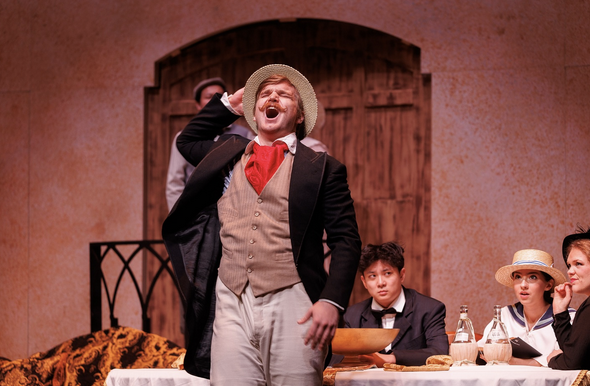 The three one-act operas that make up Giacomo Puccini’s Il trittico (The Triptych) are typically connected by theme, rather than location. Although the trio of works take place in 13th-century Paris, 17th-century Siena, and 20th-century Florence respectively, they all deal with keeping someone’s death a secret — whether tragically or comedically.
CIM Opera Theater’s recent production of two-thirds of the triptych brought the action into one particular place and time, as director Dean Southern moved both Suor Angelica and Gianni Schicchi into 1918’s New York City. What stood out more, however, were the impressive performances from across the large cast, which I heard on November 7 in Kulas Hall.
The change in setting neither diminished nor enhanced Gianni Schicchi, where the new Upper East Side location could have easily been forgotten amid the characters waxing poetic about Florence. But placing Suor Angelica at the Magdalen Asylum in Inwood did successfully add a more sinister aura to the environment of nuns set on “reforming” wayward girls.
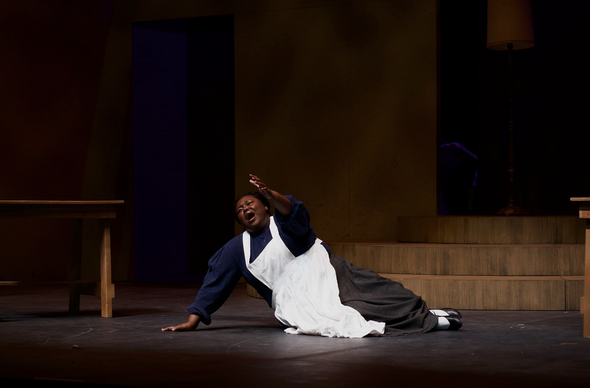 Soprano Kiana Lilly delivered an absolutely spellbinding performance as the titular Sister Angelica, her voice standing out from the crowd from the very first note. Sent away seven years earlier by her rich family for having a child out of wedlock, Angelica has devoted herself to faith and obedience. But her desire to learn news about her son roils beneath the surface, which quickly becomes evident with the arrival of her Aunt (the fittingly intimidating mezzo-soprano Cynthia Skelley-Wohlschlager).
Lilly let out a truly anguished scream upon her character’s revelation that her son died two years prior — news that leads Angelica to poison herself, a dark spiral that Lilly portrayed with maturity and grace. The hall flooded with red light as Angelica realizes that suicide is a mortal sin, before returning to a bright white as she sees a vision of her son waiting for her in heaven.
The chills-inducing combination of the offstage chorus and Lilly’s laments was one of many high-quality moments involving the full cast, a collection that speaks to the depth of female talent within CIM’s voice department.
The newly-renovated Kulas Hall still needs to work out a few bumps in the road, including some choppy lighting effects and the strangely high placement of the supertitles. The fast-paced and overlapping libretto of Gianni Schicchi, in particular, meant that one’s eyes often bounced up and down between stage and screen.
The space also favored the orchestra over the singers, another issue which became more apparent during Schicchi. Thankfully, the CIM Orchestra did a lovely job giving life to Puccini’s lush orchestrations. Conducted by Harry Davidson, the large ensemble added plenty of beautiful moments to the action, including standout solos from bassoon, French horn, and cello.
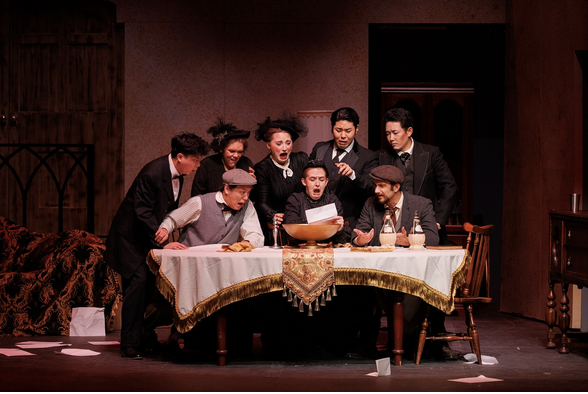 Schicchi served as the lighthearted post-intermission fare, with the varied cast leaning into the physical comedy and playfulness of singing. Amid the Donati family’s uproar at being disinherited by their now-dead patriarch, Buoso Donati, Rinucchio (the lyrical tenor Jingdian Zhou) steps in to advocate that the group call on Gianni Schicchi — an intelligent newcomer who could find a solution.
Characteristic comedy ensues, including the famous aria “O mio babbino caro,” sweetly delivered by soprano Ella Sobkowicz as Lauretta, who beseeches her father to help the Donatis so that she can marry Rinucchio. Baritone Davis Fischer made a charming and crafty Gianni Schicchi, adopting a humorously nasal voice as he impersonated the dead Buoso Donati in front of the unsuspecting notary. (Baritone Colin DeMatteo as the doctor Spinelloccio also earned plenty of laughs with his own nasal voice in an all-too-brief appearance).
The crafty Schicchi eventually declares he will leave Buoso’s most prized possessions to himself, to the shock and horror of the gathered Donatis — especially Buoso’s cousin Zita, portrayed energetically by mezzo-soprano Morgan Potts. Now with the house to himself, Fischer delivered Schicchi’s final words in spoken English, musing that “if this sends me to hell…then I hope it’s got a stage!”
Published on ClevelandClassical.com November 13, 2025.
Click herefor a printable copy of this article
