

by Peter Feher
 This article was originally published on Cleveland.com
CLEVELAND, Ohio — Classical musicians have exhausted just about every attempt to complete Franz Schubert’s “Unfinished” Symphony in the two centuries since the composer’s death at age 31.
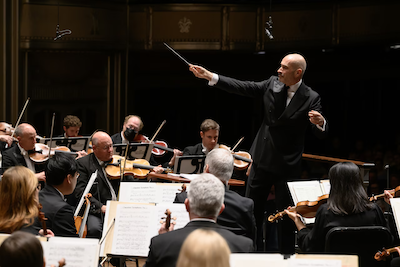
But the Cleveland Orchestra doesn’t give in easily to creative despair. With guest conductor Antonello Manacorda, the ensemble has fashioned an effective, elegant substitute for the “missing” movements of Schubert’s score.
The surprise material on this weekend’s program at Severance Music Center comes courtesy of another Austrian composer, Arnold Schoenberg. His Chamber Symphony No. 2, a piece with its own fraught inception, is paired with the “Unfinished” in a posthumous collaboration of sorts.
Together, the two works — played with the Orchestra’s characteristic cohesion — made for a satisfying second half in Mandel Concert Hall on Thursday evening, Feb. 5.
Of course, a certain amount of contrast couldn’t be avoided. An entire century of artistic upheaval separates the Romantic sensibility of Schubert’s songwriting from the modernist precision of Schoenberg’s 12-tone method. Yet as different as they are on the surface, both styles speak to a shared experience of internal struggle.
It was only later in Schoenberg’s career, after he had developed his distinctive atonal approach, that he was able to fill in the fragments of his Chamber Symphony No. 2, begun some three decades earlier in 1906.
The composer’s mature voice is subtly present in sections of the first movement that seem to strain against harmony and in the somber conclusion to the originally fiery finale.
With emphatic gestures from the podium, Manacorda pushed the Orchestra to put utmost passion into every measure, in Schoenberg no less than Schubert.
Had Schubert lived another 30 years, he might have fully realized the symphonic aims he started to set down in the “Unfinished,” whose two completed movements are marvels of musical expression.
The opening Allegro moderato elicits an astonishing range of emotions from just a couple of melodies — an effect that Schubert perhaps struggled to recapture in the sketches he left for the rest of the symphony.
Certainly, that magic carried over into the second movement, Andante con moto, which featured sensitive solo playing from clarinetist Afendi Yusuf and oboist Frank Rosenwein, despite Manacorda’s sometimes hurried tempo.
The first half of Thursday’s program flew by in a sprightly performance of Felix Mendelssohn’s Violin Concerto starring Augustin Hadelich. There’s famously little downtime for the soloist in this piece, who immediately introduces the main theme before taking up a series of thrilling technical feats.
When that theme reappears in the full orchestra ten minutes later, the violinist has now adopted a furious ricochet action as a kind of spotlight-stealing accompaniment.
Hadelich’s signature strength is still conveying the music’s beauty in such challenging moments. There was an especially dazzling passage in the cadenza where he soared up to the same high note in two different ways (first as a delicate harmonic, then with a resonant vibrato tone).
For a final flourish, he tossed off a bit of fiddling fun with an encore of Coleridge-Taylor Perkinson’s Louisiana Blues Strut — a stylistic turn entirely in the evening’s spirit.
Photo by Yevhen Gulenko
Published on ClevelandClassical.com February 12, 2026
Click here for a printable copy of this article