

by Kevin McLaughlin
 This article was originally published on Cleveland.com
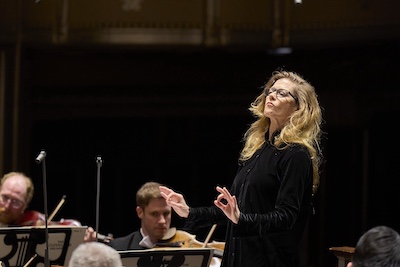
CLEVELAND, Ohio — Conductor Barbara Hannigan brought an unusual playlist to her appearance with The Cleveland Orchestra on Thursday evening February 12: music by four American composers who rarely share a stage, and who have very different ideas about what American music sounds like.
The Severance Music Center program was a sequence of sharply defined pieces, each showing a different side of American music — experimental, modernist, lyrical, and theatrical. And in Hannigan’s expressive hands, those contrasts felt intentional and well placed.
George Crumb’s “A Haunted Landscape,” though not programmatic, succeeds in conveying what the composer described as “a sense of brooding menace” — the feeling of a place haunted by memory, like the deserted battlefields of ancient wars. Hannigan kept the pacing taut, allowing hushed textures to give way to sudden eruptions before quieting again.
Crumb’s shifting colors — muted percussion, distant wind calls, and low sustained sonorities — created the illusion of suspended time. A heavenly string chorale, reminiscent of Charles Ives’s “The Unanswered Question,” surfaced twice before dissolving, leaving the hall in a heightened sense of quiet.
Written in the 1920s, Carl Ruggles’ “Sun-Treader” is one of only twelve works the composer completed. Unmistakably Romantic in gesture despite its hard Schoenbergian rhetoric, it moves in massed sonorities. Hannigan kept the structure clear and her gestures expressive, preserving the music’s long sweep even as the harmony thickened.
The work’s unity and sheer scale produced a kind of rapture, unexpected in music so harmonically forbidding, as the music advanced in large, inevitable spans. The brass played with startling power, and the ferocity of the final climax lingered long afterward.
Swedish soprano Johanna Wallroth sang Samuel Barber’s “Knoxville: Summer of 1915″ with compelling directness. Her interpretation was warm and intelligent, her voice rich in every register.
In James Agee’s affecting prose poem, remembrances of childhood, fragrances, and sounds are filtered through adult memory, but beneath the surface lies a growing awareness that such moments pass. Barber’s score moves gently between intimacy and orchestral bloom, mirroring the way that memory enlarges ordinary experience.
Hannigan let Agee’s words shape the pacing and kept the orchestral textures light, allowing details in the winds and strings to speak as clearly as the voice. The streetcar episode brought a brief surge of rhythmic activity before the music returned to quiet reflection. Wallroth’s closing lines were delivered simply, leaving summer’s memory to linger.
The evening ended with Robert Russell Bennett’s “Symphonic Picture” from “Porgy and Bess.” George Gershwin moved easily between concert music and popular song, and Hannigan is comfortable inhabiting both worlds. Bennett’s arrangement feels less like a pops medley than an orchestral rethinking of the opera.
Familiar and less familiar melodies are shaped into a continuous sequence, with phrasing and pacing that still suggest their vocal origins. In such numbers as “I Got Plenty o’ Nuttin’” and “O Lord, I’m on My Way,” the orchestral lines retained their vocal phrasing and character. And even the sly edge of “Sportin’ Life” came through in “It Ain’t Necessarily So.”
As with Leonard Bernstein’s suites from “West Side Story,” the orchestration develops the material rather than simply repeating it. Textures shift, rhythms sharpen, and transitions keep the music moving forward.
Saxophones and banjo added distinctive color, and the large liberty bell on the back row gave the performance a touch of theatrical flair. Marc Damoulakis was thrilling in the xylophone solo, and “Summertime” unfolded expansively, the strings carrying a soft, impressionistic sheen.
Thursday’s program traced a loose history of American composition. Hannigan’s achievement lay in pointing up each work’s uniqueness without smoothing over their differences.
Photo by Roger Mastroianni
Published on ClevelandClassical.com February 19, 2026
Click here for a printable copy of this article
