

by Kevin McLaughlin
 This article was originally published on Cleveland.com
CLEVELAND, Ohio — The art of conducting is a kind of alchemy — the transformation of inert notes on a page into something vividly alive. A conductor absorbs a composer’s intentions, reimagines them, and releases them again through that remarkable instrument, the symphony orchestra. On a good night the music feels less reproduced than re-created, and the listener senses the thrill of discovery.
In her appearance with The Cleveland Orchestra at Severance Music Center Thursday, March 12, conductor Elim Chan provided such an evening. She honored the distinct language of each score — Stravinsky’s refashioning of Baroque style in Pulcinella, Haydn’s elegant Trumpet Concerto with Michael Sachs as the eloquent soloist, and Beethoven’s enduring Fifth Symphony. But fidelity did not mean routine.
Stravinsky’s Suite from Pulcinella was an electric opener. The score famously borrows eighteenth-century material — once attributed to Pergolesi but now known to come from a handful of minor Baroque composers — and filters it through Stravinsky’s cool twentieth-century sensibility. Chan let both the “neo” and the “classical” speak. Melodies were restrained, yet the slightly skewed harmonies and rhythms added a dry sparkle that kept reminding you whose music this really is.
The Cleveland Orchestra’s winds were in particularly fine form here. Oboist Frank Rosenwein and bassoonist John Clouser traded phrases with a kind of wry stage-comedy timing, while the strings kept the dance movements light and care-free. In the Tarantella, Chan leaned into the music’s rhythmic snap, and the orchestra responded with crisp articulation. Lyle Steelman’s trumpet lines carried a welcome swagger that made Stravinsky’s sly wit unmistakable. Like a sequence of finely etched miniatures, the music was bright, pointed, and just a little mischievous.
Haydn’s Trumpet Concerto shifted the focus from ensemble playing to individual virtuosity, and Michael Sachs supplied that with characteristic ease. Haydn wrote the concerto in 1796 for the keyed trumpet, an experimental instrument that allowed for chromatic notes unavailable on the older natural trumpet. Modern valve trumpets have long since solved that technical problem, but the concerto still carries the sense of discovery Haydn must have felt when hearing the new instrument’s possibilities.
Sachs wasted no time in establishing his presence. His opening “do–re–mi” radiated like a beam of light. Fanfares were clear and commanding, while he shaped the more lyrical lines with warmth and ease. Chan kept the orchestra light and attentive under the soloist. A tricky cadenza with rapid runs and playful skips may well have tested fingers and lips, but Sachs made it sound easy.
The slow movement revealed Sachs’s singing voice. Haydn’s melody, first heard in the violins, was passed seamlessly to Sachs, who spun it out in long, unbroken arcs. Chan set a soft cushion of sound in the strings around the soloist, while the winds blended delicately.
The finale, a buoyant rondo, brought out Sachs’s technical command and quick musical reflexes. There was a sense throughout that soloist and conductor were enjoying the piece’s good humor, and the orchestra — along with the audience — seemed to share in the fun.
After intermission came Beethoven’s Fifth Symphony, which Chan conducted with clarity and relentless energy. The famous opening motive emerged sharply, almost violently, defining a new urgency and sense of alarm. The orchestra ricocheted the repeated notes with tight ensemble and focused energy. Rather than lingering over the drama, Chan kept the movement pressing forward, determined, as E. T. A. Hoffmann once wrote about this work, to “open the realm of the colossal and the immeasurable.”
The Andante offered contrast. Cellos and violas warmly introduced the noble theme, while the winds colored the variations with careful phrasing. In the scherzo, Chan drew striking contrasts between proclamation and shadow. The low strings delivered the fugato with muscular precision and steadily gathering intensity as the music approached the famous transition into the finale. It is one of Beethoven’s most theatrical strokes. Even knowing what was coming, the moment sent a chill. C major rarely sounded so triumphant.
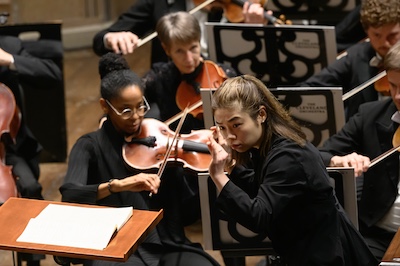
Photo by Yevhen Gulenko
Published on ClevelandClassical.com March 19, 2026
Click here for a printable copy of this article
