



by Kevin McLaughlin
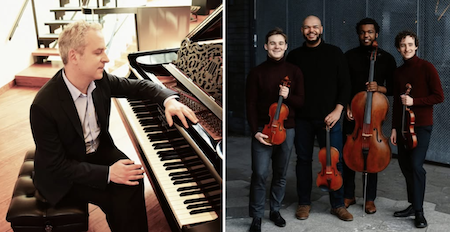 Presented by the Cleveland Chamber Music Society at the Cleveland Museum of Art’s Gartner Auditorium on May 19, the Isidore String Quartet — violinists Adrian Steele & Phoenix Avalon, violist Devin Moore, and cellist Joshua McClendon — offered a program that moved from Haydn through Ligeti to Brahms with the addition of pianist Jeremy Denk.
Haydn’s Op. 76, No. 4 (“Sunrise”) begins with a first-violin line unfurling over softly lit inner voices as the quartet waited for daylight. But when Haydn quickly broadened the texture into something fuller and more forceful, the quartet’s delicacy came at the expense of expressive weight.
The second movement opened almost inaudibly, the players hardly breathing, as if afraid of being discovered. By the Menuetto, the ensemble had loosened up, swaying with Haydn’s unexpectedly intricate rhythms, not waiting to be asked to dance. In the finale’s fugue, lines passed so smoothly from one player to the next that the seams disappeared, leaving only music.
Ligeti’s Second Quartet moved the evening into unfamiliar territory. Written in 1968 after the composer left Hungary and immersed himself in the European avant-garde, the piece turns sound itself into drama. The Isidore didn’t flinch at its extremes, finding bite in its rough edges but also warmth and the occasional hint of blues. Precision counted, but so did nerve, and the quartet brought plenty of both to their performance.
The opening silence froze the hall before the first jagged entrance. Tense, volatile, and physical music-making followed. Sudden eruptions gave way to suspended calm as lines unraveled into scratches, whispers, and ghostly harmonics.
The third movement, Ligeti’s so-called “machine music,” stood out for its overlapping pizzicato rhythms, which the players navigated with uncanny precision. The fourth movement was compressed, its music boiled down to raw energy. The finale faded into fragments and memory, its last notes barely registering as sound.
After intermission, Jeremy Denk joined the Isidore for Brahms’s Piano Quintet in F minor which began with immediate weight — piano and strings moving with striking unanimity. Occasionally a rougher edge was needed from the strings — something Denk, with his firm touch and rhythmic certainty, often supplied himself
The slow movement brought an opportunity to breathe. But it was the scherzo that commanded attention. The rhythms pressed forward, nearly tumbling over themselves, before giving way to a passage of greater lyricism. The finale begins with a recitative that drifted in from another world. Unsettled and searching, the music groped its way out of shadow before Denk and the Isidore gathered their energies for a final, blazing push.
For all the warmth and breadth of the Brahms, it was Ligeti’s music that lingered, the Hungarian’s sounds and silences conjuring a world that Haydn and Brahms, for all their powers of invention, could scarcely have imagined.
Published on ClevelandClassical.com May 28, 2026
Click here for a printable copy of this article
