


by Stephanie Manning
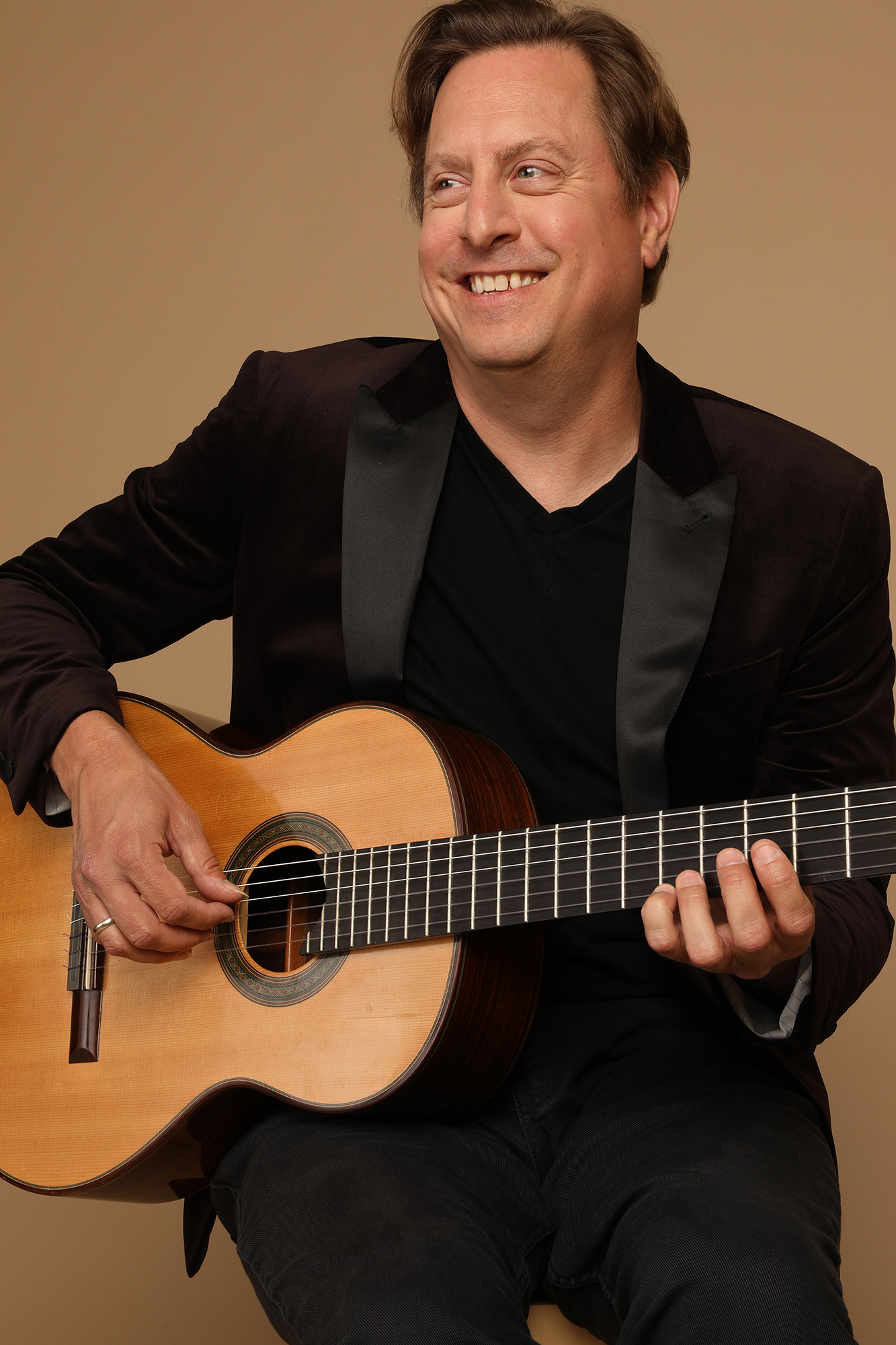 More than five minutes after the scheduled 7:30 start time on June 4, Mixon Hall still buzzed with conversation. The first concert of the Cleveland International Guitar Festival had drawn a large crowd to the Cleveland Institute of Music, and the room’s murmur quickly morphed into applause with the arrival of the evening’s headliner, guitarist Jason Vieaux.
At this event, Vieaux is often a doubly-familiar face, recognizable both by frequent Festival attendees and by general Cleveland audiences. To kick off the 2026 event, he brought a program that he called “a trip through memory lane,” bringing together pieces he learned as a teenager but hadn’t formally performed in years.
Importantly, Vieaux made sure that he wasn’t simply blowing the dust off old interpretations, but revisiting beloved pieces with new maturity in life and in playing. Take Fernando Sor’s Fantasie élégiaque, which Vieaux estimated he last performed in 2002 or 2003. Written as tribute after the death of Sor’s young student, it’s quite a heavy, somber work, and Vieaux placed it at the end of the first half.
A purposefully covered quality to the guitarist’s tone helped augment the piece’s sentimentality, and the recurring funeral march theme felt somewhat pianistic, with distinct left and right-hand parts. Throughout, Vieaux’s use of silences became more pronounced, and at the conclusion, he bowed his head and briefly sat with the audience in the quiet.
Despite this melancholy centerpiece, much of the surrounding program was more upbeat — warm and friendly, like Vieaux himself. “It’s great to see so many people here,” he said fondly after opening the concert with Manuel Maria Ponce’s Valse. He would later return to Ponce with his encore, the sweet Prelude No. 8 in F sharp minor.
In Julián Orbón de Soto’s Preludio y Danza, Vieaux skillfully twisted in and out of major and minor, navigating the changes with precision. While the Preludio lingered in the echoes of crunchy, dissonant chords, the Danza picked up the tempo for a more energetic air. Similarly, Máximo Diego Pujol’s “Tristango En Vos” from Cincos Preludios started off with a relaxed melody before Vieaux built an infectious bass line, ending with a funky — and highly technical — groove.
Post-intermission, Vieaux swapped out the planned Choros No. 1 by Heitor Villa-Lobos for the composer’s Prelude No. 1, pairing it with the flair of Etude No. 8 in C sharp minor. Andrés Segovia’s thoughtful Estudio Sin Luz — written during a health scare where the composer feared he would lose his eyesight — smoothly transitioned into Agustín Barrios Mangoré’s Julia Florida, which sported a similar tempo but a more contented mood. In the silence after the notes faded and before the applause, a number of audience members gave a satisfied “mm.”
Vieaux spoke briefly about one of his childhood guitar idols, Jorge Morel, before performing a set of two of Morel’s works. The upbeat Choro segued into the Danza in E minor, where he rode the undulating waves of pitches and dynamics with ease.
Finally, he capped things off with one of his own contributions to the guitar literature: Gratitude, written at the height of the COVID pandemic. This beautiful little piece sounds just like its title — tinged with nostalgia, while also hoping for better days.
Photo by Asia Margo
Published on ClevelandClassical.com June 9, 2026
Click here for a printable copy of this article
