

by Stephanie Manning
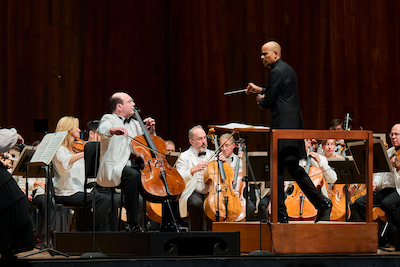 This article was originally published on Cleveland.com
CUYAHOGA FALLS, Ohio — “Dance” was the operative word and cello the instrument of choice on Saturday evening at Blossom Music Center.
The 20th-century program on July 25 sandwiched The Cleveland Orchestra’s first performance of Bohuslav Martinů’s Cello Concerto No. 1 between two pieces inspired by the art of movement: Zoltán Kodály’s Dances of Galánta and Sergei Rachmaninoff’s Symphonic Dances. Heading it all up was conductor Kevin John Edusei, making a memorable Cleveland Orchestra debut.
Edusei, whose career has primarily focused on Europe, has been appearing with more American orchestras lately, with Cleveland the most recent on the list. The German conductor’s efficient, incisive style immediately left a mark on Dances of Galánta, where he kept the tempos brisk wherever possible.
Although this 15-minute piece is Kodály’s most famous orchestral work, it often goes overlooked in the programming of major orchestras. But it’s a real treat. Inspired by the folk dances of the composer’s hometown, the music seesaws between riotous fun and beautiful woodwind cadenzas, which included a smooth, warm solo from principal clarinet Afendi Yusuf.
Edusei generally favored a lengthy, vertical conducting motion, but his movements smartly diminished in size as the piece got faster, trusting the musicians to drive the music forward without demanding it.
The concerto portion of the evening featured a familiar face — cellist Mark Kosower, who has held the Orchestra’s principal chair for 16 years. His performance of Martinů’s Cello Concerto No. 1 marked the Orchestra’s first performance of the work.
Revised multiple times after its initial composition, this Neoclassical concerto developed from a 1930 chamber orchestra setting into a 1955 full orchestral version that gives the soloist more of a spotlight, creating a dialogue between the orchestra and the virtuosic cello line.
Kosower played with the comfort of someone who has studied the music inside and out, especially during the lulling second movement, which featured extended, sweet solos with often only a single viola to keep him company. Edusei, a cool and collected intermediary, kept the Orchestra light and precise.
The audience members who had arrived early that evening heard a pre-concert performance from the Kent Blossom Chamber Orchestra, who later joined The Cleveland Orchestra for a side-by-side performance of Rachmaninoff’s Symphonic Dances.
It was easy to be awed by the sheer size and sound of this combined ensemble, especially as the string section drove the pulsing main dance theme of the first movement. Edusei made sure the augmented ensemble did not cover up the more delicate textural additions — piano, alto saxophone, and harp.
The conductor’s characteristic efficiency worked somewhat less effectively here, maintaining a lovely twirl to the second-movement waltz but gradually losing some urgency and momentum. But in the third movement, percussion interjected a burst of energy, and the final stroke of the gong felt like it reverberated off every ceiling beam.
The dances Rachmaninoff set out to capture in this piece were more abstract — he was likely composing the piece to be set to a ballet that never materialized. But the music can still bring to mind the idea of movement, in all its forms. Perhaps it could be the tumbling of the children rolling down the Blossom lawn’s grassy hill, shrieking with joy before running back up to do it all over again.
Photo courtesy of Roger Mastroianni
Published on ClevelandClassical.com, July 30, 2026
Click here for a printable copy of this article
