

by Kevin McLaughlin
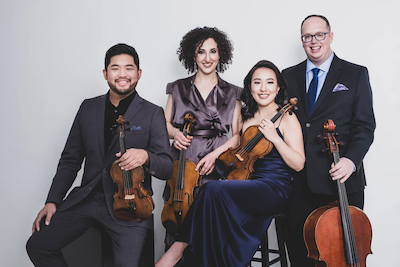 In a program titled “American,” the Verona Quartet — Jonathan Ong and Dorothy Ro, violins, Abigail Rojansky, viola, and Jonathan Dormand, cello — spent much of their concert at Federated Church in Chagrin Falls on Saturday, October 3 moving among American musical dialects: Philip Glass’s minimalism, Samuel Barber’s lyricism, along with early jazz and popular song.
Antonín Dvořák was the outlier, though his American years supplied a plausible connection, and his final quartet gave each member of the ensemble (who are quartet-in-residence at the Oberlin Conservatory) more room to speak.
Philip Glass’s Company began as four musical interludes for a stage adaptation of Samuel Beckett’s prose work. Glass later wrote that he chose the string quartet for its ability to be both “introspective and passionate.” The Verona treated repetition as something active rather than static. Foreground and background were simultaneously present: Ong and Ro’s melodic lines remained distinct even as Dormand and Rojansky maintained the repeating triplets underneath. The effect was mesmerizing. Dormand called it Glass’s “most thought-provoking” quartet, and he may have had a point. The players sustained a state of concentrated, suspended attention.
The program listed Samuel Barber’s Adagio for Strings next, using the title that the composer gave to his later version for string orchestra, though the Verona actually played the original Molto Adagio movement from his 1936 String Quartet, Op. 11.
Scrupulous in rhythm and pulse, the players made good use of Federated Church’s acoustic, which favored transparency and cohesion. As the long melody passed among the four instruments, this familiar work felt newly intimate, unified, and unexpectedly moving.
Next came a set of early jazz and popular songs, arranged with engaging flair by Peter Myers. Tea for Two was a humdinger, featuring Ong in a coy and conversational mood.
I’m Comin’ Virginia and In the Dark made a particularly apt pair, having Bix Beiderbecke in common (Virginia became one of his important recorded vehicles, while In the Dark was his own piano composition.) Myers preserved the latter’s strange harmonic atmosphere. In Cotton Club Stomp, he wisely avoided asking the Verona to impersonate a jazz band. The players found the tune’s rhythmic lift and Ellingtonian panache all on their own.
After intermission came Dvořák’s last Quartet, Op. 105. Dormand began the slow introduction alone, his smooth cello line gradually drawing the others in. Ong took charge when the Allegro appassionato arrived, giving the music fresh urgency. But this was no first-violin show: Rojansky stayed present inside the texture, and Ro repeatedly asserted an independent voice.
The scherzo brought sharp syncopations and a strong dance impulse, handled precisely but without tripping up the dancer. When its broad, lyrical middle section arrived, the players deepened their sound, opening up a sudden stretch of warmth and space.
Dvořák gave the second violin an unusually conspicuous role in the slow movement, and Ro relished the opportunity to shape the line with suppleness and a singing tone. Dormand’s repeated notes underneath gave the darker middle section a quiet, ominous pulse.
The finale released the accumulated energy in its Czech dance rhythms. The Verona supplied momentum without heaviness, letting Dvořák’s recurring ideas gather force steadily toward the finish.
Published on ClevelandClassical.com October 8, 2026
Click here for a printable copy of this article
