


by Kevin McLaughlin
 “Full many a flow’r is born to blush unseen,” wrote Thomas Gray in his Elegy Written in a Country Churchyard. The same might be said of music that has waited generations to be heard.
The Lysander Piano Trio’s November 17 program for the Cleveland Chamber Music Society at Disciples’ Church traveled across continents and centuries, from Grieg’s Nordic lyricism and Dvořák’s Bohemian heart to the African rhythms of Bongani Ndodana-Breen. Among its pleasures was a long-neglected trio by Swedish composer Amanda Maier.
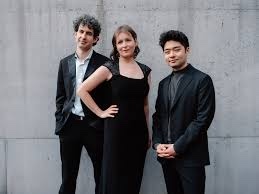
Formed at Juilliard fifteen years ago, the Lysander Trio — violinist Itamar Zorman, pianist Liza Stepanova, and recent addition cellist James Kim — made a persuasive case for this varied program.
Grieg’s Andante con moto (1878) is all that survives of his unfinished piano trio. Built largely from one theme, it ranges from gentle lyricism to surprising force.
Grieg’s manuscript remained obscure until 1978, though his friend Julius Röntgen had recognized its promise long before. Röntgen, who married Amanda Maier in 1880, links the two composers.
Zorman and Kim established a beautifully blended string sound, with Stepanova providing a well-balanced foil. The three built successive climaxes with precision before bringing the music to a quiet close.
Between these Scandinavian works came South African composer Bongani Ndodana-Breen’s Two Nguni Dances (2009), written for Haydn’s bicentennial but rooted in Xhosa traditions.
The first, Inyanga, evoked a healing ritual through insistent rhythms and a two-note motif suggesting the uhadi, a Xhosa musical bow. Stepanova’s piano lines darted through percussive strings as the trio navigated intricate patterns with crisp assurance. The second, Intsomi, drew on storytelling, with phrases passing conversationally among the instruments. Both dances drew appreciative applause.
Maier’s Piano Trio in E-flat, written in 1874 while she was studying in Leipzig, disappeared for more than a century before resurfacing in 2016 and reaching publication two years later. Where had this music been all my life? Its four movements reveal a young composer steeped in Romanticism — Schumann especially — but already speaking in her own voice.
The first movement balanced vigor and lyricism and the scherzo skipped along with a folk-like lilt. The elegiac slow movement found Zorman and Kim trading tender phrases over Stepanova’s gentle support, though Kim sometimes let sentiment tip the balance. The energetic finale recalled the slow movement’s theme, neatly tying the work together.
The second half belonged to Dvořák’s Piano Trio No. 3 in f, Op. 65, written in 1883 in the shadow of his mother’s death. Among his most searching chamber works, it recalls Brahms in its scale and density.
The first movement’s questioning phrase developed into music of mounting urgency, the Lysanders guiding its course with care. The scherzo’s Czech rhythms danced on uneasy ground. In the Poco adagio, Zorman and Kim found warmth in their melodic exchanges, though Kim occasionally let feeling overflow. Stepanova, attentive to every nuance, contributed a quieter kind of expression. The trio met the finale’s challenges with vigor and precision, carrying the music to an exhilarating close.
For an encore, the trio offered “They Will Not Lend Me a Child,” the fourth of Samuel Coleridge-Taylor’s Five Negro Melodies for Piano Trio — another find of rare beauty.
Published on ClevelandClassical.com November 23, 2026
Click here for a printable copy of this article
