

by Mike Telin
 This week, Apollo’s Fire takes audiences on an excursion to 17th and 18th century France with a program celebrating the music created for the Palace of Versailles under the reign of the Sun King, Louis XIV. Led by Associate Artistic Director Alan Choo, the program features works by Charpentier, Leclair, Lully, Rameau, and Rebel.
Performances begin on Thursday, March 5 at 7:30 pm at St. Paul’s Episcopal Church, Akron. The program will be repeated on Friday and Saturday at 7:30 at St. Paul’s Episcopal Church in Cleveland Heights and Sunday at 4:00 pm at Rocky River Presbyterian Church. Tickets are available online.
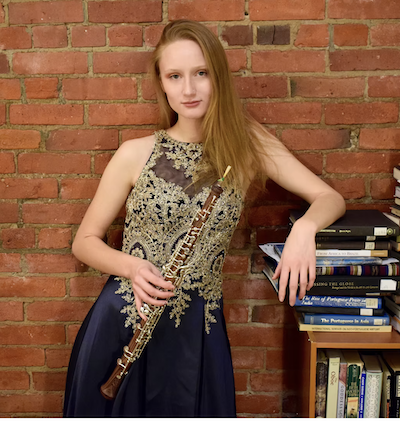
We caught up with oboist Gaia Saetermoe-Howard by Zoom, who will be giving a pre-concert lecture one hour before each performance. I began by asking her what the earliest piece on the program will be.
Gaia Saetermoe-Howard: The earliest piece is Michel-Richard De Lalande’s Les fontaines de Versailles. It was written to celebrate the move of the royal court from Paris to Versailles and the installation of the fountains in the Palace gardens.
When I was preparing for the pre-concert talk, I discovered how the fountains actually worked. Originally, there was no natural water source at the palace so they developed this thing called the Marly Machine to pump in the water.
Mike Telin: How personally involved in the arts was Louis XIV?
GSH: He was a huge patron of the arts and he commissioned many things to be performed at the court. He was a dancer himself, and would often have the composers write roles for him in the opera ballets and the comedy ballets, little parts that were written for him.
We’re going to play three works by Jean-Baptist Lully — the Passacaille from Armide and two selections from Les Bourgeois Gentilhomme, Canarie and my favorite, the March of the Turks. It’s beautiful and especially great for the oboe and since I’m playing second oboe I’m really excited to play that.
What’s interesting about the March of the Turks is that it comes from a period in French culture when people were obsessed with the Ottoman Empire and Louis XIV inherited that obsession. At the same time there was a distrust among the population for the Turks, which led to the “interesting” way that Turks were portrayed in French opera.
One story is that all of these Turquerie comedy ballets that Louis XIV had commissioned were based on a single interaction that he had with the diplomat Suleiman Aga.
The story goes that during an encounter, Suleiman Aga was rude to Louis XIV so the King commissioned pieces that poked fun at the Turks while still trying to maintain that political alliance. This is one of them, about a middle class guy who was pretending to be nobility. This class question is a common theme in Les Bourgeois Gentilhomme as well — this tension between politics and art and how those things teeter one another.
MT: What other composers did he commission music from who are represented on this program?
GSH: I’m not positive if any of the other composers we’re playing were commissioned by Louis XIV. But he was certainly part of creating the works that we’ll play by Leclair, Charpentier and Rameau.
I should say that even in the 17th century, all of these pieces were being performed publicly as well. Molière, the playwright who wrote all of the librettos actually said that the public is going to get the same version that we gave to the king. Whether or not that’s true, it is what he said.
Leclair and Charpentier wrote a lot of music for the general public. The Concert Spirituel — a public series — was a big thing at the time, and that was what Leclair’s Violin Concerto in A minor that Alan Choo is playing was written for.
MT: What is the instrumentation for this concert?
GSH: It’s going to be flutes, oboes, strings, and a large continuo section. There’s also percussion which will be super fun. The French wrote the best orchestrations. And unlike the British, they were specific about which part is for the oboes and which parts are for the flutes and the violins. So there will be a lot of varied textures in terms of instrumentation.
MT: Is there anything else you think people should know about the program?
GSH: One thing is that De Lalande’s Les fontaines de Versailles has only been performed a few times so it only exists in manuscript, so Alan created this edition for us to play from, and that’s really special.
But Rameau’s Suite from Les indes galantes is a complex piece that has some incredibly beautiful and interesting music. It also contains a lot of ethnic stereotypes that touch on some themes in history that really fascinate me.
I’m doing my Ph.D in historical musicology, and I write about indigenous and European musical interactions. That’s part of why Alan asked me to do the pre-concert talks because we wanted to do this piece, but it’s a complex piece to put on. We’re doing everything that we can to emphasize both the beauty of the music and the complexity of the politics of the piece. So there’s a lot of modern re-imaginations of that piece that have a more educated, more worldly view. And that’s what we’re trying to bring to it.
Published on ClevelandClassical.com March 3, 2026
Click here for a printable copy of this article
