

By Mike Telin
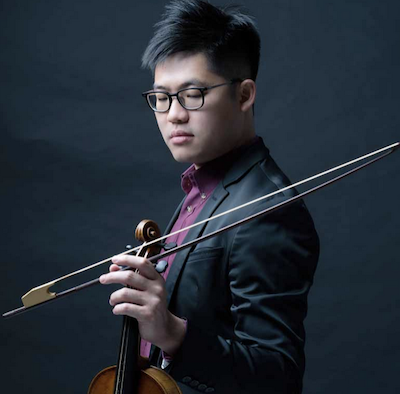 Logging onto Zoom from Singapore, Apollo’s Fire concertmaster and assistant artistic director Alan Choo was in high spirits. “We just finished a dress rehearsal with Red Dot Baroque, Singapore’s first professional Baroque orchestra. It’s been around since 2018.”
Choo was especially excited to talk about his upcoming Apollo’s Fire concerts. He said what unifies the six works on “Winter Sparks” is that the composers take their works’ thematic material and pass it around to different soloists.
“Sometimes the music feels like a friendly conversation, sometimes it feels like a love duet, and sometimes it feels like a duo that is exploring the rhetoric of the conversation between soloists, which I think is quite interesting.”
On Thursday, January 29 at 7:30 pm at First United Methodist Church in Cuyahoga Falls, Apollo’s Fire will debut Winter Sparks from Bach & Vivaldi. The program will be repeated at 7:30 on January 30 & 31 at 7:30 at St. Paul’s Episcopal Church in Cleveland Heights and Federated Church in Chagrin Falls, and at 4:00 pm on February 1 at Rocky River Presbyterian Church. A pre-concert conversation with oboist Debra Nagy, hosted by Alan Choo, will take place one hour before each performance. Tickets are available online.
They’ll begin with Vivaldi’s Symphony in g, RV157, which Choo said is an example of a concerto for the entire band.
“He writes virtuosic material for every part, violin one and two, viola, and bass. It’s full of fiery, dramatic passages that are passed around all the different parts. There’s something about the interplay that heightens the drama and with the incredible musicians of Apollo’s Fire we like to play up the fire in it. I think that a piece where everyone onstage is a soloist will be a nice opener to the program.”
Next up will be Vivaldi’s Oboe Concerto in a, RV 461 with Debra Nagy as soloist. “We know Vivaldi as a composer for the violin, but he also wrote some of the earliest oboe concertos along with Albinoni and Marcello. They’re all really nice pieces, but this concerto is one of my favorites. It has a very nice sense of poise and drama. I’ve loved it for a long time and I’m excited to work with Debra on it. This is also the first time Apollo’s Fire will be performing it so I’m excited for that too.”
The program’s first half will close with J.S. Bach’s Orchestra Suite Number 2, featuring flutist Kathie Stewart. Choo noted that while Bach’s concerto is a little more sophisticated than Vivaldi’s, the texture of his music is still quite contrapuntal, with a lot going on in the inner parts.
“He also gives the flute some episodes where it breaks away from that texture and goes on flights of fancy of its own. To me the piece is an interesting amalgamation of strict German counterpoint coupled with Italian virtuosity and French-style dances.”
The second half of Winter Sparks will feature two concertos for multiple instruments with a French piece sandwiched in between.
“Evaristo Felice Dall’Abaco was a contemporary of Vivaldi and perhaps somewhat overshadowed by him,” Choo said. “He is also an interesting case of an amalgamation of styles. He was Italian, but spent time in Brussels where he assimilated the French style. This concerto features Kathie Stewart and Debra Nagy and you’ll hear passepieds and a sarabande-like movement. So again there’s that French elegance combined with Italian virtuosity.”
Cellist Sarah Stone will take the spotlight in Marin Marais’ showpiece Sonnerie de Sainte Geneviève. “It’s an evocative programmatic piece that depicts the church bells in Paris,” Choo said, adding that the piece is basically three notes repeating over and over. “But above that, Marais weaves some of the most imaginative writing for cello and violin. It feels like a fencing match — which was quite popular in France — where you’re sparring with each other, taking turns passing some pretty dramatic musical material back and forth. It’s really fun.”
The program closes with another Vivaldi concerto featuring Choo, Nagy, Stewart, and Stone as soloists.
Since we had a few minutes to spare I asked Choo to say more about Red Dot’s concert. “It’s really fun. It features dancers and choreography from the Baroque times along with freshly choreographed pieces. We’re working in collaboration with the Yong Siew Toh Conservatory of Music, which is the National Conservatory of Singapore where Red Dot Baroque is an ensemble in residence. We work with the students side by side as well, so there are some students playing with us and also dancing. The program has a little bit of everything.”
Although I apologized for asking Choo to speak on behalf of an entire continent, I was curious to know his thoughts on the state of early music performance in Asia.
“Now is actually an exciting time to be in Asia because early music is really catching on and catching on quite nicely,” he said.
He said that Japan used to be the center of early music in Asia. “But nowadays there are more people of my generation who are returning from their studies in Europe or the United States, and bringing what they learned back to their home countries and starting their own ensembles. And so in Singapore there’s my ensemble, Red Dot Baroque, but I have recently played in Korea and Shanghai as well as with a group in Taiwan.”
Choo pointed out that these musical exchanges have been quite fruitful. “I do think that based on the quality of the musicians and on the interest level that we’re getting from audiences in Asia, it’s only going to grow more and more. So I think it’s great to be in Asia at this point. It feels exciting to be part of a new wave or something, and to be introducing new ways of performing, new pieces, and new ideas to the audiences here.”
How does Choo manage to keep his life in order?
“It’s hard work building something, but as long as you feel passionate about it and feel that it’s meaningful and gives your life purpose, then you just keep going. Of course, you also have to take care of yourself, which I’m now mindful to do. But I accept and love challenges when they come my way. So yeah, I love them because I love the music that I play and the people that I work with.”
Published on ClevelandClassical.com January 25, 2026
Click here for a printable copy of this article
