

by Peter Feher
 In 1715, the French composer Jean-Féry Rebel had the shrewd idea of combining the most popular Baroque dances of his day into a single crowd-pleasing piece. Les Caractères de la Danse was a hit with Parisian audiences, thanks in large part to the thrill that accompanies recognition.
Modern listeners can surely relate, even if they might struggle to tell a minuet from a musette or a gigue from a gavotte. Take Rebel’s concept, but swap in the music and moves of “Y.M.C.A.” or “Kung Fu Fighting,” and you have “Evolution of Dance,” one of the first viral videos in internet history.
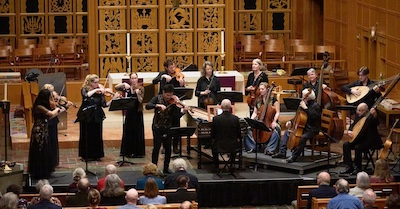
If any group of performers could make this connection across centuries, it would have to be Apollo’s Fire. Sure enough, Cleveland’s period orchestra brought its customary fervor and flair to a spirited reading of Rebel’s work on Friday, March 6, at St. Paul’s Episcopal Church. It was a fitting conclusion to a concert that drew its energy from both the past and the future.
The ruling taste of the ancien régime was revived for the evening, with the repertoire primarily sourced from the Palace of Versailles during the reign of King Louis XIV. But command of Apollo’s Fire ultimately rested with concertmaster Alan Choo, who — in his expanding role as the ensemble’s associate artistic director — devised and shaped the entire program.
Standing among his fellow musicians, Choo served as a collegial conductor on violin, just as ready to cue a phrase as to follow another player’s lead. While a spirit of collaboration isn’t strictly authentic to the French Baroque — the composer Jean-Baptiste Lully was famous for beating time with a big wooden staff — some changes are nevertheless welcome.
Percussionist Anthony Taddeo demonstrated Lully’s domineering method by pounding along to the concert’s opening selection, the Turkish March from Le Bourgeois Gentilhomme, before ceding the stage with comic dignity.
It wouldn’t be an Apollo’s Fire performance without a little choreography to highlight what’s happening in the orchestra. And no piece on the program displayed more colorful detail than a suite of instrumental excerpts from Jean-Philippe Rameau’s Les Indes Galantes. A thunder sheet shook in the section titled “Storm,” a piccolo chirped up in a later movement like a gentle breeze, and the whole ensemble was swept along in the whirling accelerando of the finale.
The elements seemed subdued by comparison in Michel-Richard de Lalande’s Les Fontaines de Versailles, which depicts the forces of nature — water and wind bursting forth — as elegantly contained within the royal gardens. The music flowed most expressively in a lovely, understated duet between oboists Kathryn Montoya and Gaia Saetermoe-Howard.
The evening settled into a slight lull with two works for strings only. In the solo spotlight before intermission, Choo didn’t find his best sound until the slow movement of Jean-Marie Leclair’s Violin Concerto in a, Op. 7, No. 5. Then the job of starting the second half fell to a small group of string players asked to linger over the dissonances of Marc-Antoine Charpentier’s Concert Pour Quatre Parties de Violes.
But the liveliness soon returned with Rameau’s suite, followed by Rebel’s romp through Baroque dance. If past success is any promise, Choo and Apollo’s Fire may just have scored a new crowd favorite — and perhaps their next YouTube hit.
Photo by Malcolm Henoch
Published on ClevelandClassical.com March 19, 2026
Click here for a printable copy of this article