

by Mike Telin
 This week, Jeannette Sorrell and Apollo’s Fire will premiere a fresh version of their celebrated program O Jerusalem! Crossroads of Three Faiths. In this musical tour of the four quarters of Old Jerusalem (Jewish, Christian, Arab, and Armenian), surprising cross-influences emerge.
The program will be presented on Thursday, April 9 at The Bath Church UCC, on April 10 in Gartner Auditorium at the Cleveland Museum of Art, and on April 11 at Congregation Mishkan Or, all at 7:30 pm. Pre-concert conversations will be presented by Daphna Mor and Ronnie Malley, one hour before each performance. Tickets are available online.
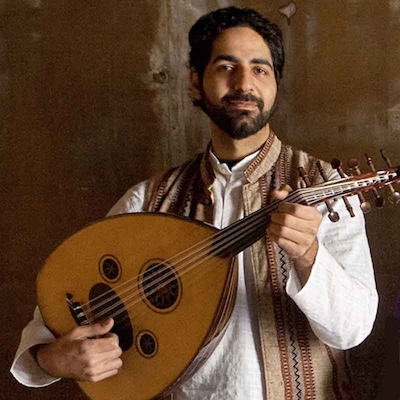
I caught up by telephone with Ronnie Malley, who, in addition to playing oud & accordion, served as the Arab musical and cultural consultant for this project. I asked him to talk about what he brought to the program.
Ronnie Malley: Jennette was very open to whatever I wanted to bring. And I thought, I am a Jerusalemite and I should bring something from there. And the one thing that the city has always represented to me are the three Abrahamic faiths — Judaism, Christianity, and Islam.
The musical system they call maqam is unique in that it doesn’t have any single designated faith. Maqam is heard in the mosque — the call to prayer in Islam is always done to a maqam. But you’ll also hear the same thing in Christian Orthodox churches. Assyrian Orthodox, Greek Orthodox, and Byzantine music, all use maqam.
And it’s funny how all the region uses this particular mode called Bayati, which has four to five notes of a scale. And it has something very indicative of the Middle East, which is called a quarter tone. The best way to describe quarter tones is to imagine the tones that exist between the white keys on a piano.
I grew up in a Muslim household in Chicago, but a lot of my musical upbringing was in the Arab Christian churches in and around the city, so I would hear all of these things.
Because I’ve been doing a lot of interfaith work, I thought, “Let me devise a chant that uses music across these faiths for this program.”
Abrahamic Medley (Maqam Bayati) includes a chant by the 16th century Sephardic Jewish Rabbi Elijah Azikri. He wrote a beautiful piece called “Yedid Nefesh” (Beloved of the soul).
The second piece is “Moran Etrahem ‘Alayn” (Our Lord, have mercy on us) by St. Ephraim. It’s a Syriac hymn that was written in the fourth century. And it’s in a dialect very close to what Jesus of Nazareth spoke.
The final piece is a very popular Arabic nasheed or hymn called “Ya Imam a-Rusli”. It’s by Abdulrahman Al-Buri’i, who was a 13th century sheikh from Sudan and it uses a folk melody from Greater Syria that’s become one of the most popular pieces in the Islamic repertoire.
I also wanted to include two Palestinian Folk Songs. “Hadi Ya Bahar” (Keep Calm O’ Sea) is a lamentation about longing to return home. Today it’s grown to be quite an anthem for exiled Palestinians.
I’m also bringing “Ala Dalouna” (Onward to help), which is a dabke dance folk song about helping neighbors sow the land with olive and almond trees, sage, and zaatar. It’s a very agrarian song, but people have used it in weddings, to talk about the bride and the groom, or in societal situations to talk about politics. And like so many folk songs such as “Barbara Allen,” there are tons of different lyrics and different melodies. So, when Jeanette said that we could also teach a quick dance, I thought this would really be very appropriate, especially to represent my Palestinian heritage.
MT: How did you find your way to the oud?
RM: I grew up in a musical family. My dad’s a musician and so is my brother. We played in a lot of restaurants, clubs, and for weddings as a family band.
They’re both percussionists and I started off as an orchestral percussionist as well. Then I switched to guitar. My brother and I would play a quick show when our Dad’s band was taking a break. One day my dad said, “You know, if you switched to keyboards we could really be a tight unit. And you’ll have a lot more at your fingertips, the bass with your left hand and all that.” So I switched over to keys.
For many years I played guitar and keyboards until I had a realization — almost like imposter syndrome. I thought, here I am playing all this music from the Middle East on instruments that had “made in Japan,” on them and I thought that I needed to have at least one heritage instrument under my belt. Switching from the guitar to the oud seemed like a reasonable option.
And all of a sudden, people were far more interested in seeing the oud than they were watching me play a keyboard. So I stuck with it. And you know, it really opened up a lot of new doors. That’s what got me into early music as well.
And early music has spawned a long journey. I’m finishing up a PhD in ethnomusicology about how these instruments and the music that came out from the region of Andalusia in Spain was integrated and interwoven in what we consider the early music repertoire of the day.
I thought that maybe this is a way that we can find the overlap of how these cultures and traditions influence each other through their instruments. The lute comes from the Oud, and then the Renaissance guitar comes from the lute.
Published on ClevelandClassical.com April 9, 2026
Click here for a printable copy of this article
