

by Mike Telin
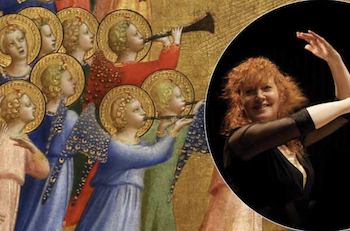 On Friday, December 12 at 7:00 pm at St. Paul’s Episcopal Church in Akron, Apollo’s Fire will revive its popular Praetorius’ Christmas Vespers under the direction of Jeannette Sorrell.
Soloists include sopranos Rebecca Myers, Andréa Walker, and Molly Netter, countertenor Doug Dodson, tenors Michael Jones and Matthew Newhouse, and bass Matthew Dexter along with Apollo’s Singers, and members of Apollo’s Musettes (Treble Youth Choir). The program will be repeated at 7:00 pm on the 18th and 19th at Trinity Cathedral, 7:00 pm on the 20th at First Baptist Church, and at 4:00 pm on the 21st at St. Raphael Catholic Church. Tickets are available online.
I caught up with Jeannette Sorrell on Zoom and began our conversation by asking her when she first created the program.
Jeannette Sorrell: Exactly 20 years ago. So, we’re bringing it back on the 20th anniversary of the premiere.
Mike Telin: And it’s your creation?
JS: Yes, I compiled and arranged music from four of Michael Praetorius’ major works because he did not, as far as we know, actually create a Christmas Vespers, although he wrote a lot of Christmas music and a lot of sacred music in general. So I put it together in a format that evokes a Vespers service for Christmas.
MT: There are a lot of performers involved.
JS: Praetorius’ music uses a lot of antiphonal choirs, meaning you break up the choir into different groups and separate them in different spaces. Which is something that Monteverdi did as well. And people who love the Monteverdi Vespers will love this too. The two works are closely related and I would say that Praetorius was really influenced by Monteverdi.
MT: You’ll use a professional choir and a children’s youth choir. Tell me about the Musettes.
JS: Apollo’s Musettes was founded 20 years ago specifically to sing in the Praetorius program. And we’ve used them in many other programs since then, but that was why they were created.
MT: And the child soloists, are they coming out of the Musettes?
JS: Yes — Federica Salvagni, Rosie Horvath, and Aika Birch. They’re all local. And the director of our Musettes ensemble is Anna O’Connell. She plays with us on baroque harp, and she sings with us. She also has a masters degree in choral conducting as well as a doctorate in early music, so she’s wonderfully qualified to lead the Musettes. We held auditions and have 12 young singers who are very good.
MT: Would you like to give a shout-out to the adult soloists? You’ve got a wonderful lineup.
JS: This particular program really features the three soprano soloists and they are so wonderful. Rebecca Myers is a very much in-demand early music specialist. We featured her last spring in the Bach B-Minor Mass.
Molly Netter has sung with us several times, and Andrea Walker, who we recently featured in Dido and Aeneas, was such a hit in that. The three of them have quite a lot of wonderful solos in this program, including a very impassioned trio for three sopranos and three plucked instruments. Ach mein Herr is really a piece for Lent. It expresses a lot of repentance and the wish to be humble and to try to do better as a person — and that’s a very moving part of the concert.
MT: The instrumental ensemble is fairly large.
JS: It’s similar to the orchestration of the Monteverdi Vespers but slightly larger. There are two cornettos, which is a very unusual instrument — it’s sort of a cross between an oboe and a trumpet and has a unique sound. There are sackbuts, which are the early trombones, Baroque trumpet, a little bit of percussion, two theorbos, which are the giant lutes, Baroque harp, and recorders. So it’s a very festive ensemble.
MT: You’ve also recorded the piece which was released when, in 2015?
JS: I think it was originally released in 2007 on our old record label, and then it was released by Avi in 2015.
MT: Are there any differences between this live performance and the recording?
JS: Not a lot. The concert has a sort of theatrical gospel processional at the beginning of the second half, so that is not on the album. But I think that musically it’s pretty much the same.
I will say that the live concert is quite a visual experience. There’s a lot to watch — very cool instruments — and quite a bit of movement, and you don’t quite get that from the CD.
I always try to use the architectural space in interesting ways, which is what composers were really into during that period — placing small groups of musicians in different corners or in the balcony and things like that.
MT: The Cleveland performances are at First Baptist, Trinity Cathedral, and St. Raphael.
JS: Yes. We tried to use entirely what you might call Cathedral venues. And Trinity, of course, is so stunning visually, and we will be filming those concerts there so there might be glimpses of the audience in the video.
MT: I’m trying to remember exactly how long the Vespers is.
JS: It’s about two hours.
MT: What excites you about revisiting the piece?
JS: It’s very exciting to be returning to it after a 10-year break. For the past 10 years we’ve only performed Handel’s Messiah and a few different Irish Christmas programs that I put together. But it felt like it was time to revisit the Vespers because it was always very popular.
I guess my favorite aspect of it is that it’s multi-generational and that is what the composer intended. Praetorius was writing in the Lutheran tradition, and Martin Luther wanted the common people, including children, to be able to actively participate in the worship service. So he decreed that music should include children, and that is what Praetorius did. Not in every movement but the kids sing about five times. And it’s just really fun to have the joy that children bring to the stage. I think that kind of youthful joy and innocence is what we all kind of need right now in the world.
Published on ClevelandClassical.com December 11, 2025
Click here for a printable copy of this article
