


by Mike Telin
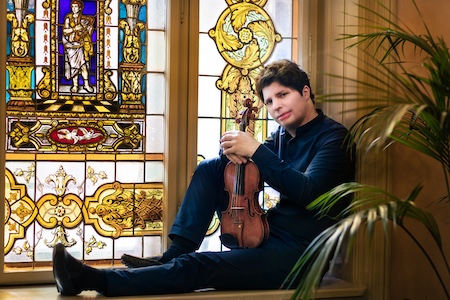 “I absolutely love the beautiful playing of the Cleveland Orchestra,” violinist Augustin Hadelich said, “and every time I have returned has been a real highlight.”
On Thursday, February 5 at 7:30 pm, Hadelich will return to Severance Music Center to join The Cleveland Orchestra in Felix Mendelssohn’s Violin Concerto. Under the direction of guest conductor Antonello Manacorda, the program also includes Arnold Schoenberg’s Second Chamber Symphony, and Franz Schubert’s Symphony No. 8, “Unfinished.”
Although Hadelich’s busy touring schedule prevented a telephone interview, he graciously agreed to answer questions by email.
Mike Telin: How do you make such a well-known concerto sound new and fresh?
Augustin Hadelich: That is actually the biggest challenge with this work! Like many violinists, I learned this piece very early, when I was eight years old. It can be hard to get away from old habits in the interpretation, and the violinistic tradition is not so helpful either — over the years, interpretations have gotten more and more sentimental and exaggerated!
At some point I took a break from the piece, and started over with a new score, as if I was learning a new piece. In the process, I fell in love with the music again!
This is early romanticism, and although the emotions are very intense, the structure and gestures are still closer to the classical style. It is such a concise and perfectly structured piece — not one note out of place!
MT: Will you please say a few words about each of the movements?
AH: Mendelssohn composed his violin concerto for his friend and concertmaster of the Gewandhaus Orchestra, Ferdinand David. When they were discussing the proposed concerto, David asked Mendelssohn to write a brilliant, virtuosic piece – even jokingly using the words ‘stilo moltissimo concertantissimo’. Mendelssohn joked back that the soloist’s entire first entrance would consist of a high E. Thankfully, he didn’t keep his word on that! The work is extremely well written for the instrument and exhibits its capabilities to full effect.
Rather than beginning the work with an orchestral introduction (as would have been expected at the time) the soloist enters immediately with the urgent, passionate first theme spinning out over murmuring, agitated arpeggios in the violins and a portentous, heartbeat rhythm in the bass. The mood is restless, and the tempo indication “molto appassionato.”
In complete contrast, the second theme is calm and blissful — tranquillo, romantic, and loving. Mendelssohn’s placement of the cadenza at the end of the development was a new idea at the time, and by connecting all three movements he further shapes the work’s dramatic flow.
To connect the second and third movement, he inserts a short operatic intermezzo of just fourteen bars (allegretto non troppo). It is a short recitativo based on the opening motif of the first movement, tracing the outlines of the theme of the second movement and bringing us into E major, where the fun can begin! This is Mendelssohn’s whimsical side, which is on display in many of his scherzo movements (in A Midsummer Night’s Dream, for example, or in the Octet), and which for me conjures up delightful images of woods teeming with fairies and other magical creatures.
MT: Have you worked with Antonello Manacorda before?
AH: This is actually our first time working together!
The program will be repeated on Friday and Saturday at 7:30 pm. Tickets are available online.
Photo credit: Suxiao Yang
Published on ClevelandClassical.com January 28, 2026
Click here for a printable copy of this article
