



by Mike Telin
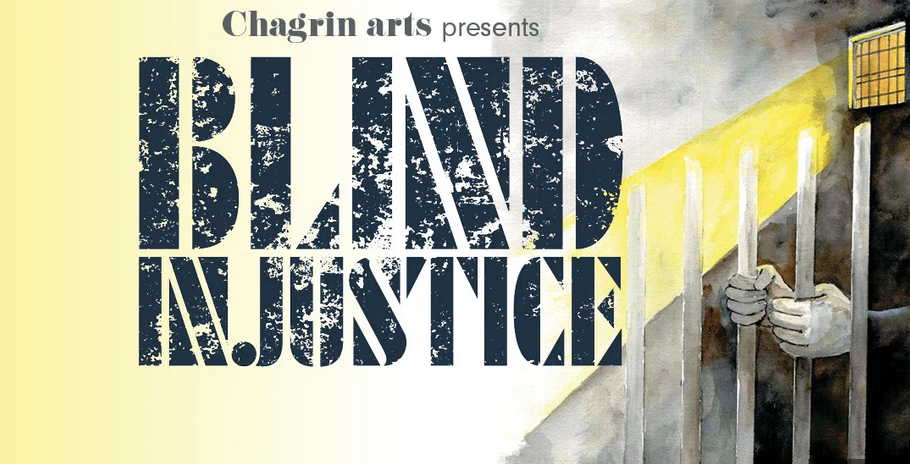 This weekend, Chagrin Arts will present the Northeast Ohio premiere of Blind Injustice at Outcalt Theatre in Playhouse Square.
Composed by Scott Davenport Richards with a libretto by David Cote, the opera is based on Ohio Innocence Project co-founder Mark Godsey’s book of the same name and interviews with six people who had their convictions overturned. The 90-minute opera will be presented on Friday, July 11 (sold out), Saturday, July 12 at 7:30 pm and Sunday, July 13 at 3:00 pm. Tickets are available online.
We caught up with director Eric van Baars, conductor Andrew Grams, and chorus master Jay White on Zoom. I began our conversation by asking them how they became involved with the project.
 Jay White: Karen Prasser of Chagrin Arts has been one of our staff pianists here at Kent State for quite some time, and when she was starting to look at the possibility of bringing the opera to Northeast Ohio she came to tenor and fellow Kent faculty member Tim Culver and myself, along with a couple of other faculty members and said, we’d really like to make this happen here for myriad reasons.
This all happened shortly after the Opera’s premiere in 2019. We presented three scenes at the Severance Hall gala for the Kent State University Glauser School of Music School in May of 2022.
Eric van Baars: I was at that gala, and that was my introduction to the piece. Flash forward to this year, Karen Prasser contacted me because the original director, Robin Guarino, who had helped create the piece in Cincinnati and had been the director of every subsequent production since, had moved on. So I read Mark Godsey’s book, and was immediately drawn into it because the stories are very compelling. And the fact that it is Northeast Ohio-centric. It’s a rare opportunity to be able to present a piece about a community at a time when it’s as relevant now, if not more so, than when it was first created.
 Andrew Grams: Although I had not known Karen Prasser before this project, my partner Saeran St. Christopher, the second flutist in The Cleveland Orchestra and Barry Stees, the former associate principal bassoon, were both very much involved in the Ohio Innocence Project. Barry knew about Karen’s idea of bringing the piece here, so he brought the two of us together. And as Eric and Jay have said, the relevance to our community was an immediate draw for me.
What really sealed the deal was being at an event where I got to meet the exonorees Nancy Smith and Rickey Jackson. To have these real people’s stories told in this art form through music with words and staging, is the type of thing that as a classical orchestral conductor I feel is extremely important.
With all of these people being from Northeast Ohio, especially around the Cleveland region, I thought it has to be done here — it just has to. So how do we make it happen?
Mike Telin: It’s a huge production.
JW: Because of the connection that we have with Kent State, as the chorus master, I was able to pull many current students, recent graduates and alumni into the fold, so there’s a very strong Kent State connection and that was something that we all felt important to have. Not to mention just the educational factor of presenting an opera that is relatively new. If you think about it being only six or seven years old, that’s exciting for us.
We can call it an opera, but there are so many styles of sounds in it that the singers are finding it fascinating to be able to decide how do I do this? How do I do that? What kind of sound do you want? Because it’s much more of a theater piece with music or a music piece with theater, depending how you want to look at it.
 Although some of the roles had already been assigned, when I jumped on board we were still in the midst of casting — and it is a challenging piece to cast. Part of what we wanted was to have an Ohio-cenric cast as well. So not all the artists who are involved, but most of them, are from Ohio. Many of them are from Cleveland and the surrounding area. So I was also responsible for putting together a design team rather quickly and then getting into the nuts and bolts of staging it.
It’s gratifying to be doing it at the Outcalt, which is almost like you’re walking into a prison — it’s dark and it’s cold. My great passion is working on ensemble pieces and this is very much a complicated ensemble piece where people come in and out. We have an ensemble of four who play multiple roles and really glue all the stories of the six exonerees together. So it’s just been a joy to put together the pieces of the puzzle.
MT: Andrew, please say a little bit about the score.
AG: It’s for twelve-plus instrumentalists with a strong rhythm section — drum set, piano, and double bass.
Jay and I were going over the score last night and we commented that once this or that number starts, and the groove gets in the slot, everybody just has to go with it. And it’s really those three people, the piano, drums, and bass who are going to provide the music for everybody to coast upon.
As for the score itself, I think Scott, has created something that is musically diverse, and captures so many elements of the personalities of each of the exonerees, and the supporting roles as well.
MT: What do you hope that audiences will take away from the experience of hearing and seeing this opera?
One is the call to action: aksing yourself the question, what can I do? We’re assisting that conversation by having a post-show discussion with the creators and hopefully some of the exonerees after every performance. Also, the work continues because the injustice continues, and what we can do as individuals and as a society to help change that.
Another takeaway is how the genre of opera evolves and becomes more accessible for people. I’m really hoping that some individuals who are dragged into a performance thinking, ‘Oh my God, I’ve got to sit through an opera’ will realize that they can relate to it because the stories are relatable. And the music is very relatable and accessible to multiple generations and multiple cultures, and people will enjoy that element of it.
JW: What I think is striking is what Eric just said about the idea that people are going to come to this and think I had no idea about these stories. I had no idea about the struggle, the heartache, and the suffering. I had no idea that opera or even a musical theater piece could have these elements in it. And because a lot of the words that David used are from the exonerees themselves, the importance that we’re putting on the text is paramount.
We will have super titles because it goes by really quickly. And that’s one of the things that I think people are going to look at it and think, I just had no idea. Because when I came to this piece I had no idea either. And it’s taught me a lot about how we can expand people’s understanding of what is telling the story through music.
MT: Andrew, would you like to add anything?
AG: I agree with everything that was said. The only thing that I can add is that, like I said earlier, the importance of telling these people’s stories and being able to do it in an artistic way where you can heighten the emotion.
We can talk about each of the exonerees’ stories, like a set of facts — and you can have a certain relationship to those facts. But when their stories are told in a dramatic way, the possibility for people to connect on a deeper, more emotional level.
JW: One of the things that struck me early on in the rehearsal process is we are celebrating two national holidays surrounding freedom, Juneteenth and Independence Day.
And the whole concept of freedom builds pretty much to the end of the Opera. We really are left with the question what is freedom? If one can be wrongly accused and incarcerated but then released, are we still free?
MT: does anybody want to add anything?
EB: I will add that we have a phenomenal group of singer, actors, musicians involved in this. It’s just been a joy that everyone is so invested in the storytelling of it, but also in giving of themselves. It’s challenging material to present over and over again in rehearsal and I’m just so grateful for the people we have and the support and guidance they’re giving each other, and the grace that they’re giving themselves.
There have been some real Aha! moments happening where we’re realizing, that at the heart of it, this is someone’s life we’re honoring. And it’s been very rewarding to do that.
Published on ClevelandClassical.com June 16, 2025
Click here for a printable copy of this article
