

by Mike Telin
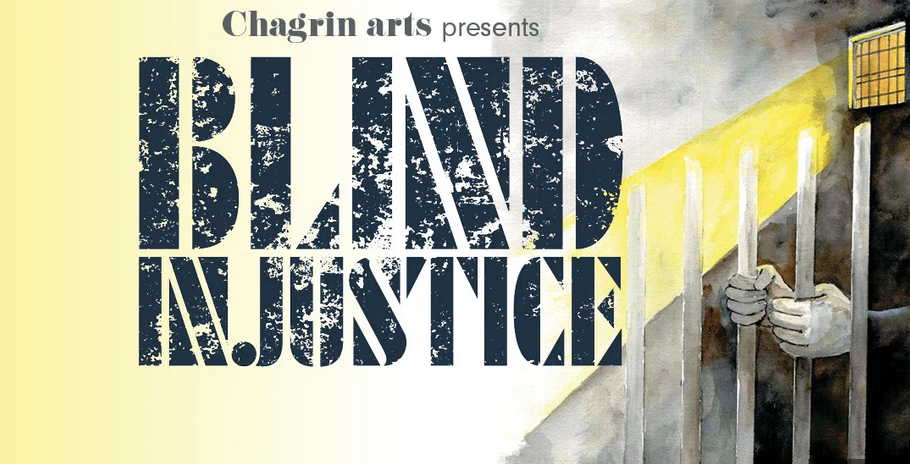 This weekend, Chagrin Arts will present the Northeast Ohio premiere of Blind Injustice at Outcalt Theatre in Playhouse Square.
Based on Ohio Innocence Project co-founder Mark Godsey’s book of the same name and interviews with six people who had their convictions overturned, the 90-minute opera will be presented on Friday, July 11 (sold out), Saturday, July 12 at 7:30 pm, and Sunday, July 13 at 3:00 pm. Tickets are available online.
We caught up with composer Scott Davenport Richards and librettist David Cote on Zoom.
Mike Telin: Who originally approached whom about creating this opera?
David Cote: The Cincinnati Opera reached out to me because they heard about my work, but the director, Robin Guarino, was already attached to the project. At the time, she was running the opera program at Cincinnati Conservatory, so I flew out there, met her, and we hit it off. We did some initial interviews with the exonerees. So we had a framework, but we needed to find the perfect composer.
Scott Davenport Richards: I was approached by Robin and David. I had known Robin for a while — New York City Opera had read my work and had done two of my pieces at the Vox Festival.
I came into opera with the idea that if jazz musicians can play solos over changes, why can’t we use that same structure to set words?
I read the draft of David’s libretto and I thought, wow, I know how to do this. It will allow me to call on a whole range of musical vocabulary that I’ve been looking for a way to use in one piece for a while — and that was very exciting to me.
MT: David, I understand that you did some interviews with the exonerees.
 DC: There were a bunch of us in the room. Mark Godsey, of course. He had sent me a PDF of his book, so I read it and interviewed him. Then in Cincinnati, Robin, Mark, myself, the exonerees, and other people were in the room as well. We were not trying to ask a million questions, but we wanted to ask each of the exonerees about what happened to them. Tell us about the day you were arrested, or first realized that you were under investigation. How you got through the first night in prison, how you survived mentally, and what happened when the Ohio Innocence Project (OIP) got involved in your case.
We ended up with something like 15 hours of transcripts. Robin and I sat down and thought, okay, we have these four cases and six people, each of which would make for a three hour opera. So we realized that we had to take a cinematic approach between using verbatim sections of the stories, and then going into more explanatory episodes about how this or that happened.
SDR: I wanted to approach jazz as a cinematic language but I think the score really chooses different language for different characters.
One of the brilliant things about David’s libretto is that it builds on the common elements of everyone’s experience. One character says, “they put me in the hole,” and then we hear the story of another character’s experience in the hole. So each arrest is individualized to some extent, but all have common elements.
MT: Did you need to create any characters to help advance the story?
DC: There are fictional elements, like the scientists who appear for the number called “The Wonder of Forensics.” And Alicia is a made-up student, although I did interview someone named Alicia who worked with the OIP.
MT: Were either of you familiar with the OIP before this project?
DC: I wasn’t.
SDR: Innocence Projects in general, yes, but not specifically the Ohio one.
DC: There’s a play from 15 or so years ago called The Exonerated, which is based on oral histories of people who were on death row. I saw that in New York and it’s a powerful piece of theater. It didn’t have music but it is part of a whole genre about the flaws of the criminal justice system.
MT: I’m curious. You’re both actors. How did that influence the writing of the libretto or the composing of the music?
 SDR: It definitely influenced the writing of the music. As part of the process I try to inhabit the character. I speak each of their lines and then place that over a time grid. I also make demo recordings and sing every role. The singers have that available to them as they’re learning their parts and I think it’s successful, because you can really understand — even in English — almost all the words in performance.
DC: I don’t think that Robin and I knew how Scott was going to work when we started collaborating. But then he started sending us these demos and I was like, “Oh my goodness, this is so theatrical already. I can see it on stage.” And hearing the interplay of all the voices, the dynamism and the energy, was just fantastic.
I write plays as well so I try to infuse my libretti with theatrical qualities — dramaturgical qualities that I would find interesting as a spectator. People in conflict, people having internal struggles, people fighting with each other. I don’t act those out, but I do try to feel them as I write it.
MT: How did your collaborative process work?
SDR: David had a full draft of the libretto before I came on, so we started by looking for the lines that can be repeated as hooks? Then we were able to define the structures through those hooks, through those words.
DC: And as we did workshops in 2018 and into 2019, we wrote a new scene with Scott that came out of another round of interviews with the exonerees in Cincinnati. So the scene called “Visiting Day” was new material.
We also needed to address the impact that these wrongful convictions had on families. And so we were able to write a fictional scene between Derek Wheat and his mother, inspired by something he said about missing home, and how his mother would come visit him in prison to keep his spirits up.
There are no courtroom scenes in the opera, because the audience is the jury, in a sense, or the theater is the courtroom.
MT: How much freedom have you given to the director for this production?
SDR: We’ve given no advance direction. It is possible we’ll come into a rehearsal and see something that might be contrary to the spirit of the piece, but eventually we have to hand it over.
DC: The exonerees were in the room with us and gave us their blessings to honor their stories. Likewise, any director and actor who takes it on should honor the material.
MT: Has anyone questioned why you are calling this an opera?
SDR: Why not call it an opera? Historically, it’s actually a place where social and societal issues have been worked over or worked through and we ought to continue that. And the size of opera is really appropriate to what the characters are going through in their lives. We meet all of them at the most intense points in their lives that are more horrific than anything we hope we will ever face.
DC: I would say that emotionally for the characters, and for the audience, the highs are really high and the lows are really low. And that to me is opera. It’s the ideals of humanity and freedom at the top and the horror of degradation and imprisonment at the bottom.
MT: How did you manage to keep your emotions together during the creative process?
SDR: You inhabit the character — it’s what actors do. You go there, you take on your life experiences and then you pull yourself out.
DC: Fear is one of the prime emotions — fear of putting any creative work out there. But there’s the added fear of displeasing the exonerees. Not to go into detail, but there was a moment where Nancy’s praying and I had written certain language which to me was an interesting adaptation of the Sinner’s Prayer. I guess I thought I was being clever.
But in a workshop Nancy came up and said “I’m not so sure about the language you have there. It sounds like I feel guilt about what happened but I don’t, because I’m innocent.”
I felt terrible about that, and we did a rewrite and it’s a more powerful number now. So, the emotion that I had to keep in check was — I hope that they approve because they’ve gone through enough.
Published on ClevelandClassical.com July 7, 2025
Click here for a printable copy of this article
