



by David Kulma
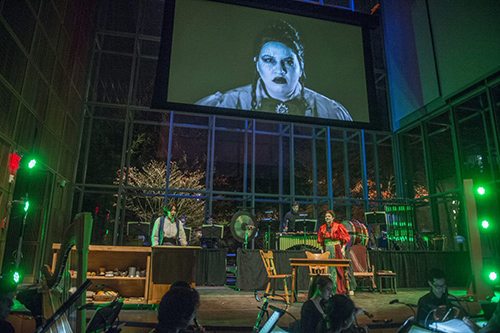 If anyone is worried about the future of opera, all they have to do is attend a college production to calm the nerves. There are numerous highly-skilled young people ready to take up the genre’s mantle, as was clear from the Cleveland Institute of Music Opera Theater’s production of The Juniper Tree in Mixon Hall on Halloween weekend. I attended opening night on Thursday, October 31, which was dedicated to the memory of the late Cleveland arts icon A. Grace Lee Mims. Artistic director Dean Southern chose a relatively recent work composed in 1984 by Philip Glass and Robert Moran. With a libretto by Arthur Yorinks, The Juniper Tree takes its plot from a grim tale by the Brothers Grimm.
A stepmother doesn’t like her stepson, kills him, and feeds him to his unwitting father. The boy’s bones are buried under a juniper by his younger sister, and thereby — in fairy-tale fashion — his soul inhabits a bird in the tree above. The boy-bird sings so beautifully that he receives a gold chain, red shoes, and a millstone from passing men. He drops each of these as a gift for a family member. Of course, the dropped stone is the means to kill his stepmother, and just as miraculously, the boy returns to human form. And all is well for the happy family.
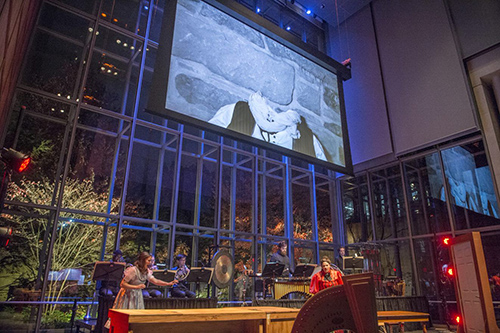 Glass and Moran divided the libretto, each setting their own scenes, which are unified with overlapping themes. The result is an “exquisite corpse” of two disparate styles. The Glass sounds like Glass: minor-chord arpeggios abound, elaborated tonal cadences cycle and recycle endlessly, and static blocks build up to emotionally powerful grandiosity. Moran chose more traditionally operatic and dramatic music for his plot-oriented scenes. His aria for the stepmother achieves an emotional complexity unusual in Grimm adaptations.
The static, abstracted character of Glass’s other operas — like Einstein on the Beach (1975) and Satyagraha (1979) — achieve a kind of hyper-Baroque splendor through repetition of solfege syllables, nonsensical English, and Sanskrit. But with the direct English prose of The Juniper Tree, his towering repetition veers toward the trite.
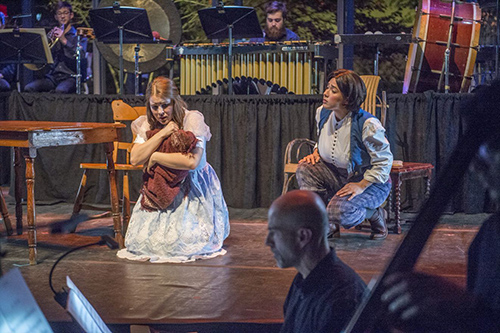 One only needs to look at the gift scene. The son as bird sings one of Glass’s earworm melodic formulas on a hackneyed lyric: “Mama killed me. Papa ate me. Little Sister gathered my bones under the juniper. Look, I’m a pretty bird.” This returns after each of the three men ask the bird to sing. Once you realize you are going to hear this again and again — with powerful sweeping arpeggios and amplified by chorus — you have arrived in Glass Purgatory.
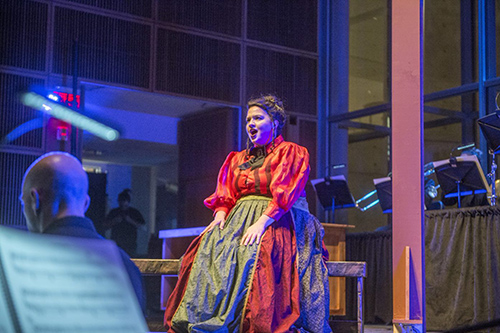
The performance itself was fantastic with great singing all around. Emma Nossem’s gripping Stepmother was fiendish in her anger, and powerfully hurt in her jealousy aria. Christophe Kennedy’s resonant Father was loving and doting, while Kayle Norris’s clarion voice was affecting in her role as the first Wife, who dies in childbirth. Rachel Glenn’s sad, timid Daughter was moving, while Polina Davydov’s delightful Son/Bird was variously joyful, cautious, and celebratory.
 Matt Mueller, Dylan Glenn, and Daveon Bolden sang their short parts with distinction, while Mengqi Gao and the treble half of the chorus were joyful as birds. The full chorus added heft, and the CIM Orchestra under Harry Davidson was excellent in the sonorous vamps.
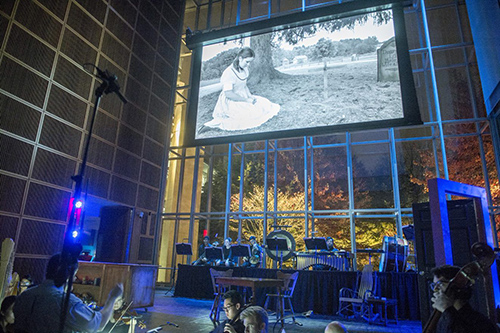
Dave Brooks’ set and lightning were minimal, yet effective: a door, various chairs, and a rolling countertop set the scene. Inda Blatch-Geib’s rural 19th-century German costumes were lovely, and the garments and headpieces for the birds were just right. Since English is often hard to understand in opera, supertitles would have been helpful.
 Gorgeous films tied the story together. Shot at Hale Farm and featuring the cast, these sepia-toned, silent scenes by Cleveland Institute of Art students Elena Beitzel, Ben Chapman, Maeve McNamara, and Taylor St. Andrassy — led by Jacob Koestler — clarified the plot, and delightfully added to its gory overtones. The image of Kennedy as the Father gleefully chowing down on his son won’t leave my mind for a long time.
Photos by Robert Muller.
Published on ClevelandClassical.com November 6, 2019.
Click here for a printable copy of this article
