


by Kevin McLaughlin
 Stop the presses! Half of the originally advertised program will be different, CityMusic’s managing director Henry Peyrebrune announced prior to their February 5 concert at Fairmount Presbyterian. Works by Elliott Carter and John Coltrane were postponed for another day and replaced by gentler pieces by Alan Hovhaness and Henry Cowell.
Taken as a whole, America @ 250: American Dreams, centered on a question shared by many American composers in the mid-twentieth century: how to write music that feels rooted, timeless, and personal without leaning too heavily on European models. The answers varied widely, from Ernest Bloch’s consciously historical gestures to Copland’s open, optimistic language.
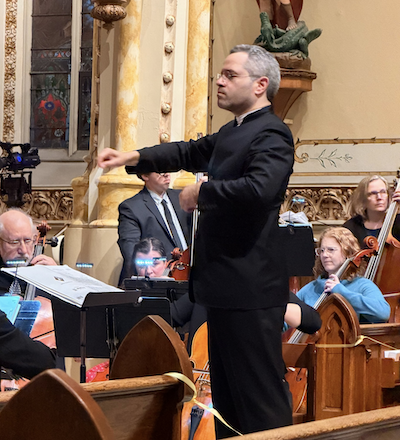
Guest conductor Andrew Grams, well known locally from his years as assistant conductor of The Cleveland Orchestra and his regular appearances in the region since, proved a congenial presence on the podium. His brief spoken introductions framed the music and kept explanations to a minimum. His informal manner suited the venue’s intimate atmosphere.
Alan Hovhaness’s Alleluia and Fugue (1940) opened the concert in a spirit of quiet devotion. Despite its formal title, the work unfolds simply, beginning with a chant-like first movement whose modal harmonies move slowly and unhurriedly. The music resists drama, favoring stillness and clarity of line. The concluding fugue brings motion yet remains light; the counterpoint accumulates gently. Grams’s remark that the piece was “not scary at all” proved accurate.
Hovhaness’s language stands apart from prevailing ideas of modernism, and his deliberately individual voice, untethered to European models, can sound unfashionable. CityMusic’s strings, an unusually cohesive ensemble, kept the surface calm, allowing the music’s austere, ancient qualities to emerge in both movements.
Ernest Bloch was represented by his Concerto Grosso No. 1, written at the Cleveland Institute of Music in 1924–25 during his tenure as director. Grams briefly recounted the work’s origin: Bloch conceived it in part as a message to students drawn toward newer musical trends. The work looks deliberately to earlier forms, combining Baroque models with twentieth-century harmony.
With clear, energetic direction from Grams, Bloch’s design and rhetorical sweep came into focus, and the contrapuntal writing emerged with confidence. The prominent piano part, played by Jiana Peng, served as the work’s spine, her articulation clean and precise. CityMusic’s strings drew energy from the music’s rhythmic drive, especially in the outer movements, where Bloch’s historical gestures gained added force from his harmonic language.
Henry Cowell’s Ballad followed the intermission — a three-minute warm bath, far removed from the composer’s experimental reputation. The piece unfolds as a compact lyrical statement, its melodies shaped by Celtic and Asian influences. The orchestra played it simply, letting the writing carry the effect.
Aaron Copland’s Suite from Appalachian Spring closed the program. Written in 1944 for Martha Graham and later arranged as an orchestral suite, the work remains one of Copland’s most persuasive statements — music that sounds unmistakably American, introducing overt quotation only with the appearance of the well-known Shaker tune “Simple Gifts.” Above all, the music conveys a sense of space: open harmonies, transparent textures, and rhythms that swing at an unhurried pace.
Grams shaped the opening pages patiently, allowing the music’s quiet expectancy to settle before the dance episodes gathered energy. CityMusic’s chamber-sized forces suited the score well. Clarinetist Dan Gilbert and flutist Laura Gilbert preserved its intimacy and kept textures clear. The variations on “Simple Gifts” emerged naturally from the surrounding music rather than as a set piece, and the final return to stillness provided a calm close to the evening.
An encore ensued — Leroy Anderson’s Fiddle Faddle, taken at a fearless clip.
Published on ClevelandClassical.com February 11, 2026
Click here for a printable copy of this article
