

by Nicholas Stevens
 Strange things happen to art amid mass violence. During World War II, Beethoven’s Ninth resounded at festivals in honor of mass murderers, who were proud to count the composer as a compatriot. Yet elsewhere, Allied soldiers were using the opening motif of Beethoven’s Fifth — three short notes, one long: Morse code for the letter V — to signify victory. So it was that, in 1943, the Nazis forced the musicians of the Theresienstadt concentration camp to perform Verdi’s Requiem for an audience of human rights inspectors, before shipping them off to gas chambers at Auschwitz. So it is that last week, CityMusic Cleveland honored the memory of those musicians and all of those lost in the Holocaust, with a performance of that very piece.
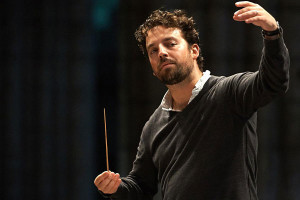
Verdi’s 90-minute setting of the Mass for the Dead occupied the entire program on Thursday, May 2, having drawn a capacity audience to the Maltz Performing Arts Center. A collaboration between the Temple-Tifereth Israel and CityMusic, the concert fell on Yom ha-Sho’ah, Holocaust Remembrance Day. CityMusic’s founding director James Gaffigan returned to the podium to lead four excellent soloists, the orchestra, and the CityMusic Cleveland Chorus in an astonishing performance.
Descending with solemn certainty, the cellos led the strings of the chamber orchestra — at times drowned out by the full-sized wind section — into the Requiem aeternam and Kyrie. These first movements afforded tenor Joshua Blue and bass Raymond Aceto opportunities to endear themselves to the audience, which they did with respectively supple and cavernous tones. Gaffigan pulled a thrilling din from the orchestra in the Dies irae, filling the acoustically tricky Maltz with the sort of Romantic terror that can make listeners levitate in their seats. The conductor too was literally borne aloft, reserving his most acrobatic gestures for Verdi’s operatic peaks and formal surprises. Here as elsewhere, the Chorus sang with admirable dynamic contrast, the sopranos’ and altos’ insistence matched by the tenors’ and basses’ enthusiasm.
Aceto’s solo in the Tuba mirum found him in villain mode, all glowering warnings and sepulchral richness. Mezzo-soprano Sasha Cooke, called in as a substitute at the last minute, sounded strong across her entire range in the Liber scriptus, bringing special gravity to the line “nothing shall remain unpunished.” Bassoonist Laura Koepke became an effective duet partner for Cooke, well-coordinated despite the physical distance between the two. Blue, Cooke, and soprano Chabrelle Williams each sparkled as soloists in the Quid sum miser, coalescing in striking unity at a crucial moment. The low brass, rooted by tubist Ken Heinlein, proved their mettle in the Rex tremendae.
 Blue showed off his sense of line and direction in the Ingemisco, building to ringing high notes with both passion and logic on his side. Gaffigan engineered the end of the Lacrimosa so that Brandy Hudelson’s low piccolo hovered above lush chords like mists over warm pavement. After a long Offertorio, the Sanctus, with its powerful trumpet section sound and intimations of darkness, came as a welcome change of pace. Percussionist David Luidens thundered on paired bass drums in the Lux aeterna.
Sometimes, the smallest moments of magic encapsulate an entire evening, and remind the listener of the fundamental allure of live performance. One such split-second act of collaborative alchemy occurred when a lovely tone from principal oboe Mary Kausek seemed to transform in midair into a rolled R at the start of one of Williams’s lines. Singing without a score, radiating conviction, and layering her gorgeous tone atop the orchestral sound like honey on warm bread, Williams brought the performance home with ardor, intellect, authority, and technical assurance. By the end of this concluding movement, a showcase for the soprano as well as all assembled, Gaffigan’s long pause amid silence felt earned — as did the ensuing applause.
Published on ClevelandClassical.com May 6, 2019.
Click here for a printable copy of this article
