

by Kevin McLaughlin
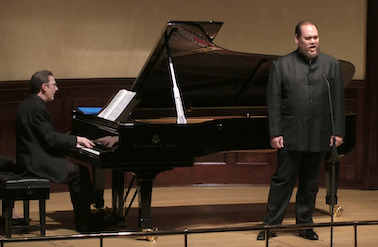 The Cleveland Chamber Music Society’s February 3 recital, presented by Hawaiian baritone Quinn Kelsey with pianist Craig Ketter, offered something both rare and reassuring: a major operatic singer heard up close, singing beautifully and without a lot of fuss.
They offered a program of early- and late-twentieth century American and English songs by Aaron Copland, Florence Price, John Alden Carpenter, Margaret Bonds, Gerald Finzi, and Ralph Vaughan Williams. From the opening notes of Copland’s “The Boatmen’s Dance,” Kelsey demonstrated a full, ringing voice that filled the room.
He brings the kind of vocal authority and humanity one associates with Verdi’s great father figures — Germont, Simon Boccanegra — calm, grounded, and humane. He has already established himself in opera houses around the world, largely in Verdi roles, and maintained that same ease across all twenty-eight songs including encores. He never forced his sound or pushed for effect, which was generous and reassuring, though slightly reserved.
Physically, Kelsey adopted a consistent, formal stage manner, recalling a grander era: standing at a quarter turn to the audience, one hand often in a pocket — sometimes both — or resting lightly on the piano. The stillness projected calm and patience and seemed a strategy supporting relaxed vocal production. In more romantic songs — Finzi’s “Come Away, Death,” for example — that reserve occasionally worked against emotional immediacy, the song’s quiet grief remaining dignified rather than urgent. Yet the lack of obvious ardor could also be persuasive: in Vaughan Williams’s “Bright Is the Ring of Words,” the singer waits, and the listener eventually yields.
That same self-containment was also an asset in the five selected Old American Songs of Copland. “The Boatmen’s Dance,” which opened the recital, arrived with striking poise. In “The Dodger” — a nineteenth-century satirical song — the humor remained understated, more wry than playful. Simple Gifts was shaped with formal seriousness, the line carried by impeccable diction — nota bene young singers: separate your t’s between “gift” and “to.” “Long Time Ago” unfolded like a prayer, one chord per bar, with quiet, reverential gravity.
Craig Ketter proved an ideal collaborator throughout — supportive, alert, and tasteful, enhancing and responding to the singer’s will without surrendering expressive territory of his own.
The program’s center of gravity came with the Langston Hughes settings. In Florence Price’s “Songs to the Dark Virgin” and “My Dream,” Kelsey held the audience close, singing simply and often quietly, allowing the poetry to carry much of the expression. In Margaret Bonds’s Three Dream Portraits, the power of the text narrowed the focus. In “Minstrel Man,” Kelsey and Ketter allowed the cost of the poem’s performative happiness to emerge without exaggeration, while “I, Too” was delivered plainly and powerfully, as a credo of endurance.
John Alden Carpenter’s Four Negro Songs comes from an early moment when jazz and blues were beginning to find their way into American art song. Kelsey acted as a guide, letting the syncopation and blues inflection — and whatever weight lay in the poetry — speak for themselves.
The English songs after intermission lifted the recital to yet another level. In Gerald Finzi’s Let Us Garlands Bring, phrases felt less shaped, each note gently sustained and colored. Kelsey’s baritone was especially touching here, his upper notes floating easily, his singing a comfort. At the piano, Ketter was note-perfect — emotionally engaged, but never drawing attention away from the vocal line. The partnership could not have been more in sync.
Ralph Vaughan Williams’s Songs of Travel closed the program, and here the performers’ restraint came most clearly into focus. The cycle traces a journey from youthful freedom to reflective farewell, but this performance lingered largely in the latter territory. The emotional temperature remained contained; what impressed — and it was impressive — was the equipoise, not the fervor. The approach brought clarity and control, even if moments of youthful vigor or romantic ardor were less strongly felt.
When the final song ended, the audience sat in silence for several seconds before the applause began — warm and sustained, garnering not one but two encores: “Goin’ Home,” the spiritual adapted from Dvořák’s New World Symphony, and “Warm as the Autumn Light” from Douglas Moore’s The Ballad of Baby Doe.
Published on ClevelandClassical.com February 9, 2026
Click here for a printable copy of this article
