


by Mike Telin
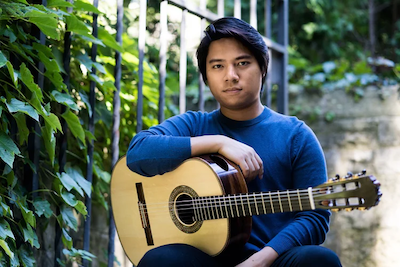 “I’m so honored to be making my Cleveland debut — I love the city,” Guitarist An Tran said during a Zoom conversation. “I’ve been there twice. The first time was to go to the Rock & Roll Hall of Fame. The second time was for the Cleveland International Classical Guitar Festival in the summer — not to play, just for fun. And now, I finally get to play there.”
On Saturday, March 7 at 7:30 pm at the Maltz Performing Arts Center, The Cleveland Classical Guitar Society continues its International Series with program by Chicago-based, Vietnamese guitarist An Tran. Tickets are available online.
Mike Telin: How did you find your way to the classical guitar?
An Tran: I was eight years old. My cousin was playing the guitar, and he was showing me Metallica songs.
I was very lucky to have the parents I did. I was not very good in school so they had me do a bunch of things like playing the piano, singing, playing tennis, to see if I was interested in anything. But I was only listening to my cousin play the guitar. I thought that was so cool.
Then I started taking lessons with the same teacher. In school there was only classical guitar, but that seemed natural to me. Everything kind of clicked, so I progressed very fast. I just fell in love with it.
MT: Was this in Vietnam?
AT: Yes, in Hanoi. I moved to the United States as an international student when I was fifteen years old.
MT: Were there a lot of classical guitar players in Hanoi at that point?
AT: The guitar is very big in Vietnam. A lot of people play it. There are guitar clubs in every university, and every time I go home to give a concert it sells out very quickly. I’m very happy to see that it is an instrument that people love.
MT: Tell me about your program. It’s like a United Nations of composers.
AT: Cleveland will be the first concert of my upcoming tour — and I’m going to give world premieres of a bunch of pieces on my new album that features twelve works that were written for me. They are just gorgeous, and I’m so honored to be able to be the guitarist that plays this music. That’s why the album and the tour are called Illumina, because we’re shining lights into this new music and into these composers.
MT: Please tell me about the composers and their pieces.
AT: Paul Ibbotson is a British composer who wrote two pieces for me. Prelude gets the people into the soundscape of the guitar. The second is called Little Dancer. The story is that Paul sent me this piece that had no title. He said it was inspired by his time in Granada, Spain.
When I was practicing it my daughter, who was two at the time, started dancing. I thought, she doesn’t dance to any of my music. I told the composer about it, so he named it Little Dancer.
In fact the pieces in the group of three — Little Dancer, Bella di Papa, and Ana Lucia — were not written for me but for my daughter. Her name is Ana Lucia.
The next is by Sara d’Ippolito Reichert, who’s a wonderful friend and wrote Bella di Papa. It’s about the relationship between her and her father, who unfortunately passed away last year.
Ana Lucía is by Olga Omelkhina Vera. It’s about the craziness of a two year old. There’s the very beautiful nap time and play time, and the craziness of a cranky tantrum. So there’s all this emotion in a five-minute piece.
It’s very difficult and I think she meant it to be because when I play it, I physically feel like I’m going through all these emotions.
Juan Erena is from Spain. He wrote Find You Again for me, and it’s inspired by my hometown of Hanoi. He’s been there, and remembers all the beauty, the chaos, and the traffic.
I end the first half with his Amanda — a very fast-paced piece. Amanda is the composer’s friend who quit her corporate job in Madrid and moved to Cadiz in southern Spain. She built her own house and has her own farm with horses. She has her own concert series on the farm. The piece is about quitting the daily routine to be free to do whatever she wants to do. It’s very virtuosic and fun to play.
MT: The second half is all music by Vietnamese composers.
AT: I’ll start with The-An Nguyen’s The Legend of the Bamboo Child. It’s fourteen minutes long and is one of the major Vietnamese works in Vietnam. It’s an amazing piece to play live because people just love the whole story of Vietnamese culture.
I’m also playing his Lullaby, which is also a special piece that he wrote for me. It’s very emotional. The composer is a well-known guitarist in Vietnam and I grew up listening to his albums.
He lives in Toronto now, and when I had a debut in Canada, I asked him if he could write me a piece that I could premiere at the concert. He said, what do you want me to write? So I looked at my repertoire and thought, I don’t have a lullaby. So I asked, do you think you can write me a lullaby?
The melody is from his memory of how his mom used to sing to him. Unfortunately his mother passed away while he was writing the piece. It’s supposed to be a regular lullaby of a mother singing to her child. But because his mom passed away he could no longer keep going in that direction because he felt the pain. That’s why the second half of the piece is more meditative and reflective.
I love to play it live because it reflects Vietnamese culture. He tried to imitate the đàn tranh, which is a 16-string zither. So there’s a lot of bending of notes and certain things that we have to do to imitate that instrument.
The next two pieces are from my new album by the Vietnamese composer Khiem Nguyen-Duy. The first, Toccata on Ly Keo Chai, is a traditional Vietnamese folk song from the south of the country. It’s very fun and virtuosic. The folk song is about a drunken fisherman.
The next is Variation and Fugue on the theme of Đường Em Đi which is also from the south but from the Sedang tribe. The composer used the melody and made it into a ten-minute piece. There’s different variations on that theme as well a fugue. It’s very crazy, and by the end you know the theme very well.
I think it might be the first fugue ever written by a Vietnamese composer — I don’t know of another. That will also be a world premiere.
The last piece is Central Highlands of Vietnam by Đặng Ngọc Long. It’s like a musical painting of that region. It has a lot of technique that is fun for the audience to see at the end.
MT: It is great to have a program with so much Vietnamese music.
AT: My manager always says that it’s risky to do this kind of programming. But I feel like it’s my mission, my calling to do it, because there’s so much great music from my country.
MT: You also have your own nonprofit.
AT: It’s called Chicago Artopia and it’s me, my wife, and her sister. We all live on the southwest side of Chicago next to Midway Airport.
MT: What made you decide to create it?
AT: What happened was I was touring — playing a bunch of concerts — and doing all sorts of educational activities. When I came home I said, you know, it’s so great. I was doing all this stuff and the kids loved it. And my wife said, why can’t we have that in Chicago? And I thought, why not?
We write grants, and ask for donations to make a concert season and bring world-class musicians from everywhere — China, Russia, France, the U.S., Chicago, — to play and it’s absolutely free for the community.
We also take the artists to local schools to play for the kids because they don’t get this kind of exposure in this area — it’s mainly an immigrant community. But we want them to have access to world-class art and music and not have to worry about buying tickets.
Published on ClevelandClassical.com March 4, 2026
Click here for a printable copy of this article
