



By Kevin McLaughlin
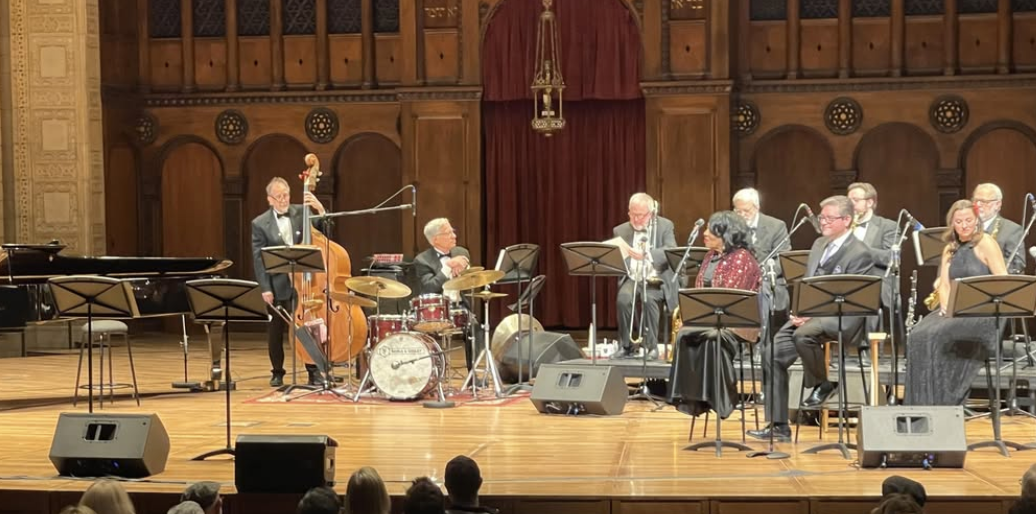 On Saturday at the Maltz Performing Arts Center, the Cleveland Jazz Orchestra and The Musical Theater Project offered a timely reminder: Hoagy Carmichael wasn’t just the composer of “Stardust.” He was one of America’s great musical storytellers — a songwriter with a midwestern plainness that could turn suddenly tender, funny, or wise in the space of a single line.
Star Dust: The Songs of Hoagy Carmichael, part of the two organizations’ tenth season of collaboration, folded biography and performance into a single leisurely program. The format has become a signature of these shows: songs set in context by narration, supported by projected slides and film excerpts. Here those visuals — Carmichael portraits, footage of Carmichael in motion, stills from To Have and Have Not (1944) and The Best Years of Our Lives (1946) — were discreet, and perhaps too few. But they reinforced the point that this music came from a particular life, and a full one.
Carmichael (1899–1981) wrote several hundred songs and scored dozens of hits, but he also made a second career in film — which helps explain why so many of his best numbers feel like miniature scenes. Even at their simplest, they arrive with a setting: a porch, a midnight street, a room you can picture without being told.
Bill Rudman, writer, co-host, and founder-director of The Musical Theater Project, anchored the evening with his script. Along with Paul Ferguson, Jack Shantz, and Joe Hunter, he worked biographical detail and quotations into the program without pedantry, never overshadowing the music. Rudman knows his way behind a microphone. He offered information the way good hosts do — as a confidence, not a lecture. He even sang a bit himself (“Small Fry”), a modest gesture that suited the show’s collective spirit.
The biographical arc was one of the evening’s pleasures. Carmichael’s early life, as Rudman told it, was marked by a kind of show-business proximity. He was named after it — his parents called him “Hoagy” after a traveling troupe known as the Hoaglands, who had stayed at the Carmichael house during his mother’s pregnancy. It was an origin story with just enough Americana in it to feel like a Carmichael (or Johnny Mercer) lyric.
At Indiana University, Carmichael earned his bachelor’s degree in 1925 and a law degree by 1926, but the legal route never held him. Music did. He had learned piano from his mother, with whom he was close, and whose own playing in dance halls and movie theaters formed part of his musical inheritance. That blend — the formal and the vernacular — never left him.
Rudman also underscored the Indiana undergrad’s early connection to Bix Beiderbecke, whom Carmichael met in 1922. Beiderbecke’s Wolverines recorded Carmichael’s original “Riverboat Shuffle” in 1924, placing him early in the stream of jazz history. Later, Carmichael would become something else again — not merely a jazz composer, not quite a Tin Pan Alley craftsman, but a songwriter with a personal accent that fit nearly any setting.
Paul Ferguson — co-host, artistic director of the Cleveland Jazz Orchestra, trombonist, and arranger of most of the evening’s music — directed the CJO with an instinctive feel for the repertoire. His arrangements kept the feel buoyant and the texture interesting; the orchestra responded with polish and warmth.
Tight-muted brass and a finely balanced sax section did their share of the storytelling, while Jack Shantz’s trumpet solos were tasty and inventive — fully at home in the period style. There was real affection in the ensemble’s playing, and not just out of nostalgia.
The evening’s main drawback was an air of low energy that lingered. The Maltz is a space that seems to dissipate energy rather than concentrate it — and the format contributed as well. With some twenty-seven songs (a few apparently added impromptu), the program ran long, and some numbers, limited to a single verse or chorus, felt more like placeholders than fully committed choices. In a show built on story and personality, one wished the vocalists had been used more fully — allowed to inhabit a lyric, take a second pass, extemporize, build an arc. They had the tools, and the audience would gladly have followed.
The speaking portions varied in effectiveness. Rudman’s writing and delivery were strong, and Jack Shantz’s plain reading of Carmichael’s words added welcome authenticity. But much of the narration fell to band members who, though earnest, rarely sounded at ease in it — script in hand, they struggled to animate the voices and anecdotes that the evening depended on. The one clear exception was Joe Hunter, who carried Carmichael’s spirit as naturally at the piano as in speech and song.
In solo turns like “Moon Country” and “My Resistance Is Low,” his delivery had a front-porch directness. In “Washboard Blues” Hunter supplied a modest showstopper with his washboard technique — a touch of vaudeville that fit Carmichael’s world. But this moment of theater sealed it: the surprise washboard virtuosity and Hunter’s eye contact turned “Washboard” into a scene.
Erin Kufel Keckan, a polished interpreter of American songbook material, sang “Stardust” (1927) with affecting grace and close attention to the text. Rudman’s script included the famous detail about the song having been recorded more than 1,500 times in forty languages. He added a wrinkle — that Mitchell Parish supplied the lyric at the publisher’s behest — a reminder that even classics can arrive by committee. Keckan, meanwhile, trusted the song’s simplicity. As she began, listeners seemed to lean forward, as if everyone knew the melody by heart but wanted to hear how she would tell it.
Evelyn Wright also demonstrated a fine ear for a song’s meaning in both “The Nearness of You” and the less familiar “I Get Along Without You Very Well.” The latter is a song of self-deception — a narrator declaring independence even as she lingers over the memory she claims to have outgrown. Wright’s calm made the sadness sharper: the narrator insists she’s fine while quietly demonstrating the opposite.
Michael Shirtz sang with a smooth tenor and easy, unforced technique. His relaxed manner and legato recalled the great Mel Tormé, and an anecdote shared afterward made the connection clear: Shirtz’s grandfather led a big band that once featured Tormé. Shirtz comes by the velvet naturally.
The concert proved Carmichael’s scale: a long career, a restless imagination, and a gift for writing songs that still sound like human speech set to melody. “Stardust” may have been the centerpiece, but it was not the point. Walking out, you had the feeling that Carmichael’s essence was never glamor but talk — ordinary American talk — warmed and wry enough to sing.
Published on ClevelandClassical.com January 25, 2026
Click here for a printable copy of this article
