



by Stephanie Manning
 This article was originally published on Cleveland.com
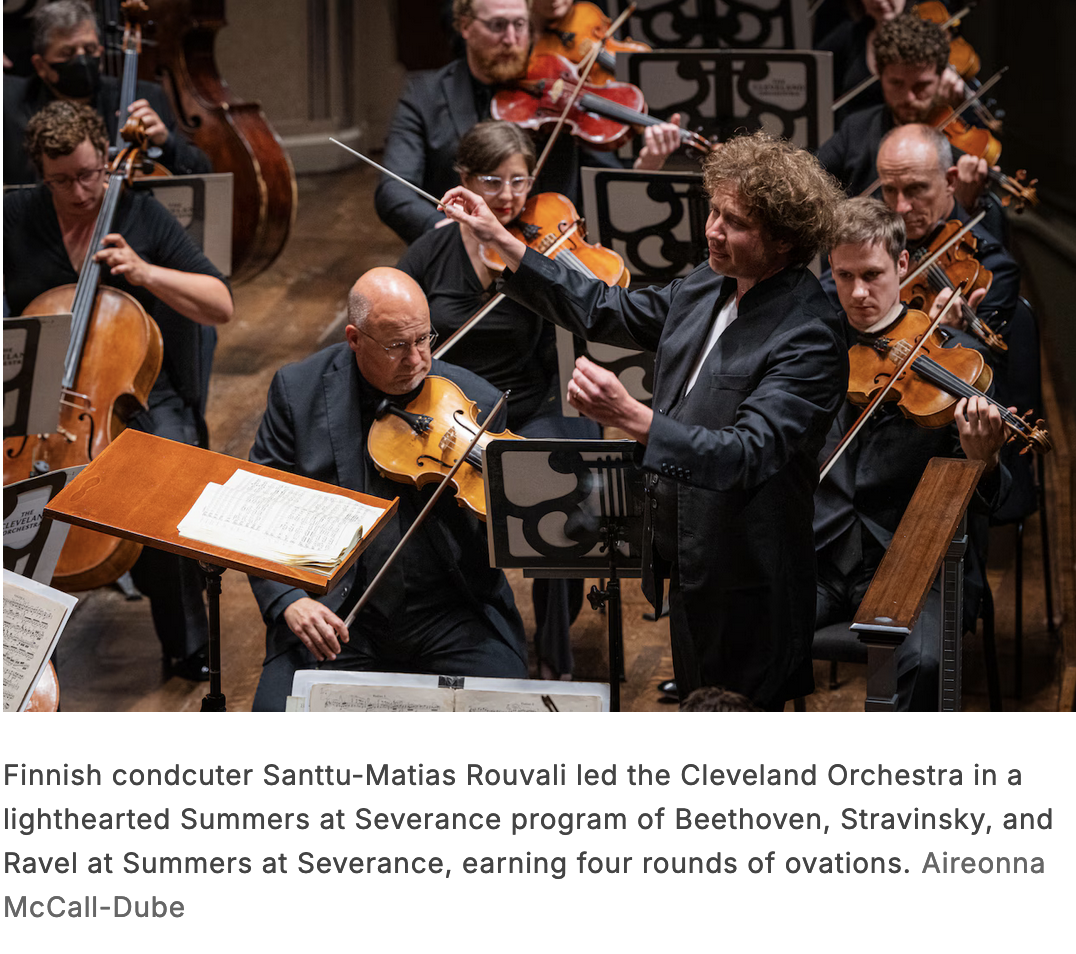
CLEVELAND, Ohio — Santtu-Matias Rouvali has only led the Cleveland Orchestra twice, but he’s already established a formula that works. The Finnish conductor skillfully matches his programs to his conducting style — whimsical, sparkling, and humorous, while remaining precise and rhythmic.
The approach meshes well with the orchestra, who easily responded to Rouvali, just as they did during his debut last fall. On Thursday, July 17, a trio of works by Beethoven, Stravinsky, and Ravel made for a lighthearted evening on the Summers at Severance series.
Nowhere was Rouvali’s magic more evident than in Igor Stravinsky’s Jeu de cartes. The wild card of the program in more ways than one, this lesser-known ballet by the Russian composer depicts an actual card game, where the mischievous Joker is eventually defeated at the end of three rounds. The conductor kept things moving briskly during the brass fanfare that opens each “Deal,” symbolizing the shuffling of the cards.
With its constantly changing meters and brief but important woodwind solos, the music is characteristically Stravinsky, although much less angular than his earlier ballets like The Rite of Spring. Still, when the prideful Joker eventually gets his comeuppance during the “Battle Between Spades and Hearts,” every orchestral accent felt like a lightning strike.
Together, the musicians and conductor shuffled between the different tempos with both tongue-in-cheek levity and pinpoint accuracy. Rouvali, who is also a percussionist, has a finely tuned sense of rhythm, and his gestures here looked just as straightforward as they did in the Classical era symphony that preceded it.
That symphony — Beethoven’s Second — opened the evening by highlighting the conductor’s penchant for musical flourishes. This effect comes off as charming rather than flashy — so watching him work is fun, not distracting. The musicians made the most of the accelerating tempos and crescendos during this playful piece, which is remarkably sunny considering Beethoven’s turbulent emotional state at the time of its composition.
Rouvali’s slower tempo choices somewhat bogged down the Symphony’s first movement, although slower tempos served him well during Maurice Ravel’s Suite No. 2 from Daphnis et Chloé, where he luxuriated in its long arcs of buildup and release. From the stunning sunrise to the eventual celebratory dance, lush string soundscapes abound — and Rouvali let the Orchestra’s world-class string section do what they do best.
In this ballet, Ravel evokes the pair of mythological lovers in the stylized world of ancient Greece. Its magical, extended flute solo was delivered sweetly by Jessica Sindell. This transfixing moment of creation — depicting the god Pan crafting a panpipe from reed stalks — resonated perfectly in the hall, and Sindell was deservingly acknowledged first during the applause.
One of the rare romances from Greek mythology to have a happy ending, the story of Daphnis and Chloé eventually blossoms into the third movement dance, where Rouvali unleashed the brass and percussion in full force. If the four rounds of ovations that followed are any indication, this memorable conductor will be greeted quite enthusiastically when he returns in April 2026.
Published on ClevelandClassical.com July 24, 2025
Click here for a printable copy of this article
