


by Kevin McLaughlin
 This article was originally published on Cleveland.com
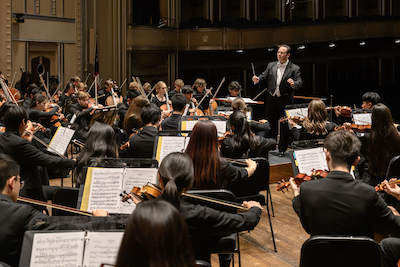
CLEVELAND, Ohio — The Cleveland Orchestra Youth Orchestra and Youth Chorus filled Mandel Concert Hall on February 22 with music that asks for breadth of sound and steadiness of purpose. Under the direction of James Feddeck, the young musicians took on three grand and optimistic works: Camille Saint-Saëns’ Symphony No. 3, “Organ,” Antonín Dvořák’s Te Deum, and Howard Hanson’s Song of Democracy. They met them well and, at key moments, with real poise.
The first half was given over to the Organ Symphony, a work that requires patience at the beginning and nerve at the end. Feddeck kept a steady hand on its lengthy span, easing the introduction forward, then letting the first Allegro gather force. A quicksilver flick in the strings — bows skating near the tip — sent a current through the texture. Organist Hunter Peterson added depth to the second movement, and drama in the Maestoso of the finale when a full organ, C-major chord abruptly filled the hall.
The orchestra remained unified and unhurried, attentive to small turns of phrase even as the final bars broadened into a full blaze. Feddeck shaped the opening pages with care, keeping textures transparent and tempos moving forward. The Youth Orchestra’s strings produced a dark, blended sound in the slow introduction, while the winds and brass handled their exposed passages with confidence.
After intermission came Howard Hanson’s Song of Democracy, composed in 1957 to a text by Walt Whitman, a paean to American optimism. Hanson, long associated with the Eastman School of Music, wrote in an expansive, tonal idiom at mid-century, unswayed by prevailing serial currents.
The piece sets Whitman’s text with broad choral writing and glowing orchestration. The Youth Chorus sang with conviction, particularly in the declamatory passages when the poet’s lines call for collective affirmation. Feddeck allowed the climaxes to bloom without losing clarity of text — a balance not easily achieved in Whitman’s long phrases.
Dvořák’s Te Deum, written in 1892 for his first season in New York, rounded out the program. A compact, forthright work, it turns quickly from radiance to shadow. French soprano Juliette Tacchino sang with a clear, silvery tone and steady dramatic focus. Baritone Emilio Vasquez offered a firm, well-carried line, warm at the center. In “Tu Rex gloriae” the soloists rose easily over chorus and orchestra, their voices meeting cleanly. Feddeck kept the harmonic shifts supple, and the closing fugato gathered without strain, chorus and orchestra united in pulse and text.
The Cleveland Orchestra Youth Chorus, prepared with obvious care by Director Daniel Singer, entered with focused, unified delivery in the opening “Te Deum laudamus,” projecting the Latin text and its meaning clearly. Feddeck maintained buoyant rhythms in the central movements, even as the music shifted from devotional gravity to bright, dance-like energy.
Any moments of strain were small beside the ensemble’s larger achievements. What stayed with the listener was the commitment of these young musicians to repertory that asks them to think beyond themselves.
There was something genuinely moving about looking into the faces of the young chorus as they sang Whitman’s words:
“Sail, sail thy best, ship of Democracy,
Of value is thy freight, ’tis not the present only,
Thy Past is also stored in thee.”
The same seriousness could be heard in the orchestra — in the strings’ dark blend at the opening of Saint-Saëns, in the winds’ poised playing, in the long patience of Dvořák’s closing fugato.
For musicians still in formation, that sense of scale and self — musical and historical — is no small accomplishment.
Photo by Yevhen Gulenko
Kevin McLaughlin is the former Library Director at the Cleveland Institute of Music. A freelance writer and editor, his weekly podcast on early jazz, “At the Jazz Band Ball,” can be found on a variety of podcast platforms.
Published on ClevelandClassical.com February 26, 2026
Click here for a printable copy of this article
