



by Mike Telin
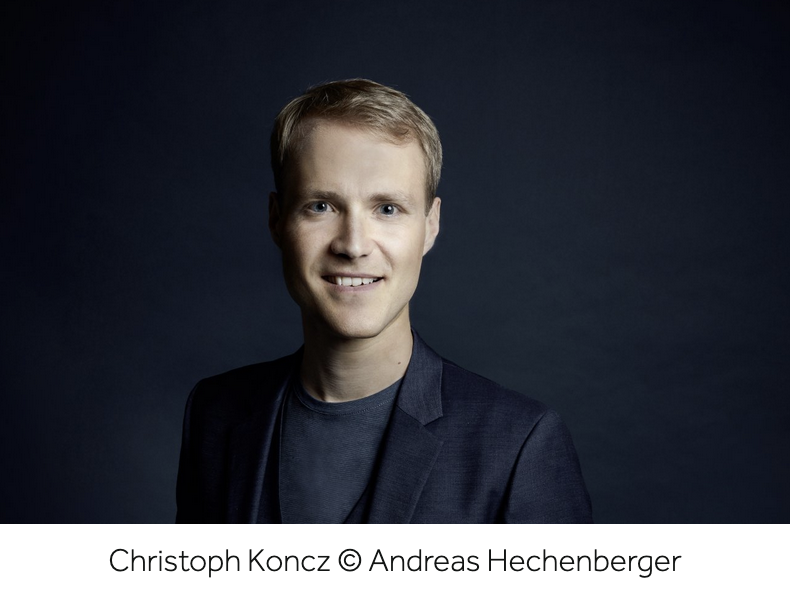 On Thursday, July 31 at 7:00 pm at Severance Music Center, conductor Christoph Koncz will make his debut with The Cleveland Orchestra in a Summers at Severance program featuring the music of Franz Liszt, Ernst von Dohnányi and Bela Bartók.
Due to his travel schedule we were unable to schedule an interview, but he graciously agreed to answer questions by email.
What does making your Cleveland Orchestra debut mean to you?
Of course it is a great honor for me to conduct The Cleveland Orchestra, one of the world’s leading ensembles with its wonderful and distinctive sound. I have been admiring the orchestra for a long time and heard them live on several occasions when they came on tour to the Vienna Musikverein. I remember a particularly touching performance of the Brahms Requiem conducted by Franz Welser-Möst. I’ve already met quite a few musicians of the orchestra and I am very much looking forward to making music with this phenomenal ensemble!
You’re bringing a beautiful program. How did you go about selecting the pieces?
This concert’s repertoire resonates wonderfully with my personal background. I grew up in Vienna, but I am also half-Hungarian. as my father was born in Budapest. Historically there were several Hungarian conductors who were essential in shaping the great American orchestras, such as George Szell’s legendary 24-year-tenure at the Cleveland Orchestra just after the Second World War. Interestingly, Szell was born in Budapest, but spent most of his childhood growing up in Vienna, the monarchy’s capital at the time.
Please give me your thoughts on each of the works you’ll be conducting — Liszt’s Les préludes, Ernst von Dohnányi’s Symphonic Minutes, and Bartók’s Concerto for Orchestra.
Franz Liszt is another great example of the close cultural ties between Austria and Hungary. Particularly important in popularizing Hungarian music in the 19th century, Liszt was born in the small village of Raiding which is nowadays part of Austria. Aside from his phenomenal success as a pianist, he was very important in establishing the so-called New German School and he invented the symphonic poem: single-movement works with a free-form concept. Les Préludes was one of the first symphonic poems he completed and has become his most popular.
Ernst von Dohnányi was a child prodigy as a pianist and composer who was admired by the likes of Johannes Brahms. He became one of the most influential figures in Hungarian musical life as a composer, conductor and pedagogue. The Symphonic Minutes were premiered in 1933, celebrating the 80th anniversary of the Budapest Philharmonic Orchestra which Dohnányi conducted. The Minutes consist of five short movements in contrasting moods, at times very virtuosic in the outer movements and reflective in the inner movements. His mastery of motivic and variation technique hints at his idol Brahms. Dohnányi moved to the United States at the end of his life, teaching at Florida State University. One of his students was his grandson, the great German conductor Christoph von Dohnányi, who is Music Director Laureate of the Cleveland Orchestra.
We will conclude the concert with Béla Bartók’s masterpiece, his Concerto for Orchestra. It was one the last works Bartók composed, written under difficult circumstances. At the time he emigrated to New York during the Second World War, his works were hardly known in the United States and he was unfortunately already gravely ill. A commission by Serge Koussevitzky gave him renewed strength and the resulting Concerto for Orchestra has become his most famous composition today. True to its title, it really is a concerto for the whole orchestra with solos for all its sections, a mixture of Hungarian folk music, impressionist nocturnal colors, and of course the brilliance of the great American brass sound, a wonderfully virtuosic and attractive piece.
I have enjoyed reading about your interesting career path. Was it ever calculated or did it simply evolve?
I come from a musical family — my parents and both my siblings are professional classical musicians. As the youngest of them it just seemed like the most natural thing in the world for me to make music as well. My favourite pastime as a toddler was sitting in the orchestra rehearsals of my father, a conductor. Apparently I made it very clear to my parents that I wanted to play the violin, and I received my first instrument as a gift from my grandparents at the age of 2-1/2. I started having regular lessons as a four-year-old and from then on everything evolved naturally, for which I am extremely grateful.
Was it difficult when you realized that you could no longer continue as principal second violin of the Vienna Philharmonic while pursuing a conducting career?
My fifteen years with the Vienna Philharmonic were like a treasure to me. I enjoyed every moment. Regularly working with virtually all the world’s great conductors and experiencing the vast repertoire of the Vienna State Opera with its fantastic singers, plus having the unique Viennese sound of my wonderful colleagues always around me — all this was a constant source of fascination and inspiration.
From childhood, I have always been interested in conducting and began my studies at the Vienna University right after graduating from high school. After having passed my probation at the Vienna Philharmonic, I looked for opportunities to perform as a conductor which gradually became more and more frequent and interesting.
When I was appointed music director of the Orchestre National de Mulhouse in France, I realized that I would not be able to continue being an orchestra musician in addition to my conducting engagements, and I decided to give up my position in Vienna in 2023. But luckily I have already had the pleasure of conducting my former colleagues on several occasions and I am returning to the Vienna State Opera to conduct a series of performances of Don Giovanni in the fall. Making music with my colleagues always makes me feel like I’m coming home!
How does being an accomplished violinist — modern and Baroque — inform your work as a conductor?
There are many different paths to becoming a conductor, from being a concert pianist, instrumental soloist, orchestra musicia, or singer to composer or musicologist. Of course my background as a violinist in different roles — as a soloist, chamber musician or orchestra musician in both symphonic and operatic — is very influential in all my artistic views, as is the orchestral culture and tradition I experienced in Vienna.
However, as a conductor you gain an even broader horizon and you need to be emphatic with all the singers and instrumentalists you collaborate with in order to decide who needs which sort of input at which moment. I always search to create a close bond with the orchestra musicians, which lets us all experience the intensity of the music together, in communion with the audience. I believe this potential emotional unity is one of the strongest virtues of classical music.
It’s fascinating that you played the role of Kaspar Weiss in the movie The Red Violin. Do you think that acting may be in your future?
The Red Violin is a wonderful Canadian film by François Girard describing the life of a fictitious violin over the course of 300 years. The great American composer John Corigliano won an Academy Award for his film score. At the age of nine I played the child prodigy Kaspar Weiss, a Mozart-like violinist in 18th-century Vienna. I spent four weeks on set and it was of course a fascinating experience to see how a movie is produced.
However, even as a child it was clear to me that I only participated in this movie because it is about classical music. In fact, the first rounds of casting my role consisted only of playing the solo pieces by Corigliano, which were quite challenging for a nine-year-old! Only in the final round did the director actually ask me to act.
François Girard has a keen interest in Classical music and has gone on to stage quite a number of operas. When I conducted the Orchestre Métropolitain de Montréal last February, François reached out to me and we spent a fantastic time reminiscing about our experiences. It was the first time I met him since having grown up!
Published on ClevelandClassical.com July 28, 2025
Click here for a printable copy of this article
