


by Nicholas Stevens
 Much like genres, names of arts organizations constitute a sort of contract between artist and audience: mislabel something at your peril. The shouting that greeted The Rite of Spring at its debut offers an example. Patrons had paid for a nice evening at the Russian Ballet, and instead watched as dancers stamped all over the floorboards — and their expectations — to an insistent beat. All this to say that when the founders of fp (fresh perspectives) Creative named their classical and new music venture, they implicitly promised that their offerings would represent the best kind of break from convention. Last week, the call of a trumpet heralded a fulfillment of terms.
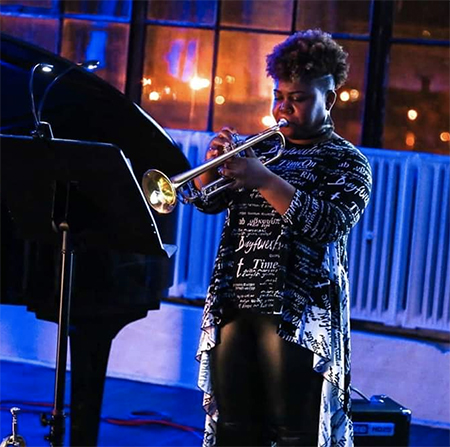
Assertive but no fanfare, the sound that approached listeners from a hallway of Snap House Studios on Thursday, January 23 arrived in the performance space in the form of guest curator and high-brass soloist Theresa May. The composition: Miles per Hour, a many-sided homage to Miles Davis by writer and composer Regina Harris Baiocchi. The visual experience: May, a Clevelander at home in many styles, unfurling arching phrases in velvet vibrato in front of unexpectedly haunting animations by Patrick Stoops. The acoustic: quite live, unsurprising given the large, hard-walled space and the solo instrument of choice. The atmosphere: electric.
May’s program focused on music by living African American composers, but it was a piece by a departed musician, Richard Peaslee’s Nightsongs, that brought the soloist her first opportunity to show off her gorgeous flugelhorn tone. It also brought her and pianist Megan Denman closest to jazz harmony. At first supplying a thrumming line under May’s melodies, Denman later lent sparkle to a series of thick chords. Switching to trumpet, May also switched moods — yet the contrast between her instruments, not always so neatly mapped onto particular emotional states, became a contrast between soaring and striving.
Next came a series of short pieces, written for May and for this occasion by Californian composer Ahmed Alabaca. In Cleveland for his first time, Alabaca supplied helpful introductions to each composition. The first, Were You There, brought hornist Van Parker and trombonist Devin Roark into glowing harmony with May. The second, Little Dance, initially a commission for a Rwandan children’s choir, exuded joy and gave each player a chance to play a solo over looping chords. Blue reintroduced Denman at the piano and gave Parker chances to soar, but May stole the show from the first.
Back on flugelhorn and equipped with an echo-inducing loop pedal, May led the entire group plus tenor Matt Jones into Alabaca’s free adaptation of Rachmaninoff’s Vocalise, complete with new introductory chant. Jones, who stepped in days before the performance, held his own amid the clouds of brass harmony and wisps of piano, his tone strong and his top notes cutting through with conviction.
The same ensemble remained onstage for a final piece by organist and composer Buck McDaniel, a fixture of Cleveland’s new music scene. Having remained long enough to attend before moving out of town, McDaniel introduced I Want to Die While You Love Me, his setting of the eponymous poem by Georgia Douglas Johnson. Bright, fluid streaks of sound leapt from Denman’s piano as biting chords grew from the brass players’ corner. Jones entered confidently and never backed down, maintaining a characteristically lovely tone. The work, like May’s performances and the evening as a whole, was enough to leave any listener feeling, well, refreshed.
Published on ClevelandClassical.com January 28, 2020.
Click here for a printable copy of this article
