


by Stephanie Manning
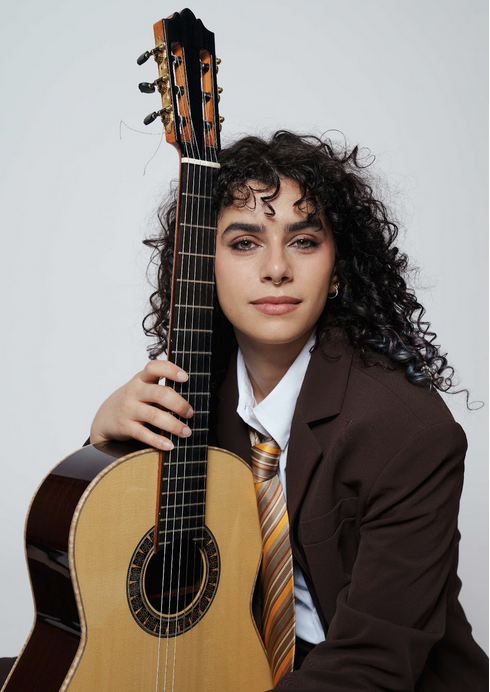 When an artist is on tour for months at a time, it can be hard not to feel homesick. Leonela Alejandro knows that experience well. Her current cross-country tour — celebrating her win at the 2024 Guitar Foundation of America International Concert Artist Competition — began in September and continues through next May.
That’s a lot of time away from Puerto Rico, where the 25-year-old guitarist grew up and began her musical education. So, as she explained to the audience at the Maltz Performing Arts Center on October 25, her Cleveland program brought a little bit of her home country with her. Presented by the Cleveland Classical Guitar Society, Alejandro’s local debut brought out her most engaging abilities as a performer, making the case that she is a young artist to watch.
The guitarist made Puerto Rico an integral part of her program with a three-piece set of music by Leonardo Egúrbida, Juan Sorroche, and Ernesto Cordero. From Egúrbida’s jaunty Valse en la menor to Sorroche’s nostalgic and tender Romanza, Alejandro clearly felt at home in these pieces — particularly Cordero’s Pregunta, where her longing felt almost palpable.
Between pieces, Alejandro casually leaned over her guitar to share her thoughts with the audience, her relaxed and personable manner of speaking succinctly describing the music and her connections to it. Noting that audience members often find Leo Brouwer’s Variations on a Theme by Django Reinhardt to be a bit confusing, she described the three-note motif to listen for and why she paired it with an arrangement of Reinhardt’s own Nuages.
Nuages provided a brief interlude for Alejandro to dip her toe into a jazz style, her head swaying as she had fun with the arpeggios. This choice of piece didn’t completely illuminate Brouwer’s abstract work that followed, but the pairing flowed smoothly, with both piece and performer turning contemplative by the end of the Variations.
Paulo Bellinati’s Un Amor de Valsa, which opened the evening, also emphasized Alejandro’s touch for the wistful. Her calm tempo made the piece sound like the perfect backdrop for a rainy afternoon, one perhaps spent sitting in a cafe while listening to the overlapping conversations. In the other Bellinati piece, Coco de Alagoas, she began the opening section as quiet as a whisper, eyes occasionally glancing upward as she concentrated.
The audience stayed reverentially quiet during “Nenia,” the second movement of Mario Castelnuovo-Tedesco’s Tre Preludi Mediterranei, where Alejandro experimented with a somber, wider vibrato. But the third movement, “Danza,” quickly turned celebratory, and she kept her fast playing in time with her breathing as she approached the end.
Meanwhile, Ronaldo Miranda’s Appassionata vacillated between these peppy and somber moods, with fast sections that felt energetic but not overeager.
The one major shift away from the Americas and Europe occurred at the top of the second half with a piece by the 20th century Japanese composer Tōru Takemitsu. Alejandro’s performance made a strong case for Equinox, a mysterious piece where Takemitsu characteristically plays with silences and dissonances. The guitarist then told the audience about why she loves the composer’s music, summing up his distinct style in just a few words: “If you hear it, you know it.”
Published on ClevelandClassical.com November 6, 2025.
Click here for a printable copy of this article
