

By Kevin McLaughlin
 Joseph Haydn’s C major Cello Concerto has had an unusual life. Written in the 1760s, likely for the Esterházy cellist Joseph Weigl, it disappeared for nearly two centuries before resurfacing in a Prague museum in 1961. Since then it has become central to the cello repertory — admired for its clarity, proportion, and wit.
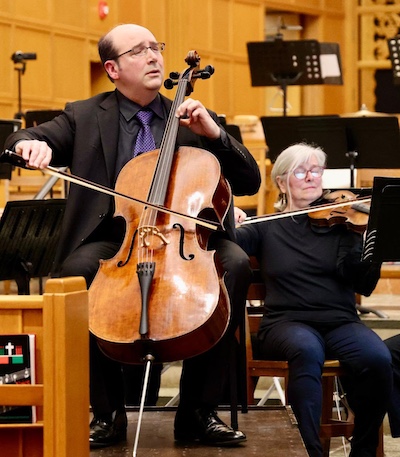
Mark Kosower, principal cello of The Cleveland Orchestra, brought distinction to the Heights Chamber Orchestra’s program on Sunday, March 22 at St. Paul’s Episcopal Church, shaping Haydn’s Concerto and Tchaikovsky’s Andante cantabile with clarity and poise. He made Haydn’s charm into a jewel, and the afternoon into something memorable.
Kosower is a smiling, modest man onstage, but his musicianship told the larger story. His playing was assured and clear, his passagework was clean and sonorous, and his phrasing logical. In the intimate space, you could watch his left hand at work — precise, disciplined, like five little soldiers carrying out orders. The cadenzas in all three movements were his own — feats of daring in classical style, full of well-turned, lucid flourishes.
The Adagio opened naturally. Kosower shaped phrases with a long breath. Conductor Travis Jürgens and the orchestra gave him room, thinning the texture and keeping the accompaniment light. In the finale, a civilized rondo, Kosower guided the conversation, while Jürgens and the orchestra served as alert respondents. It ended as it began: balanced and unforced, an Apollonian thrill.
Tchaikovsky’s Andante cantabile, arranged for cello and strings, made for an unofficial encore. Originally a movement of the composer’s First String Quartet (1871), it’s built on a simple Russian folk tune said to have been sung by a house painter. Kosower played the lovely melody with tender modesty while Jürgens kept a patient tempo and drew a blended sound from the strings.
After intermission, Benjamin Britten’s Matinées musicales offered a change of manner. Composed in 1941 and based on themes by Rossini, the suite reflects Britten’s wartime circumstances — light music for modest forces, later adapted for ballet. Its charm lies in its quick character shifts and crisp profiles.
The orchestra brightened here. Rhythms snapped and Jürgens kept the dances moving with a light hand, giving each movement its due. The March was properly rowdy, the Nocturne, a reconsidering of Rossini’s aria “La Pesca,” caught something of Rossini’s glee. The Waltz was boisterous and fast, the Pantomime featured some nice wind solos, and the Moto perpetuo kept everyone busy.
Alexander Borodin’s Polovtsian Dances closed the program. Drawn from his opera Prince Igor, left incomplete at his death in 1887 and finished by Rimsky-Korsakov and Glazunov, the dances have long outlived the opera — vivid showpieces rich in rhythm and color.
Jürgens asked for a broader sound, and the orchestra obliged. Textures thickened here and there, but the music came through. The orchestra was attentive, responsive, and Jürgens kept a firm hand.
But this was Kosower’s afternoon. His playing in the Haydn and Tchaikovsky took a solid program to exalted heights.
Published on ClevelandClassical.com March 25, 2026
Click here for a printable copy of this article
