



by Stephanie Manning
 This article was originally published on Cleveland.com
CLEVELAND, Ohio — During Jakub Hrůša’s first decade of Cleveland Orchestra appearances, the Czech conductor programmed a wide range of music, including works from his home country, cornerstones of the orchestral canon, and lesser-known gems. This weekend’s concerts feature all three.
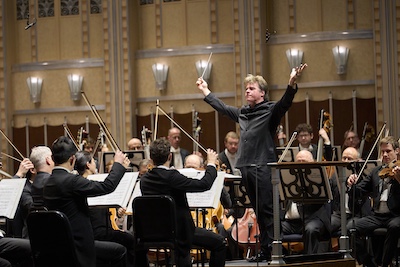
On Thursday, March 5, after more than four years away from the Cleveland podium, Hrůša returned to Severance Music Center with music by Johannes Brahms, Bohuslav Martinů, and Vítězslava Kaprálová. Without a concerto, the program focused instead on the forms of the symphony and sinfonietta — as well as on the synergy between Hrůša and the Orchestra, which produced some very fine playing.
The two Czech works, performed after intermission, grapple with the tension between light and darkness, both having been written in the shadow of the Second World War. Vítězslava Kaprálová finished her Military Sinfonietta in 1937, as the world teetered on the brink of conflict — an unfortunately relevant context for its Cleveland premiere. While a sense of unease does rumble through the work, Kaprálová avoided the distinct sounds of battle, creating instead a general sense of determination.
Hrůša took his time with the Sinfonietta’s more peaceful moments, including some shimmering solos by concertmaster Joel Link. While the conductor didn’t escalate the work’s peaks to the level of heart-racing fervor, moments of tension still arrived, accented by crisp rolls of snare drum and the growl of the timpani. It’s a well-designed work, as is Bohuslav Martinů’s Symphony No. 3.
Given that The Cleveland Orchestra commissioned Martinů’s Second Symphony in 1943, it’s somewhat surprising that his Third Symphony, written a year later, had never been heard in Mandel Concert Hall. Tracing an arc from darkness to light, this is a work with much to dig into, with overlapping layers of sound and a heightened presence of piano, harp, and percussion.
As in the Kaprálová, the undercurrent of tension repeatedly builds up and breaks through, particularly at the end of the first movement. Hrůša and the musicians again honed in on the beauty amid angular moments, including during the sweet second-movement solos by flutist Jessica Sindell and English hornist Robert Walters.
After the fourth movement’s final rush of excitement, the momentum gradually died down like a music box, although not without a remaining hint of menace — three sharp blows from piano and bass drum had the last word.
Before diving into the Czech repertoire, Hrůša began the evening with Brahms’ Symphony No. 3, a much sweeter and more lighthearted work. His focus centered on its quieter, gentler sections — uplifting moments like the recurring duet in the second movement, where warm solos from clarinetist Afendi Yusuf and bassoonist John Clouser floated over the underlying orchestral texture.
The conductor’s unhurried treatment of the Brahms created a calmness, especially in the outer movements, but he treated the final moments of all four with reverence. That sense of peace was so effective, it almost felt like the music could have dissipated the dense fog that has been clinging to Northeast Ohio the past two days, leaving us with a clear and quiet night.
Photo by Roger Mastroianni
Published on ClevelandClassical.com March 12, 2026
Click here for a printable copy of this article
