

by Mike Telin
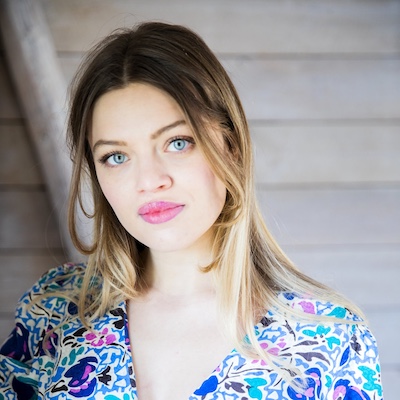
Photo credit: Amélie Chapalain
We are talking now of summer evenings in Knoxville, Tennessee, in the time that I lived there so successfully disguised to myself as a child. —James Agee, in the preface to A Death in the Family
While searching for a text for the solo piece with orchestra that would become Knoxville: Summer of 1915, Samuel Barber said that Agee’s prose-poem particularly struck him because it reminded him so much of evenings when he was a child at home.
“I found out, after setting this, that Mr. Agee and I are the same age, and the year he described was 1915, when we were both 5,” Barber told James Fasset during a 1949 interview. ‘You see, it expresses a child’s feeling of loneliness, wonder, and lack of identity in that marginal world between twilight and sleep.”
Swedish soprano Johanna Wallroth said during a Zoom call that “Knoxville: Summer of 1915 is one of my absolute favorite pieces, and I’m very excited about making my Cleveland Orchestra and U.S. debut with it.”
On Thursday, February 12 at 7:30 pm at Severance Music Center, conductor Barbara Hannigan will lead The Cleveland Orchestra in an all-American program that features Barber’s haunting work along with George Crumb’s A Haunted Landscape, Charles Ruggles’ Sun-Treader, and George Gershwin’s Porgy and Bess: A Symphonic Picture (arranged by Robert Russell Bennett). The program will be repeated on Saturday at 7:30 pm. Tickets are available online.
Wallroth said that she grew up hearing Knoxville: Summer of 1915. “My family listened to it a lot — Dawn Upshaw’s recording is very familiar to me. I’ve wanted to sing it before I even started singing. It’s such an emotional, beautiful piece with many different colors. It’s very natural and I think it’s easy for lots of people to engage with. And when you read about James Agee’s and Samuel Barber’s lives, it seems like they both had an emotional connection to the poetry.”
The soprano also looks forward to once again working with Barbara Hannigan, whom she first met when she was part of Equilibrium Young Artists, the conductor’s mentorship program.
“I sang in the Mozart Requiem with her and the Orchestre Philharmonique de Radio France. We also worked together in Copenhagen in Debussy’s La damoiselle élue with the Danish National Symphony Orchestra.”
Did Wallroth grow up in a musical family? “I would say I did. My mother is a singer and so is my sister. And although my father is not a musician, he’s very interested and likes to discover new pieces. They’re very engaged in what we do — singing in choirs, playing piano, and dancing as well — so music is a natural part of my life.”
In spite of growing up around singing, Wallroth didn’t consider studying voice until she was 18. “Before that I wanted to be a dancer, and I was very focused on that.”
Wallroth began studying dance at the age of three, when her mother heard that the celebrated American dancer and choreographer Kathleen Quinlan, who is an authority in the technique and repertory of Isadora Duncan, had established a youth company in Stockholm. “I started there and I’m still taking classes in Stockholm.”
Has studying dance been helpful to her opera roles? “Absolutely! The music — a lot of Chopin, Brahms, Schubert, and Scriabin — was all choreographed. And we had a wonderful live pianist every week. We did many performances, and I’m sure it has tremendously helped my musical understanding. And of course it has helped me on the stage.”
When did opera come into the mix of her artistic pursuits? “My mother was working in the opera choir in Stockholm when I was growing up. I was there during rehearsals just waiting for her. It was just a part of life.”
Wallroth sang her first opera role in Stockholm when she was nineteen — Barbarina in Marriage of Figaro. “I had just started studying — after that everything moved very fast!
Published on ClevelandClassical.com February 11, 2026
Click here for a printable copy of this article
