

by Stephanie Manning
 This article was originally published on Cleveland.com
CUYAHOGA FALLS, Ohio — To clap or not to clap between movements — that is the question many Cleveland Orchestra audience members faced on Saturday night at Blossom Music Center. Luckily, Japanese guest conductor Kazuki Yamada had an answer.
Hearing some scattered applause after the first movement of Robert Schumann’s Symphony No. 2, Yamada turned his head, smiled, and gently put his own hands together. That moment gave the crowd the green light they needed to join in.
Yamada’s willingness to engage with listeners felt like an extension of his genial personality, which allowed him to lead The Cleveland Orchestra on August 1 with both excitement and poise.
Schumann’s Second is often described as a battle between light and darkness, and Yamada’s interpretation favored the light. He and the musicians easily brought out the symphony’s sunniest moments. The constant flurries of string notes in three out of the four movements came across effortlessly — deceptively so, for this level of effort is a genuine physical feat.
The slow third movement, Adagio espressivo, tended to meander, but the second movement Scherzo was a real treat. Just when you might have thought the music couldn’t get any faster, Yamada increased the tempo again in a breathless rush to the end, prompting visible joy from the podium at the fabulous playing.
Cleared to applaud between movements, the audience responded enthusiastically, and did so even more at the piece’s conclusion.
The first half of the program ventured far from those 19th-century stylings. In comparison to the Schumann’s straightforwardness, Igor Stravinsky’s Symphony of Psalms is an entirely different beast, with its mixed chorus and unusual instrumentation — no violins, violas, or clarinets.
Thanks to Stravinsky’s gift for orchestration, those omissions are hardly noticeable and give the music a wonderfully dark, grounded feel. All three movements flip between tender deliveries of the psalms and the composer’s characteristic forcefulness.
Prepared by Lisa Wong, the Blossom Festival Chorus gave a dedicated, convincing account of both extremes. Thankfully, the Blossom Pavilion is quite favorable to the sound of a chorus.
Oboist Jeffrey Rathbun and flutist Jessica Sindell joined in an expressive duet at the top of the second movement, while the French horns built into big swells of energy during the third. Although woodwind intonation wavered at times during that latter movement, the repeated Alleluias from the chorus still sounded tranquil.
The evening began with Tōru Takemitsu’s Dreamtime, marking the Orchestra’s first performance of this winding and meditative 10-minute work. With a careful eye on dynamics, Yamada and the musicians brought out the ebbs and flows of the piece as if you were floating around in a dream, buffered by gentle winds.
Glockenspiel, tubular bells, and celesta added an extra sparkle on top of the brass dissonances and the tension that pushed and pulled. Yamada, ever patient with his pauses, carefully let the final note ring out. He held his pose, eyes closed, for a few moments before leaning down into a shallow bow — perhaps signaling gratitude to the musicians, to the audience, and to the music itself.
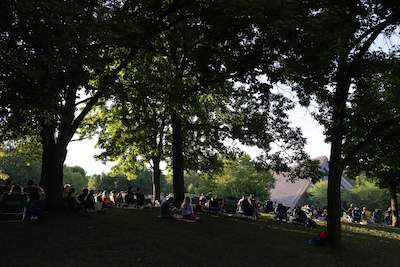
Photo by David Petkiewicz, cleveland.com
Published on ClevelandClassical.com, August 6, 2026
Click here for a printable copy of this article
