

by Daniel Hathaway
 Cleveland Orchestra Principal Cello Mark Kosower, who already had an extensive following, added impressively to his fan club in the first of two online performances of J.S. Bach’s solo cello suites streamed from Trinity Cathedral on June 5. He returns for the second performance this Friday, July 31 at 7:00 pm.
“It certainly was a very powerful and meaningful experience for me, and we were able to reach a lot of people,” the cellist said in a recent telephone conversation. “By the time the video had gone around and lived on Facebook for a number of weeks, we got 13,300 views.”
That performance was presented free of charge, but allowed viewers to contribute online to a relief fund for musicians affected by the pandemic. “It was an important activity for the causes I was playing for,” Kosower said. “Looking forward, I feel that we’re still very much in the pandemic. My approach to the second concert won’t be so different, but what will be different, of course, is Bach’s other three suites. Each of them has its own individual story to tell, heading toward the pinnacle of the sixth suite.”
Kosower’s first performance included Nos. 1, 3, and 5. On Friday, he’ll play the even-numbered suites, but in a special order. “There are at least two or three different ways to ‘successfully’ divide the suites into two programs. With these six, it seems more balanced if you have one minor-key suite on each concert,” he said. “And it’s important to think about how the pieces relate to one another — what are the parallels and the contrasts? Designing programs is almost a hobby of mine, and I think of each concert as an artistic statement.”
Out of public health considerations, no audience was present on June 5, and the cellist wore a face mask — at least during the first suite. Kosower said that he had worn a mask often enough when he left his house that he got used to the feeling. “But playing an instrument is a physical activity, and it’s certainly more natural to breathe without it. If you’re a singer or a wind player you have no choice but to breathe in sync with the music. But breathing with a string instrument is every bit as important for the outcome.”
This Friday, a small audience of five masked Music and Art at Trinity patrons will be allowed to attend the performance. While the large space of Trinity’s nave will allow physical distancing with that number of people, the Cathedral is still offering its Sunday services virtually.
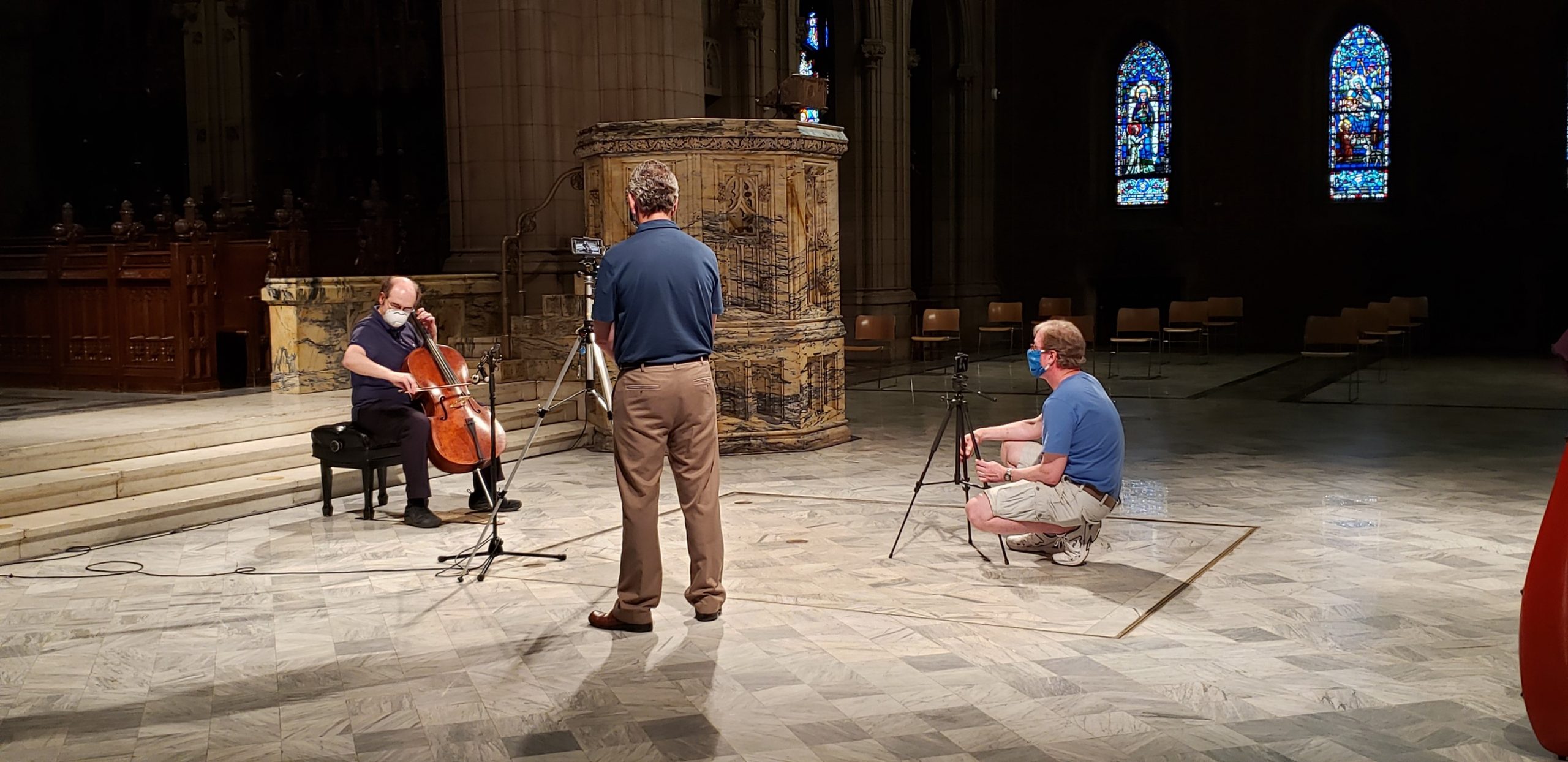 Todd Wilson, Trinity’s music director, said in a telephone conversation that his crew would do a dry run on Wednesday to figure out some tweaks to the streaming process. “We want to tidy up the beginning and the end. We weren’t quite sure when the stream actually went live on June 5, so it caught us a bit unaware. But considering the fact that the whole thing was done with two iPhones, I thought it went rather well. I’m still amazed.”
Wilson noted that The Cleveland Orchestra had helpfully boosted the viewership by cross-streaming the June performance, and that responses had been very positive. “People were admiring of Mark’s artistry, and grateful for live music-making.”
Mark Kosower is grateful himself these days for the rare opportunity to perform live, an experience he recently renewed at Severance Hall, when a small ensemble of 15 Cleveland Orchestra members met onstage to rehearse and record Tchaikovsky’s Serenade. “It’s part of a new initiative this summer to create small, socially-distanced performances and to record them for streaming to followers and supporters.
“That re-establishes the Hall as the focal point of the Orchestra’s activities,” he said. “We’ve been involved in many wonderful outreach activities like playing for healthcare workers in the hospitals, but ultimately an orchestra needs a concert hall to perform in. The Tchaikovsky was a pretty amazing experience from the very first chord. A total awakening, because collectively, members of the Orchestra carry the sound of the ensemble, and Severance is one of the top three halls in America acoustically.”
If some people wonder, in this age of social distancing, how instrumentalists can play a double arm’s length away from each other, Kosower said, “From the audience’s point of view, there’s not a huge difference, but even with the full Orchestra onstage there’s a large distance between the cellos and the horns. We’re equipped to make those adjustments, but it requires a certain amount of anticipation.”
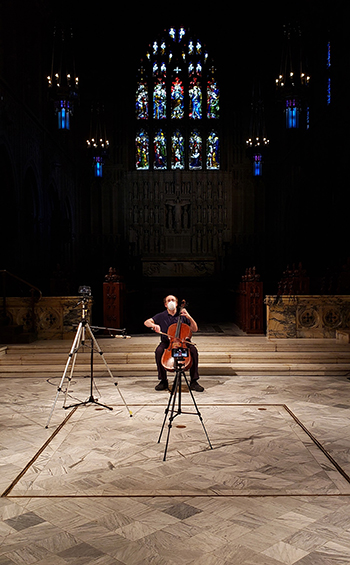 Of course, playing all alone in a Gothic cathedral presents an entirely different challenge. Viewers on Friday at 7:00 pm who follow this link can witness Mark Kosower and his cello setting a great volume of air in motion with the expressive music of Johann Sebastian Bach. Thanks to modern technology, music and images will be instantly transformed into electrons and made available worldwide to anyone with an internet connection.
Published on ClevelandClassical.com July 28, 2020.
Click here for a printable copy of this article
