




By Mike Telin
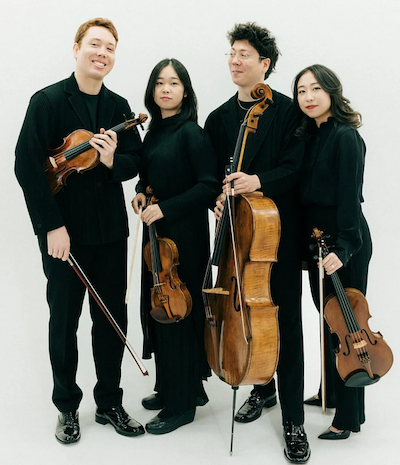 Founded in Berlin in 2019, the Leonkoro Quartet adopted its brave-sounding name from the Esperanto words for “lion” and “heart” and from Astrid Lindgren’s children’s book, The Brothers Lionheart. Two brothers, Jonathan and Lukas Schwarz, man the first violin and cello positions. Second violinist Emiri Kakiuchi and violist Mayu Konoe fill out the roster of a relatively new ensemble that impressed the chamber music demimonde in April of 2022 by winning a total of ten prizes at London’s Wigmore Hall International String Quartet Competition.
On Tuesday evening, March 3 at 7:30, the Leonkoro Quartet will make its Cleveland debut on the Cleveland Chamber Music Society series at Disciples Church, performing standard repertoire by Joseph Haydn, Ludwig van Beethoven, and Felix Mendelssohn.
I spoke with violist Mayu Konce in Columbus before the quartet’s recent engagement there, and posed questions about their repertory choices and some of the issues they’ve addressed as a new ensemble on the international concert circuit.
Mike Telin: Will this be Leonkoro’s Cleveland debut?
Mayu Konce: It is, and we’re very excited.
MT: Anytime I see Beethoven’s Opus 131 quartet listed I get excited.
MK: There’s extra pressure because it’s a favorite quartet of a lot of people, so I feel like many approach it with certain expectations.
MT: Why do you think it is such a popular quartet?
MK: It’s so monumental. It has seven movements. There’s no break, it just goes on. The fourth movement variations are very long, and the music is something else. It’s very interesting to see Beethoven use motives from his other quartets, like the Große Fuge, and I think its expressiveness is very challenging. But what makes it special is not just the very long span of concentration, but the tension you have to keep over the entire piece.
MT: It must be taxing on the brain as well.
MK: Definitely. It’s also unusual not to be able to tune between the movements. So if something happens, you can’t do much about it. We do think about that while playing — praying that it doesn’t get too out of tune. It doesn’t help if the weather is so cold because the strings react to that.
MT: You’re beginning with a Haydn quartet.
MK: We think about what fits together and what doesn’t. Do we have multiple periods of program and repertoire? But we mostly play pieces because we like them.
MT: In the middle you’re playing the Mendelssohn a minor quartet. What are your thoughts about him?
MK: We do keep in mind that he was so young, but we try not to think of his music as naive — because it’s not. He’s young, but if he can write this way, he must be very intelligent. We don’t underestimate him, but we do try to keep the freshness in his writing. We try to put ourselves in the mind of Mendelssohn. OK, was Beethoven his inspiration? What were his ideas? What would he have liked to hear? Of course it’s hard to know exactly what he wants but that’s important in our interpretation.
MT: I was reading a quote on your website that specifically addresses the middle voices of the string quartet. What is it about the second violin and viola voices that attract you?
MK: For me, it’s handling the atmosphere and the character. You’re in charge of so many things without being flashy. There’s so much going in the background which is so crucial for the entire sound and the character you want. For me, it’s also fun to sèe how much I can do to support the other players from the middle, helping to blend everything together while still doing my own thing.
I started playing second violin before I switched to viola about a year after we founded the quartet. There are big differences between the middle voices. Both of us have different tasks to do at the same time while still connecting together. But I have a lot of fun with the middle voice. I would always choose the middle voice over the upper voice.
MT: Speaking of middle voices, you have a new second violinist — your first personnel change.
MK: It’s going really well. But of course, it’s a lot of repertoire for Emiri to learn. January was the first month she officially played with us. There were a lot of pieces and some really big stages, but she did very well. Now we’re just looking forward to calming down a little, and having a little bit more time to do things.
I think most quartets go through these things. We got a lot of advice from some very kind colleague quartets that are with the same agency.
MT: I’m so happy it’s working out for you. That said, I know that you formed in Berlin and you have the two brothers, and I love how the Quartet’s name came about. But how did you meet?
MK: We started as an undergraduate university quartet. This is going to sound very unromantic, but we needed credits for chamber music, and at the time the Artemis Quartet was still teaching. And, Lucas, our cellist, was the only one not living in Berlin.
He was quite envious about having lessons with them. We said we can bring you into the group — you just have to come to Berlin, and we can have some lessons, and work on some quartets and just do the class concert. We didn’t think much about anything after that.
We had a lot of fun doing that, and the Artemis Quartet are great teachers. They’re very motivating, and so passionate, and we soaked that up.
We started thinking about doing master classes because Jonathan, our first violinist’s former teacher, used to be in the Artemis Quartet. Heim Müller was his violin professor for pre-college, so he knows him very well. And he organizes master classes in the summer.
We were trying to figure out how we could continue? What do we do first? We ended up doing master classes first, and then we met Günter Pichler from the Alban Berg Quartet at the master class and he invited us to join his class in Madrid. I think joining that class was the first time we thought about playing together in the long term.
So coming together was a coincidence, but it worked out. The brothers played a lot of chamber music in many different formations, so they just know what they want. They know how to anticipate a sound and what the other one expects from you. I think it’s definitely the start of the process of finding a quartet sound.
So we sat down and said let’s try it for two years and do a few competitions, and if it works out, great, and if not, we are still young enough to do something else.
Published on ClevelandClassical.com February 28, 2026
Click here for a printable copy of this article
