



by Peter Feher
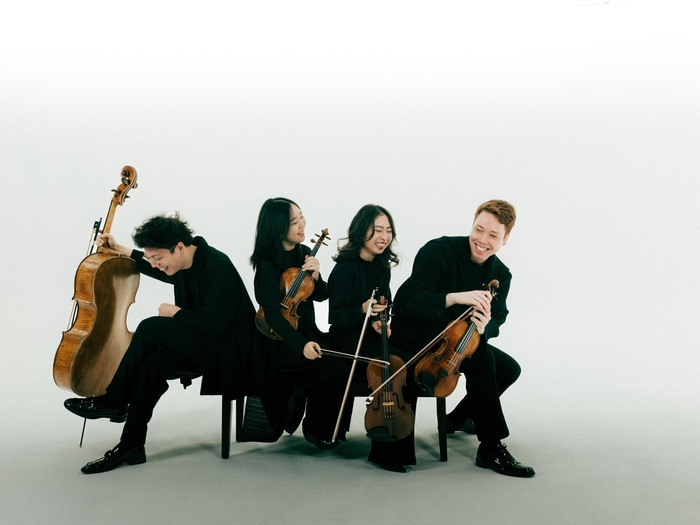 Out of Vienna is the title of the Leonkoro Quartet’s latest album, but that phrase could easily stand in for all of the ensemble’s recent performances.
Never mind the specialized focus of the recording, which centers on Second Viennese School composers Alban Berg and Anton Webern. In a program of entirely standard repertoire — Haydn, Beethoven, and Felix Mendelssohn were on the bill for the Quartet’s Cleveland debut — the influence of a certain city proved just as inescapable.
Of course, classical music in the 21st century thrives on cosmopolitanism. The young Leonkoros are based in Berlin, having formed at conservatory there in 2019, and they’ve cultivated utmost cohesion and top-level technique. Worldwide attention came after they swept London’s Wigmore Hall International String Quartet Competition in 2022.
The group’s North American tour this season included first-time stops at Carnegie Hall and the Library of Congress, as well as an appearance for the Cleveland Chamber Music Society on Tuesday, March 3, at Disciples Christian Church.
Still, the path for every string quartet leads back to Vienna. Haydn, often called the father of the genre, would agree, even as he codified the form during his years as a court composer away from the Austrian capital. The city’s many allures were never far off, and the works he produced for his noble employers would soon be published widely and to great acclaim.
The popularity has hardly waned for Haydn’s String Quartet in D, Op. 20, No. 4, and the piece’s enduring appeal has much to do with how it surprises and satisfies in equal measure. No other composer could make the irregular phrase lengths at the start of the first movement sound so symmetrical. And who else would treat the diversions of the second movement’s theme and variations so seriously?
The Leonkoros were finely attuned to Haydn’s whims, tossing off the trifle of the third movement Allegretto and then breezing through the Presto finale.
In a way, those quirks were preparation for the evening’s most demanding selection: Beethoven’s String Quartet No. 14 in c-sharp, Op. 131. The idiosyncrasies that structure this score — seven highly contrasting movements, played without pause — only cohere when understood as a single, unbroken statement of supreme personal expression. Here is Beethoven at his most uncompromising, the composer at the end of his life in Vienna and on the verge of immortality in the city’s cultural memory.
Quartet No. 14 seems to contain a whole history of music, from the slow fugue of its introduction to the sonata-form surge of its finale. The work’s crowning achievement occurs exactly midway through, in a staggering set of variations that would have done Haydn proud and that the Leonkoros were perfectly poised to handle.
The ensemble balance was never less than sublime as emphases shifted constantly among the players — all the more impressive given that first violinist Jonathan Schwarz, violist Mayu Konoe, and cellist Lukas Schwarz were joined on Tuesday by a substitute second violinist, Ryan Meehan of the Calidore Quartet.
Perhaps both full ensembles can collaborate on Mendelssohn’s String Octet in the future. For now, a thoughtful, sympathetic performance of the composer’s String Quartet in a, Op. 13, sufficed. This impassioned piece, penned by a young musician in Berlin deeply under the sway of late Beethoven, nicely completed the concert’s lineage while promising more to come.
Published on ClevelandClassical.com March 18, 2026
Click here for a printable copy of this article