

by Mike Telin
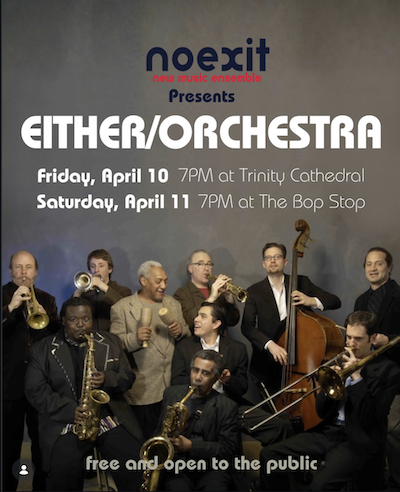 Since playing their first show on December 17, 1985, at the Cambridge (MA) Public Library, the acclaimed Either/Orchestra has been thrilling audiences around the globe with their unique combination of jazz, improvisation, and global musical influences.
This week, as part of the No Exit Presents series, Either/Orchestra will perform two different programs that feature Ethiopian music and Ethio-jazz.
On Friday, April 10 at 7:00 pm at Trinity Cathedral E/O will feature Ethiopian vocalist Bruck Tesfaye performing Mahmoud Ahmed and Nerses Nalbandian-associated songs.
And on Saturday, April 11 at 7:00 pm at The Bop Stop, the ensemble will be joined by vocalist Munit Mesfin. The program features Nerses Nalbandian songs, as well as songs by Teshome Mitiku, Bezunesh Bekele, and Mahmoud Ahmed. Both performances are free.
No Exit’s Laura King caught up with Either/Orchestra founder Russ Gershon and asked him about the ensemble’s long association with Ethiopian music, and what they have in store for audiences at this week’s concerts.
The following interview excerpts are reprinted with the permission of No Exit.
Laura King: The Either/Orchestra has long been celebrated for its deep engagement with Ethiopian music, a connection that continues with your recent release of Éthiopiques 32: Nalbandian – L’Éthiopien. How did your relationship with this genre first develop, and how has it culminated in a mega-project like this one?
Russ Gershon: In 1999, we added Vicente Lebron, a Dominican master conguero to the mix, which significantly changed the rhythmic foundation of the group. He found a strong partner in our drummer of that era, Harvey Wirht, from Surinam. Their grooves enabled me to indulge my own personal take on Latin music.
Around the same time, I began bringing Ethiopian music to the band. I had fallen in love with modern Ethiopian music (1950’s through ’70’s) a few years before, and I thought that the E/O could put our own spin on these pentatonic, rhythmic sounds. It turned out to be a hit with audiences and drew the attention of Francis Falceto, a French producer who has done more than any other non-Ethiopian to bring Ethiopian music to the world, and vice-versa, with his éthiopiques series of (mostly) reissues.
Francis shared his knowledge and research with me and ultimately invited the E/O to perform in Ethiopia in 2004. Playing our peculiarly North- and Latin-American accented version of their music for Ethiopians was a revelation — for us and for them. It also led to collaborations with the old-time greats of Ethiopia – Mahmoud Ahmed, Mulatu Astatke, and others.
When it comes to learning a new language, nothing beats conversing with the most eloquent speakers, and we have had that opportunity. These collaborations, in the US, Canada, and across Europe, prepared us, among other things, to be invited back to Ethiopia to play the music of Nerses Nalbandian.
Nalbandian was an Armenian genocide refugee who wound up in Ethiopia in 1939 as a music teacher, part of the Emperor Haile Selassie’s quest to have European style brass bands as an imperial accoutrement. In 1956, Selassie made Nalbandian the first head of music at the new National Theater, and from this perch Nalbandian brought a lot of international — and particularly American — influences into the evolution of Ethiopian popular music.
E/O’s new album is a collection of our interpretations of Nalbandian’s music, recorded with various Ethiopian guests at the National Theater in Addis Ababa and other locations. His scores were in some cases incomplete and the recordings spotty, so it’s a project of reconstruction and interpretation. Like almost every creative step I have taken in my career, this unlikely thing is driven by curiosity, an open mind, and a little luck. I’m fortunate to have found so many excellent musicians who are able and willing to join in the adventure.
LK: For these upcoming No Exit concerts, you’ll be presenting different programs at Trinity Cathedral and The Bop Stop. Can you give us a sense of what audiences can look forward to in each performance?
RG: The E/O took a hiatus from late 2019 till December 17, 2025 – our 40th anniversary. I wasn’t sure if we’d ever come back, but between the new album getting some influential promoters interested in us again, Tim Beyer of No Exit, and our loyal Boston fan base, I was encouraged to crank it up again.
At the distance of six years, it was an out-of-body experience to go through our catalogue and think about what to play. The band has had so many different eras over four decades, with different players and moods. There is an enormous body of music we’ve played, so pulling enough pieces for a handful of four concerts has been challenging. Also, we have some new members who need to soak up the material — and I’m learning what they do best.
The concerts will feature a mix of my originals from as far back at the 80’s, and Ethiopian music from our new album and from previous collaborations. At Trinity, we’ll be joined by Ethiopian vocalist Bruck Tesfaye, singing Mahmoud Ahmed and Nalbandian-associated songs. At the Bop Stop, vocalist Munit Mesfin will sing Nalbandian, as well as songs by Teshome Mitiku, Bezunesh Bekele, and Mahmoud Ahmed. We’ll even play one section of our yet unreleased album The Collected Unconscious, a suite I composed on a grant from Chamber Music America.
Generally speaking, the audience at our No Exit Presents shows can expect deep grooves from the Africa-North, America-Latin, and America pan-African space, intricate ensemble playing by our six-horn section, strong, idiosyncratic soloing from all ten members of the band, surprising juxtapositions — and to feel and to be entertained.
Read King’s full interview with Russ Gershon here.
Published on ClevelandClassical.com April 8, 2026
Click here for a printable copy of this article
