

by Kevin McLaughlin
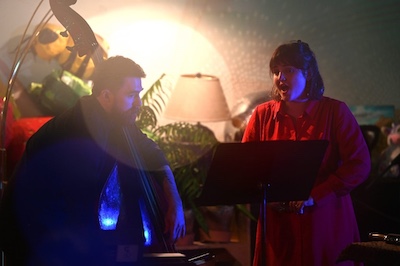 As is often the case, the February 7 No Exit Presents concert featuring LIGAMENT demanded close attention.
The modest forces and the intimate setting of Praxis Fiber Workshop placed the focus squarely on vocalist Anika Kildegaard and bassist Will Yager, in a program of works by Stefano Pierini, Ruby Fulton, James Dillon, Amy Beth Kirsten, and Katherine Balch. The duo, careful shapers of sound, drew listeners into worlds that were by turns surprising, unsettling, and utterly absorbing.
The evening opened with a brief set by the Cleveland State University Percussion Ensemble, led by Katalin La Favre, establishing the concert’s emphasis on quiet listening. With the lights lowered, the first of three works — a solo for acquarian — introduced a xylophone-adjacent instrument with glass bars mounted on a wood and stone frame. Without resonators, the instrument’s sound remained hushed, rarely rising above mezzo piano. Colored light shining from beneath the instrument lent the scene a dusky, piano-bar atmosphere.
A duo for the same instrument followed, played with a varied assortment of beaters and, at moments, a small metal chain. The glass bars and softened attacks made the tuning seem unstable — toy piano-like — though La Favre confirmed afterward that the instruments were conventionally tuned.
In Nicolas Allen’s Dependency, the full percussion ensemble supplemented the acquarian instruments with glass shakers, wine glasses used as claves, and long knitting needles employed as beaters. The resulting sound world, delicate and disorienting, prepared the ear for the evening’s second half.
Kildegaard and Yager formed LIGAMENT around a shared interest in new music and a desire to collaborate with composers. Praxis’s small space suited the duo’s approach. As Kildegaard remarked, it allowed the performers to “look everyone in the eye,” and invites the audience to hear the voice — and the bass — more directly.
Stefano Pierini’s Canzoni al Sol (2016) opened the Duo’s set in a lyrical vein, allowing voice and bass to settle into a shared space of sustained tone and gradual transformation. Pierini draws on texts by Van Gogh, Nietzsche, and Artaud, building the music from the natural overtones of the bass’s open G string. Kildegaard and Yager shaped phrases as shared gestures, voice and bass closely aligned, and sounds gathering and blooming together — an early statement of the evening’s central argument: sound as physical presence shaped through breath and resonance.
Ruby Fulton’s and if not, why not, written for LIGAMENT in 2023, introduced more troubling states of mind. Drawing on a 1913 newspaper account promoting “Better Babies” contests, the work absorbed the language of physical evaluation into repetition and fragmentation.
Kildegaard delivered the text, which she herself arranged, with shifting degrees of naïveté and clarity, moving between speech, pitched tone, and percussive consonants (sh, sht) that pierced the musical surface. A brief three-quarter-time lullaby returns in fragments, placing the music in a nursery setting that grew increasingly ominous. Beneath it, Yager’s harmonics and altered tunings created an unstable harmonic field hovering between tone and noise. What became of these contests, the women, and their babies, we are left to wonder.
James Dillon’s A Roaring Flame (1982) stood at the center of the program. A Scotsman often linked with the “New Complexity” movement, Dillon writes music that demands immense precision and control. The work unfolds in contrasting scenes, Kildegaard moving between singing, speech, and harsher vocal sounds, while Yager’s bass imperfectly shadowed the voice through shifting registers and contrary rhythms. Short spans gathered energy and fell away again, intensified by careful attention to timing and balance. In Praxis’s close quarters, the sound felt physical, almost animal, before settling back.
Amy Beth Kirsten’s yes I said yes I will Yes drew on the rhythmic momentum suggested by its Joyce-derived title (Molly Bloom’s soliloquy from Ulysses). Voice and bass moved in close rhythmic exchange, patterns returning in small variations as tension accumulated through persistence. Theatricality emerged by gesture and timing rather than overt staging.
Katherine Balch’s Vidi l’angelo nel marmo closed the program with hocket-like fragments passed between the performers, aligning and separating before settling into clearer shapes. Kildegaard and Yager allowed the piece to unfold patiently, revealing its form through balance, shared timing, and attention to sound itself.
As in much of No Exit’s programming, the concert asked for sustained attention. Its rewards accumulated through texture, gesture, and detail, the performers steadily shaping the act of listening itself. By the end, sound, physical action, musical meaning — and listeners — drew closer together.
Published on ClevelandClassical.com February 11, 2026
Click here for a printable copy of this article
