



by Peter Feher
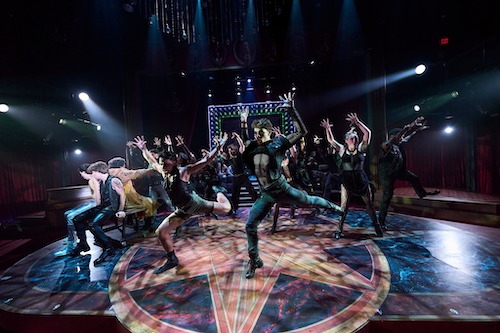
The stars aligned for Oberlin Music Theater’s production of Natasha, Pierre & The Great Comet of 1812, suggesting a bright future for the college’s newest area of study.
Oberlin Conservatory has cultivated young talent for more than 150 years, but musical theater only entered the curriculum this semester. The program’s first students arrived in the fall under director and professor Victoria Bussert, who brought with her several colleagues from Baldwin Wallace University — including a few who collaborated on her 2023 staging of Great Comet for Cleveland’s Great Lakes Theater company.
Even for the experienced, this show is a massive undertaking, with a story adapted from Leo Tolstoy’s War and Peace and a score demanding stamina and stylistic range. But nothing daunted the student actors on opening night, December 3. Not the immersive direction by Bussert, nor the energy-intensive choreography by Alex Sanchez. (Two casts alternated in eight performances through December 10.)
Great Comet is an ensemble piece, and the real measure of success was how the epic drama unfolded largely as a series of intimate moments within the black-box space of Oberlin’s Wurtzel Theater. Chandeliers dotted the ceiling, and a massive door loomed at the back of the stage, but all attention was otherwise focused on the action.
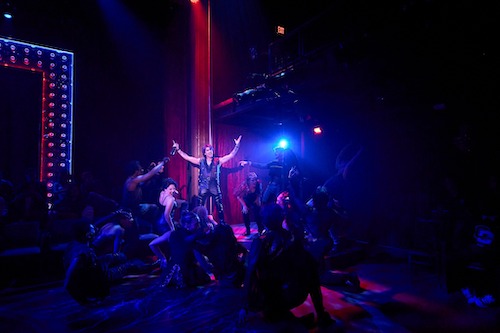
There’s a reason why so many of the scenes have simple titles like “Natasha & Anatole,” “Pierre & Andrey,” and “Sonya & Natasha.” As in any great 19th-century novel, the plot hinges on a series of subtle social exchanges. Wisely, Great Comet lets Tolstoy’s characters speak for themselves, often in language taken verbatim from Louise and Alymer Maude’s 1922 English translation of War and Peace.
Which isn’t to say that the show’s creator — composer, librettist, and Lakewood native Dave Malloy — had an easy task as dramaturg. He condensed a couple of episodes from the 1,000-page novel into a stand-alone story and then invented the musical vernacular to tell it. “A pop-rock opera with Russian drinking songs” was the identity of the project through its various New York City incarnations between 2012 and 2017.
Hence, the young countess Natasha has some of the sparkle of a Disney princess, though grounded in genuine depth. Meanwhile, her less-loved cousin, Sonya, gets a plaintive solo in the style of an indie-folk singer. This being 21st-century Broadway, both ladies also have to belt, and Kayla Petersen and Bebe Moss excelled in this aspect of their respective roles without sacrificing acting nuance or emotional resonance.
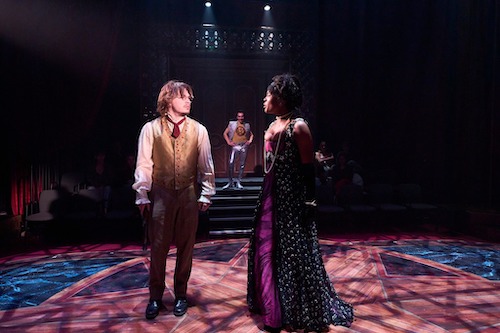
The villains have even more fun, musically speaking. Prince Anatole, who seduces Natasha upon her entry into Moscow’s high society, is a simpering bad boy who sings in falsetto, and Nic Rhew found his sweet spot in that register. Hélène, Anatole’s sly sister, contributes to the debauched plan by crooning “Charming,” a ravishing number that ensnares Natasha and that Jai McAllister made the highlight of the evening.
The minor characters were just as vivid vocally. Reese Henrick growled out her part as Marya Dmitrievna, Natasha’s godmother and de facto guardian who at the last second saves the day. Jake Van Eycken shouted and rasped as the comical old Prince Bolkonsky. And Jazmin Rhodes was perfectly obstinate as his daughter, the plain Princess Mary, who opposes Natasha in clashing half-step harmonies.
“What about Pierre?” — the question posed at the end of the Prologue as a sort of refrain. Ryan James Sweeney was a rock star in the role, less of the swaggering variety and more of the sensitive, soul-searching kind. His character’s private philosophical quest played out in a handful of separate scenes before uniting the entire cast under the symbol of the Great Comet and all it promises.
Photos by Roger Mastroianni
Published on ClevelandClassical.com on December 18, 2025
Click here for a printable copy of this article