



by Kevin McLaughlin
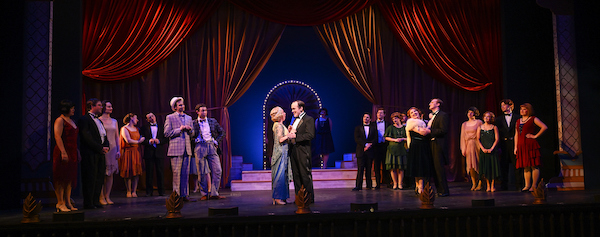 On a sunny Thursday afternoon in Wooster on June 26, Ohio Light Opera’s revival of the Gershwin brothers’ Tip-Toes (1925) made its premiere during a carefree two hours at the College of Wooster’s Freedlander Theatre.
Director Jacob Allen embraced the show’s silliness — mistaken identities, romantic mix-ups, and a heroine with amnesia — while keeping the action kinetic and the comedy light on its feetThe production succeeds due to excellent staging and choreography, but also thanks to sharp acting, nimble dancing, heartfelt singing, and general razzle-dazzle. Proof that even the more neglected musicals of the Jazz Age can still charm a modern audience.
As Tip-Toes Kaye, Kate Bilenko was thoroughly beguiling. She sashayed onstage with the coquettish confidence of a Broadway ingénue, aiming her mischievous wit and vocal charm squarely at a receptive audience.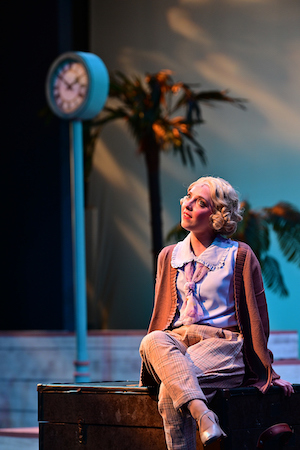 Her rendition of “Looking for a Boy” was a highlight — she brought fresh nuance and a warmly personal touch to both George Gershwin’s melody and Ira Gershwin’s clever lyric.
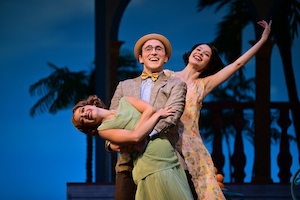 Spencer Reese was equally delightful as Bilenko’s romantic opposite, the lovable but socially awkward millionaire Steve Burton. Reese blended self-assurance with just enough vulnerability, especially in his post-amnesia confession scene. The chemistry between the leads anchored the show, and their duet, “That Certain Feeling,” was tender and affecting.
Noah Sickman as Tip-Toes’s scheming brother Al and Jack Murphy as her feckless uncle Hen, were nimble vaudevillians. Their goofy subplot — involving a ploy to find Tip-Toes a rich husband at the Palm Beach hotel — was good fun, if a little cringe worthy. Was it shtick or were they channeling specific old-time actors?
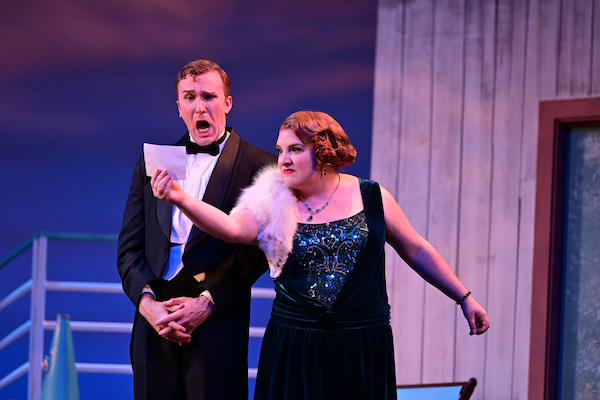 Meanwhile, Rollo Metcalf (Timothy McGowan) and Sylvia Metcalf (Maggie Langhorne) played the flawed but winsome second couple, generally leaning into their domestic squabbles for laughs.
The chorus and ensemble dancing were uniformly satisfying. “Lady Luck” and “When Do We Dance?” were both nostalgic treats in Act One, the latter sung with delicious abandon by Burton (Reese) and his recently appointed female tutors (Rachel Wresh and Quinlyn Kessler).
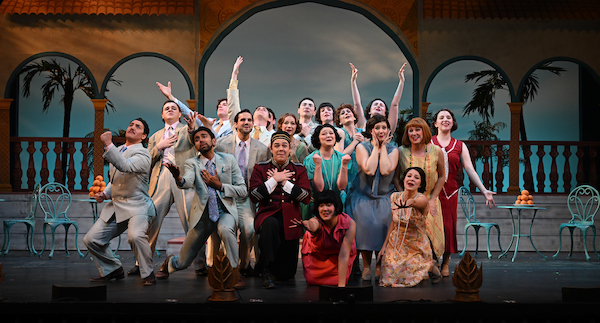 But the tap ensemble in “Sweet and Lowdown” stole the show. Spencer Reese’s Charleston-indebted choreography made a strong case for vaudeville as the natural wellspring of American musical theater.
Daniel Hobbs’s set — a bright, breezy evocation of 1920s Palm Beach — gives the whole affair room to sparkle while conductor Michael Borowitz coaxed plenty of Gershwin sheen from the pit, allowing singers to project and dance freely. A deft touch was the inclusion of two pianos on the apron of the stage played by Wilson Southerland and Eric Andries — faithful to the original 1925 production and a sly breach of the fourth wall.
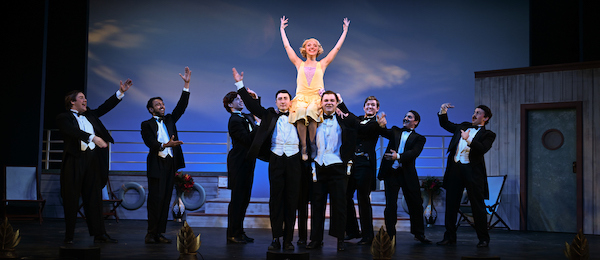 If there’s a quibble it’s that the second act drags as the comedy duo’s jokes begin to meander. Still, Tip-Toes may be a sleeper hit. It doesn’t shake the ground like some of OLO’s more canonical productions, but the dancing and score are enough to buoy it. This is polished, pleasurable musical theater — full of smart, nostalgic Gershwin tunes and sweet-to-the-taste comedy. It’s vaudeville as revitalized art, and if the performances over the summer remain as lighthearted as Tip-Toes’ first act, audiences will be shimmying out of Freedlander Theater with a spring in their step.
Published on ClevelandClassical.com July 4, 2025.
Click here for a printable copy of this article
