



by Kevin McLaughlin
 How to explain the pleasure of Ohio Light Opera’s production of How to Succeed in Business Without Really Trying, which opened on June 15 at Freedlander Theatre? With music and lyrics by Frank Loesser, it’s a good-natured romp from the Mad Men milieu of the early 1960s that tries not to recall the bad old days too clearly, or to at least do it in jest. With an excellent cast, sets, and costumes, it’s hard not to have a good time with this production directed by Jacob Allen. I did, even if some of the old-fashioned attitudes rankled a little.
You might suspect that How to Succeed, which won the 1962 Pulitzer Prize for drama, had been ahead of its time, shining a light as it did on the bad behavior of get-ahead businessmen. Nah… Some of the more obvious sexist jokes and lyrics of the original may have been toned down for this production, but a lot of the caddishness remains, even if obviously intended as a send-up.
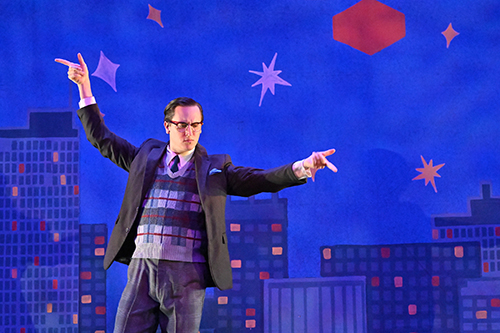
The performances were very good. Spencer Reese was deft and charming as the boy-next-door J. Pierrepont Finch, and seemed to take the “without really trying” part to heart. Reese’s Finch was disarmingly unflappable.
Pretty soon you catch on that Reese’s — and Finch’s — secret power is his sangfroid, embodying a young man untroubled by rivals or challenges. The book he carries (How to Succeed in Business, voiced over nicely by James Mills) is Finch’s constant guide and inspiration as he climbs his inexorable way to the top of the World Wide Wicket Company. Inner calm also applies to Reese’s musical performances. His two big numbers, “I Believe in You” and “Brotherhood of Man,” were sung with carefree grace and impressed as the best musical moments of the show.
 Louisa Waycott was likeable and steady as Rosemary, the loyal secretary who is hopelessly in love with young Finch, even if he is more in love with himself and with getting ahead. We believe in her, even if Finch isn’t ready to. Waycott, who played her part for camp, was funny but also slightly pitiable in the cringe-worthy “Happy to Keep His Dinner Warm” and its reprise. Finch’s coming around in the duet “Rosemary” at the end of Act 1 seems more of a nod to conventions than an expression of true love. And Rosemary’s pushback against the lovely-voiced Smitty (Madison Barrett), projecting Cinderella fantasies onto her (“Cinderella, Darling”), doesn’t last long.
Vincent Gover was an affable J.B. Biggley, the lecherous and slightly clueless company boss. With a brusque baritone he conveyed the right mixture of thunder, boorishness, and ill-hidden neuroses (Biggley knits to soothe his nerves).
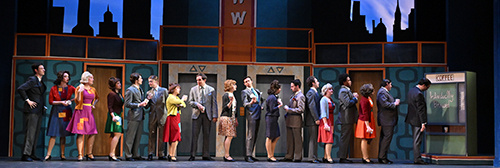
The show has its funny moments. “Coffee Break,” an encomium to the need for caffeine, was delightful, and the parody college song, “Grand Old Ivy,” belted with gusto by Biggley and Finch, was entertaining. The funniest lines may have been given to Matthew Reynolds as Bud Frump, the boss’s nephew, who was loveable and campy as Finch’s feckless rival.
The attempts to satirize the sexism of the original are occasionally funny, but the view of men and women in the workplace is all too depressingly recognizable and contemporary. In “A Secretary Is Not a Toy,” the Mad Men are cartoonish lechers, yes, parading around the office in hot pursuit, and J.B. Biggley is an obvious hypocrite (scolding while he keeps a doxy of his own), but the women are still gratuitous objects of desire. The old-fashioned images only seemed to normalize the chauvinism, not to challenge it.
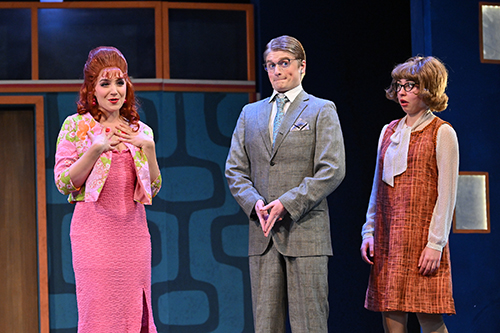
Kiah Kayser’s sets, mid-century modernist honeycomb architecture, were well matched by costume designer Amber Cook’s off-the-rack business suits and secretarial outfits. The lighting seemed oddly dark at times — I understand the executive bathroom scene needed darkness to highlight Finch’s face, but still it cast a pall. Spencer Reese’s choreography was frothy fun.
Loesser’s songs are a bit of a mixed bag. With the exception of “Brotherhood of Man” and “I Believe in You,” which hit their mark, the rest are unremarkable. The women in the chorus had little to do, except in the regrettable “A Secretary Is Not a Toy” and the “Paris Original” number, in which they all discover they’ve ended up with the same “designer” dress. But the tunes that do stick in your ear are cuddly orphans.
The orchestra, led by Wilson Southerland, added zip and polish. The degree of difficulty for scores written after West Side Story tends to climb, and Succeed is certainly no mean feat.
OLO’s production, though weighed down by some quaint attitudes, ultimately succeeds with its grin of impetuous youth.
The production runs in repertory in Freedlander Theater at The College of Wooster through July 29.
Published on ClevelandClassical.com June 22, 2023.
Click here for a printable copy of this article
