

by Stephanie Manning
 Much has already been made of the meaning of “Poiesis,” a Greek word that means “to create,” particularly something new. The Poiesis Quartet, who play new and commissioned works all the time, live up to their name in all sorts of ways. But this idea felt more relevant than usual during their recent visit to the school where they were founded.
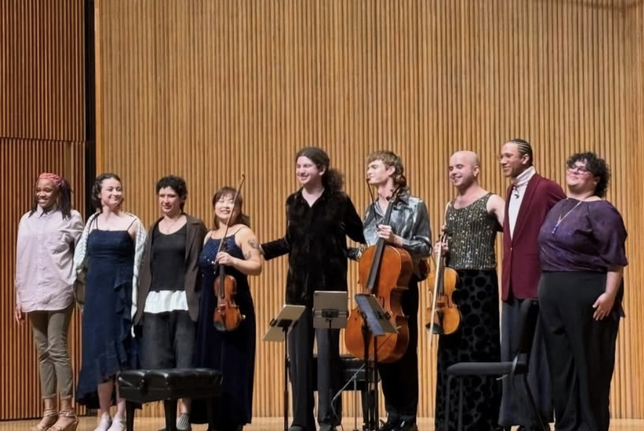
On March 18, the Poiesis returned to Oberlin Conservatory to present “Love Letters,” a project that commissioned works from five QTPOC (Queer & Trans People of Color) composers, all either current Oberlin students or alumni.
The resulting collection of deeply personal pieces gave the Quartet — violinists Sarah Ying Ma and Max Ball, violist Jasper de Boor, and cellist Drew Dansby — the opportunity to give back to the communities that shaped and supported them. And it gave the composers the opportunity to hear their music performed by a quartet whose star only continues to rise.
“I believe in art as a tool for change,” violinist Sarah Ying Ma said during the pre-concert talk in Warner Concert Hall, sitting with the composers onstage. While all five were given full creative license, many themes emerged that connected their music — explorations of identity, desires for freedom and safety, and the hope of being able to build a new world.
Zola Saadi-Klein’s bolbol: āb garm o seylāb (“nightingale: warm water and floods”) is full of long, searching notes and intense silences. It’s a tribute to Mahsa Amini, whose death after being arrested by Iranian authorities for not wearing the hijab caused massive protests in Iran in 2022. The microphones gave an extra gloomy, echoey quality to the piece’s openly dissonant chords.
It can be hard to make crunchy harmonies like this sound deliberate, but that’s no trouble for the Poiesis, who possess both the innate musicality and the level of care that lets each piece that lets it be heard with intention. In all the pieces, their interpretations brought out all kinds of colors and textures — as did their concert outfits, which combined jewel-toned silks, leopard print patterns, and plenty of sparkles.
The Quartet brought out all of the contradictory qualities in Daniel Lasagna’s Circus of the Mind, a deceptively cheerful piece about Lasagna’s experience of putting on a happy face while in an abusive relationship. The players gave a beautiful warmth to the sound as the peaks of tension were smoothed over, but never completely erased.
The imagined utopia of forest of taldeni, by Maya Irizarry Lambright, took shape in the form of percussive knocks, pitched slides, and outpourings of emotion over a sparse backdrop. The dance-like section really grooved in the Poiesis’ hands.
Max Lang’s commonplace little perils traded imagination for the real world by bringing to life Lang’s experience working as a horse wrangler in Colorado. The composer aptly paints these beautiful but dangerous mountain landscapes, using whispers of bow to create a whooshing wind sound.
As the Poiesis played, Lang began narrating the work’s accompanying poem, which felt particularly powerful to hear in the author’s own voice. The third and final movement featured a gorgeous convergence of earlier and later melodies before returning to a state of thoughtful quietness.
Calvin Ray Shawler’s Order drew on both the Poiesis’s precision and lyrical powers. Stuttering bow movements layer themselves like Morse code over evocative chords before the piece reaches a peak of unrestrained emotional intensity. Musically, the work feels a bit unfocused, although that is part of the message — how order and predictability dissolve while being confronted with conflicting ideas.
While the Poiesis enjoy pushing the boundaries of expectation, the result lands far from chaos. In projects like “Love Letters,” their trust and love for their peers create spaces to celebrate queerness, identity, and how young musicians and composers engage with classical music in a 21st-century world.
Published on ClevelandClassical.com March 25, 2026
Click here for a printable copy of this article
