

by Mike Telin
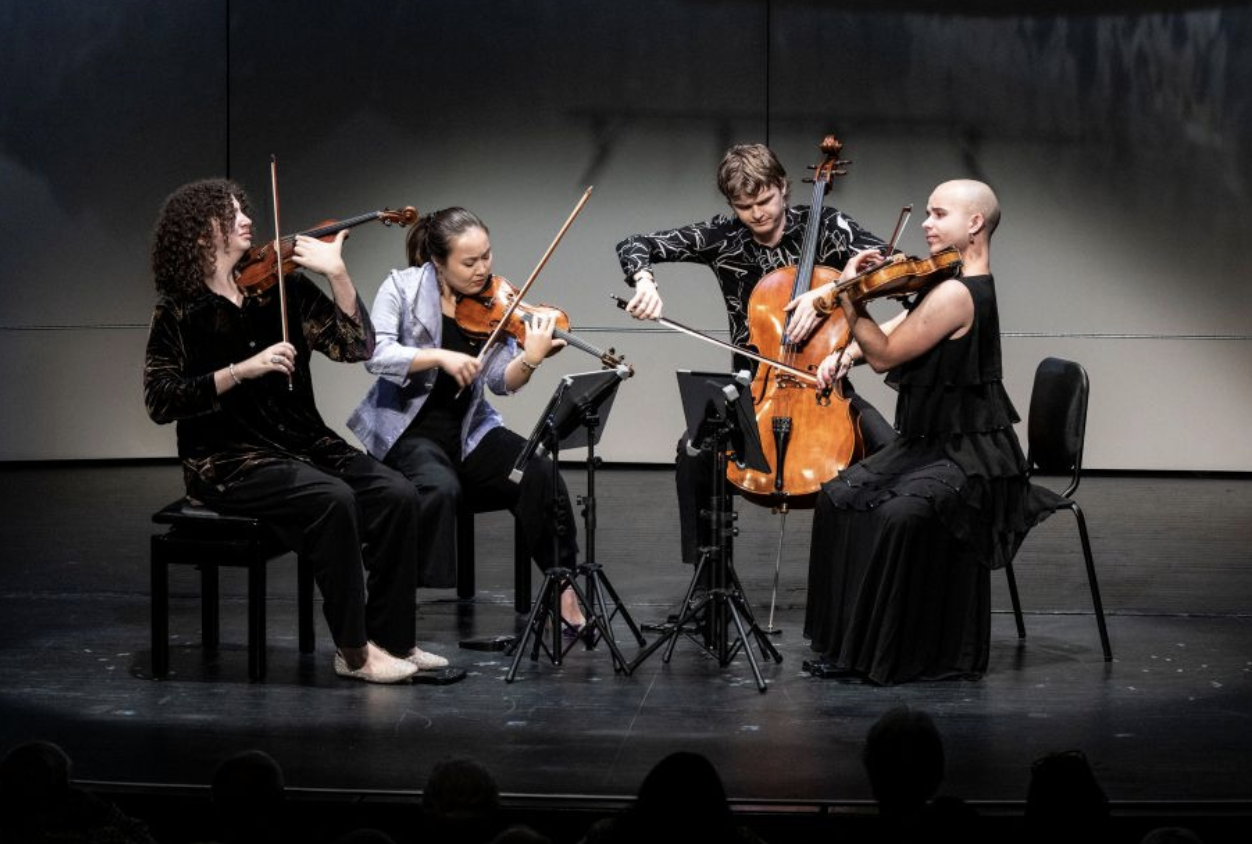 Since forming at Oberlin Conservatory in the fall of 2022, The Poiesis Quartet have enjoyed a meteoric rise in the ranks of professional string quartets.
In 2023, the Quartet won the Gold Medal and BIPOC Prize at the St. Paul String Quartet Competition and the Grand Prize and Lift Every Voice Prize at the Fischoff National Chamber Music Competition.
In May 2024, they joined the roster of Concert Artists Guild and last August were named First Prize and Commission Prize winners at the 2025 Banff International String Quartet Competition. The Poiesis are currently the Graduate Quartet-in-Residence at the University of Cincinnati College-Conservatory of Music.
On Friday, October 31, violinists Sarah Ying Ma and Max Ball, violist Jasper de Boor, and cellist Drew Dansby will return to their alma mater to be featured in John Adams’ Absolute Jest with the Oberlin Orchestra. Directed by Raphael Jiménez, the program at 7:30 pm in Finney Chapel also includes Carlos Simon’s Fate Now Conquers, Angelica Negrón’s Campos Flotantes, and Zhou Tian’s Transcend. The concert is free.
I caught up with the group on Zoom in Victoria, B.C., where they were in the middle of a residency at the University of Victoria. After congratulating them on their win at Banff I asked how they kept themselves focused during a week-long competition that has so many stylistic requirements.
Jasper de Boor: After each round we would reset our heads for the next one.
It was very much a compartmentalization — only focusing on the pieces for each round. It also helped that all our living needs were taken care of by the competition, so it was easy to stay focused on the music.
Max Ball: We had spent so much time and energy rehearsing, internalizing, and just polishing everything so we’d be ready to go a week or so before the competition. Having that security allowed us to do what Jasper was talking about — only worrying about one thing at a time. And when it was time to move on we were in an okay spot to do that.
MT: The Miró Quartet, another group founded at Oberlin and former Banff winners, were just here a couple weeks ago.
MB: We performed two concerts with them back in August. We also played for them and picked their brains about their experience at the competition, so it was really an awesome opportunity.
Mike Telin: What went through your heads when they announced that you were the winners?
MB: Winning was kind of a shock. It was something we had been working towards and had in the back of our minds for a long time, so seeing it finally realized was just amazing.
MT: In addition to the cash prize there will be a number of winner’s tours.
JD: The Banff tours pick up in January. There’s one then and a couple more in the spring, and several in the summer. It’s an exciting time starting next year.
MT: Let’s jump to John Adams’ Absolute Jest: How did this concert come about?
Sarah Ma: We received the offer to play with the Oberlin Orchestra through Concert Artists Guild, our former management. Of course we were really excited about it. And we’re excited to go back to Oberlin and see everybody there, and work with the orchestra and the conductor we collaborated with so often when we were students.
MT: Please give me your thoughts on the piece.
SM: It’s really a fun, crazy piece. I can’t even explain how musically dense it is and how intense it is to prepare a solo work with three other people and an orchestra. There are so many parts to configure in your head as opposed to playing a concerto. But the piece is really cool and we’re excited to play it.
MB: One scary thing about it is that Adams will just drop in a snippet of one of the late Beethoven quartets, so you have to quickly switch gears from playing in a contemporary soloist style to playing a chunk of Beethoven that has to be stylistically appropriate. So that’s one of the really fun parts about the piece.
MT: I understand that you’ll be coming back to Oberlin as part of your Oberlin Commission Project.
SM: We’ll be back in March to give world premieres of five pieces that we commissioned by queer and trans composers of color who are students or alums of Oberlin. Each of them are writing ten minutes of music, and they delve into different themes and concepts. Some are social and political commentary, and some explore family dynamics and intimacy. One of the composers, Max Lang, is writing a piece about their experience in Colorado of being on a ranch and working with horses, and the parallels that they experience in the dangers of their day-to-day life as a queer person.
We’ve just received the scores, and the music is really fun to play — and really meaningful.
MT: How was the project funded?
SM: We crowdfunded the majority of the money along with a couple of larger donors. We’re really thankful for everybody who donated — we just hit our goal a couple of days ago.
We’re hoping to partner with some local organizations and support the community in Lorain County through the concert as well. It’s going to be a great time. The composers will all be there — three of them are current students and two of them are coming back to give talks.
MT: Are there any other projects in the works that you can talk about?
DD: We’re having former Oberlin professor Jeff Scott write a quartet for us. It’s being commissioned by the Caramoor Center where we’re a string quartet in residence. We’re visiting there three times over the course of the season. Our first visit is in a few weeks, and our final visit in the summer is when we’ll be premiering Jeff’s piece.
MT: I’m switching topics here, but you have accomplished so much in three years. Do you ever wake up and say, “Wow, what just happened?”
DD: Sometimes. I mean it’s a lot of commitment and a lot of work being constantly available and always thinking about what comes next. And seeing every day, every concert, and every connection as an opportunity to explore something new.
Building a career as a string quartet is very intense work, but it’s incredibly rewarding, and it takes place over a long period of time. So it’s a big investment,
but it really is fun. Sometimes we feel like, “Oh my gosh. what city are we in right now?” But it really comes down to the connections we’re able to make with our audiences, and performing music that is meaningful to us. And being able to share that.
SM: I agree with everything Drew said. And I think that being in a string quartet is probably one of the most ridiculous jobs in the world — but it’s a huge privilege to be in a position where we get to travel and play music we care so deeply about for so many audiences.
Every once in a while after a concert somebody will come up and express how meaningful it was for them to see their community or their own identity represented on a program, and that makes everything worth it.
Whenever I hear someone say, “You’ve opened up my world beyond Haydn or Mozart,” it’s really exciting for me to see culture and ideas changing as a result of what we are privileged to be able to do. It all comes down to the audiences and the communities we get to work with, and that is very meaningful.
Published on ClevelandClassical.com October 29, 2025.
Click here for a printable copy of this article
