


By Mike Telin
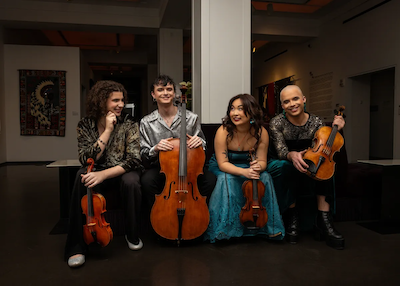 Since their founding at the Oberlin Conservatory in the fall of 2022, the Poiesis Quartet — Sarah Ying Ma and Max Ball (violins), Jasper de Boor (viola), and Drew Dansby (cello) — have quickly risen to the top of professional chamber music ensembles.
Their accolades include the Grand Prize and Lift Every Voice Prize winners of the Fischoff National Chamber Music Competition (2023), Gold Medal and BIPOC Prize winners at the St. Paul String Quartet Competition (2023), and First Prize and Commission Prize recipients of the Banff International String Quartet Competition (2025). Most recently they were named the recipients of the Cleveland Quartet Award (2026).
On Wednesday, March 11 at 7:30 pm in Oberlin’s Warner Concert Hall, the Poiesis will present A Love Letter, five world premieres by emerging QTPOC (Queer/Trans People of Color) composers from their alma mater. A pre-concert talk begins at 7:00 pm.
In an artist statement, Sarah Ying Ma, writes: “At its core, A Love Letter is an homage to our quartet’s roots, identity, and mission. It is a practice of gratitude and community. Our time at Oberlin together was marked by vibrant and diverse scenes of queers making art. This immersion in a plethora of genres, departments, styles, aesthetics, and experiences — both within and outside Oberlin’s academic curricula — was an experience that was evidently built and sustained by queer students in the fight to create a safe space for ourselves.
“When we were students it was always in our minds to commission our friends to write music for us,” Ma said during a recent telephone conversation. Ma added that as Oberlin graduates, this project serves as the Quartet’s way of giving back to the communities who raised them and brought them together.
“Ultimately, that’s what this project is: music by composers who are our friends who we went to school with. Maya Irizarry Lambright and I were roommates for a year and a half, and Maya was in the same studio as me and Max. And Zola Saadi-Klein was good friends with the others in the Quartet. That’s how it all started — we wanted to commission friends to write music for us and we thought, why not turn it into a bigger project.”
The program will begin with Zola Saadi-Klein’s bolbol: āb garm o seylāb (nightingale: warm water and floods). Saadi-Klein (they/them) is an Iranian-American composer, vocalist, violinist and multimedia artist from Los Angeles, CA. In their program note Saadi-Klein says the piece is inspired by the Persian dastgāh (“scale/mode”) music tradition including the techniques of indigenous instruments like the santur (hammered dulcimer) and the kamāncheh (violin).
“Zola composed this piece in memory of the murder of an Iranian girl named Mahsa,” Ma said. “It serves as a bit of a prayer and a reflection on the aggression in Iran against women, not only at the hands of the Iranian government, but also foreign intervention, and the deaths that are happening against gender minorities. It’s a haunting piece that closes with the four of us building into a unison line, almost like a mantra, a repetitive statement that is full of grief and sadness, but also a tang of hope for a resistance in the future.”
Daniel Lasagna (he/they) writes that Circus of the Mind is a reflection of the human experience of being in consciousness: Watching your mind undulate and play games with you, dance, and have a theater.
“He’s trained as a jazz composer and integrates a lot of different elements and tonalities into his music,” Ma said. There are elements of jazz improv that are interwoven throughout. It also delves into contemporary classical form and very non-traditional harmonies and rhythmic structures that sometimes to me feel a little Bartókian, which is very interesting.”
Daniel believes that every person has their own “circus” going on in their mind in different ways. “There’s a lot of repetition, relentlessness, and almost placidity at times. The piece has an overwhelming feeling of sadness — even though it’s pretty upbeat with a waltzy texture. It feels like a merry-go-round, and yet it’s very dark, like a fog over your brain.”
Maya Irizarry Lambright (they/them) is an improviser, composer, and violinist. Their artistic journey is deeply rooted in a childhood surrounded by diverse musical influences, shaping a musical style that transcends genres.
“Maya’s piece is titled forest of taldeni which is a magical safe haven where there’s no oppression, and full equality in the world where people can be true to their communities and their whole identities,” Ma said. “It’s a beautiful piece that implements reggaeton because Maya is Puerto Rican and Native American. So they integrate some fascinating rhythms and dance forms to indicate this active evolutionary process of going through this forest. You’ll hear all these forest textures and the stillness of rocks, and wind blowing through the trees and the creaking of wood. And it’s in graphic score, so we have to improvise out of the drawings they’ve made.
Max Lang (they/he/she) is a Palestinian-American composer, writer, vocalist, researcher, and music director from Columbus, OH. In the program note for commonplace little perils Lang writes, “When I was contacted by the Poiesis Quartet about this commission, I was two weeks away from traveling to the Rockies to be a full-time wrangler on a horse ranch for the summer. It seemed almost obvious: my string quartet would be about my time in the mountains, somehow or some way.”
“The piece is about his time working on a ranch, where he had to ride horseback through dangerous terrain,” Ma said. “The weather changed very quickly: there would be forest fires, wind storms, and all of these dangerous things that were part of daily life.
Max wrote this piece as a parallel to our experiences as marginalized people. There’s this knowledge that there’s danger, but you still move through the world knowing that it’s there. commonplace little perils asks the players to recite the poem that Max wrote — it’s really beautiful and very heartwarming and I think it’s probably the most tonal of the five pieces. And it has a storyline arc because of the poetry that’s woven into it.”
Calvin Ray Shawler (they/them) fell in love with performing arts from a young age as a means of personal expression and radical imagination. Growing up queer and Christian in a mixed family has influenced their focus on contradiction, nuance, and balance through their art, whether they are writing, directing, conducting, acting, singing, or composing.
“The piece draws not only from their personal background and experience, but also from their understanding of family and those dynamics within the household, within friend groups, within communities,” Ma said. “It’s a very interesting piece, and starts with a bit of struggle and difficulty before developing into a lot of fear and tension and even anger. But at the end it resolves in a very screaming way. There’s this idea that even though all of these beliefs are conflicting, we refuse to accept that they’re conflicts and we are always trying to search for something objective. So the piece doesn’t really resolve, it just ends with a scream of why are we still searching?”
Ma noted that all of the pieces are very different. “We did not give the composers any parameters. We said, you can write about anything you want. We’re giving you complete creative liberties. We wanted them to be artists in their own right, and we didn’t expect anybody to compose from the same perspective. But because of this unified, shared identity as a baseline, it has created a program thread where every composer in some way is searching.”
Ma pointed out that the act of commissioning was not just an opportunity for Poiesis to choose cool people to work with, it also provided composers with a much needed opportunity to have their music performed. “There are many demographics in the world who do not get those opportunities as frequently. And as musicians, and knowing that every person, no matter what their major, if they’re trained as a composer, everybody has the ability to create something compelling. Everyone has a story to tell. And if we put our trust into these composers and give them a financial opportunity, they will respond with really beautiful and compelling art.”
Wednesday’s premieres will not be the last time these five works will be heard. “We’ll be programming them throughout our next couple of seasons. And hopefully that will give them enough of a spotlight in the industry that others will start to recognize their work.”
When it came to fundraising, were donors receptive to financing the project? “Absolutely,” Ma said. “We had a lot of support from people in Cincinnati, where we’re based, especially some major donors. We also had crowdfunding which was really great. I think it goes to show that people are more involved in projects like this that develop and progress our communities. People are more invested in funding the arts than we think they are.”
Ma said they knew that there were people who may not be comfortable with the identities that these composers hold, with the mission of this project, or even its politics. But people were enthused by the idea of giving and creating opportunities for young composers.
“There were so many people who we didn’t think would fund us who were very excited to help. And ultimately that’s the power of these types of artistic projects — they can bring so many people together in unexpected ways. With all the publicity from our win at Banff we received hundreds of dollars in donations, so the publicity has really been a great help. I don’t know if that will be true for our next project, but I hope so.”
Photo by Eden Davis
Published on ClevelandClassical.com March 9, 2026
Click here for a printable copy of this article
