

By Kevin McLaughlin
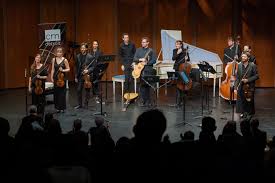 On Sunday, January 18, the New York–based Relic Ensemble presented an imaginative interweaving of Baroque music and Homer’s Odyssey at Heights Theater. The project used historical layering as its technique, allowing ancient Greece, Baroque Europe, and the present to meet on the premise that an epic can be retold in different ways without losing its force.
Operating from its early-music comfort zone, Relic assembled a sequence of Baroque movements, chosen for their affect and fitted to eight episodes from Homer’s tale. The music leaned toward illustration rather than direct dramatic correspondence — a tension that would surface more fully as the evening unfolded. Still, the fleet, precise, and often virtuosic playing of the ensemble carried the evening.
Founded by Juilliard-trained players active in New York’s early music scene, Relic Ensemble has built its identity around programs that travel well, both in concept and in practice. This Odyssey, recently presented on tour in Kalamazoo, Ann Arbor, and now Cleveland, showed how an ambitious idea can be realized almost anywhere, even in a modest concert space in Cleveland Heights.
The Heights Theater, built in 1919, proved something of a mixed blessing. Faded beauty — softening plaster and a century’s wear — promised cozy intimacy, but the high, boxy stage kept the performers at a distance.
Adapted excerpts from The Odyssey in Robert Fagles’ modern English translation were spoken with clarity by Rebecca Nelson, which went a long way toward enlivening and orienting each episode. Cullen O’Neil’s Handelian recitatives which accompanied the narration provided connective tissue and sustained the momentum.
Odysseus’ journey emerged in clear outline: menace, temptation, forgetfulness, grief, disorientation, rest, and return. The musical selections emphasized character and atmosphere. Downward bass lines suggested descent, dotted rhythms conveyed danger, and brilliant concertato represented urgency and conflict.
The violinists were standouts, especially Natalie Kress, who fairly shredded in the Con furia movement of a concerto by Charles Avison, after Scarlatti. Cullen O’Neil (cello), Cameron Welke (theorbo), Robert Warner (harpsichord), and Georgeanne Banker (bassoon), formed an exceptional, sonically rich continuo group.
The program succeeded in tracing the broad emotional arc of The Odyssey — themes of loss, memory, and return — even as the music moved through discrete movements that did not always align with a larger narrative. The ending provided a clear sense of resolution, yet Homer’s reflective, stoic voice frequently collided with the heightened emotionalism of the Baroque. The two aesthetics never quite settled into alignment. Across so many short selections, the music often served as atmosphere rather than narrative, exposing the difficulty — perhaps the impossibility — of using Baroque affect to convey the moral and emotional texture of a Greek epic.
But the evening succeeded on musical terms, carried by poised, accomplished playing that gave the music its full expressive force, even when the story it shadowed remained only partially told.
Published on ClevelandClassical.com January 26, 2026
Click here for a printable copy of this article
