



by Peter Feher
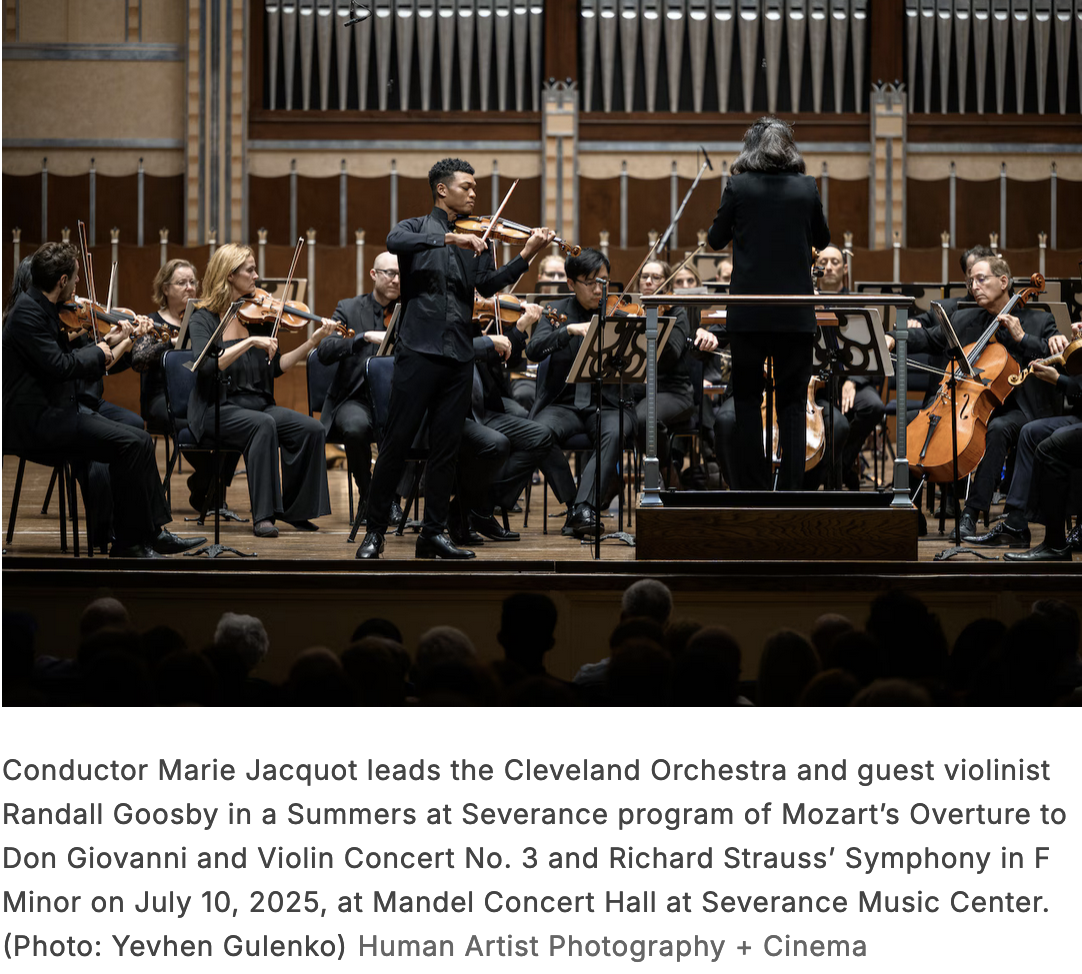 This article was originally published on Cleveland.com
CLEVELAND, Ohio — In a night that saw several promising debuts at Severance Music Center, one young artist impressed so thoroughly that he’s already been invited back next season.
Richard Strauss was only 20 years old when he completed his Symphony in F Minor, which received its first Cleveland Orchestra performance on Thursday, July 10, in Mandel Concert Hall.
Of course, Strauss is no stranger to Cleveland or to the standard repertory — his music has been programmed for almost every season in the Orchestra’s century-long history. But this favorite composer still has a few surprises to offer even the most well-acquainted concertgoer.
Striking a balance between fresh and familiar, Thursday’s concert was a fitting way to usher in Summers at Severance, the Orchestra’s casual, all-classical series at home that continues with three more concerts through mid-August.
Strauss’ symphony is a crash course in great composers, taking inspiration from Beethoven, Brahms, and a handful of others. The brooding opening Allegro and the sprightly Scherzo that follows reflect some of the many moods of Felix Mendelssohn. And some of the string sonorities in the slow third movement, along with the technique of recalling earlier themes in the Finale, are maybe borrowed from Anton Bruckner.
So, Strauss hadn’t quite found his own voice in 1884, which helps explain why this early symphony is so seldom heard compared to the utterly unmistakable symphonic poems he would start composing a couple years later. Style and talent are waiting to burst forth but are still somewhat constrained.
How marvelous, then, that the rising young French conductor Marie Jacquot, making her own Cleveland debut, was able to unleash the piece’s full potential. She had the brass play out in each movement to thrilling effect, evoking the heroism that would become synonymous with Strauss. Meanwhile, the composer’s trademark thorny writing for strings and woodwinds — tamer here than in the tone poems — went smoothly for the most part, a few missteps in the Scherzo aside.
More Strauss is on the Orchestra’s schedule in the coming months, but anyone who was at Severance last night can now say that they knew this composer back when.
In that same spirit, violinist Randall Goosby asked the audience during the first half of the program who remembered his debut. The 29-year-old soloist was speaking from the stage before launching into his encore, a sensitively swaggering rendition of Coleridge-Taylor Perkinson’s “Louisiana Blues Strut.”
Goosby reminded us that his previous appearance with the Orchestra was at the annual Martin Luther King Jr. Celebration Concert in 2011, when he was a teenager fresh off his win in the junior division of the Sphinx Competition. His repertoire then was the first movement of Mozart’s Violin Concerto No. 3 in G — the very piece we had just heard in its entirety.
Goosby’s account of the complete work was sweet and understated, highlighted by his refined approach to the Adagio, where Mozart’s accompaniment mellows out to muted strings and a pair of flutes. Certain passages in the outer movements burst with energy, but this music more often stayed subdued, with the Orchestra having to play extremely softly to maintain balance.
Mozart’s Overture to “Don Giovanni” began the evening with an extra bit of brilliance, which would soon be picked up by the other prodigies on the program.
Published on ClevelandClassical.com July 16, 2025
Click here for a printable copy of this article